
Best Grounding Mats for Stress Reduction: 2026 Reviews
Table of Contents
- What to Look for in Grounding Mats for Stress Reduction
- How to Use a Grounding Mat for Stress
- How Long to Use a Grounding Mat Daily
- Earthing Mat Safety Precautions You Shouldn't Skip
- Grounding Mats vs. EMF Shielding: What's the Difference?
- Building a Stress-Reduction Routine with Grounding Mats
- Conclusion
- Frequently Asked Questions
Last Updated: September 15, 2026
What to Look for in Grounding Mats for Stress Reduction
Most grounding mats are simple conductive sheets, which is exactly why so many buyers get it wrong. The best grounding mats for stress reduction come down to three things: the surface material, whether a safety resistor is built into the cord, and whether you can verify your outlet actually works. Get those right and the rest is comfort preference.
At thewellbeingshop.com, we treat a grounding mat the way we treat any mind-body tool: it should slot into a routine you'll actually keep, not sit rolled up in a closet. The NIH National Center for Complementary and Integrative Health overview of grounding research is a useful starting point for understanding what earthing claims are and aren't supported by evidence.
Conductive Materials and Build Quality
A grounding mat only works if its surface can carry electrons from your skin to the grounding wire, which requires a conductive layer bonded to a stable base.
Look for carbon-infused synthetic leather or cork over a natural rubber base. Carbon-infused surfaces hold conductivity well and resist daily wear. Cork has a warm feel and improves grip as it warms, which matters if you sit cross-legged. The Cork & Natural Rubber Meditation Mat at thewellbeingshop.com ($34.95) is built this way: natural cork top, natural rubber base, non-slip on hard floors.
What most guides miss is the backing. A thin, curling base lifts at the corners within weeks, and a lifted mat loses consistent skin contact. Weight and flatness matter more than thickness.
Safety Resistors and Outlet Testers
A safety resistor is a small component built into the grounding cord that limits current flow if your home's wiring fails. It is the single most important safety feature on any grounding mat.
An outlet tester confirms your wall outlet is correctly wired before you connect anything. Reverse-polarity and missing-ground outlets are common in older homes, and a grounding mat plugged into a faulty outlet is not grounding you at all (osha.gov).
How to Use a Grounding Mat for Stress
Using a grounding mat for stress is straightforward: place it where you already sit, connect the cord to the mat and a verified grounded outlet, and make skin contact with bare feet, hands, or legs. The goal is consistent, low-effort contact during time you already spend seated.
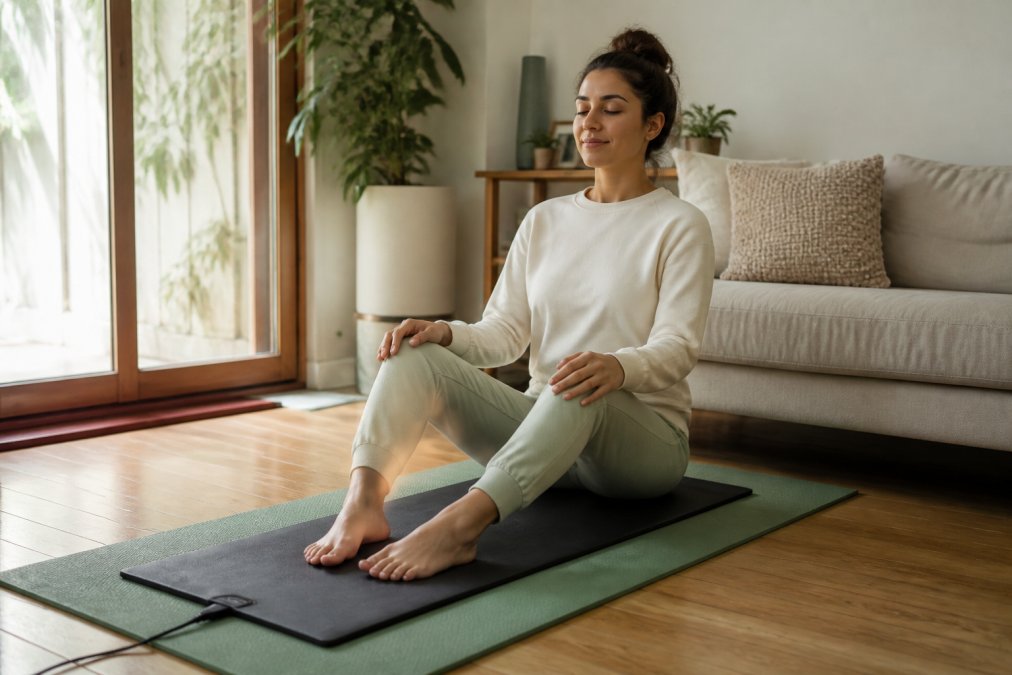
A practical setup takes about five minutes:
- Test the outlet with an outlet tester and confirm the ground indicator lights up.
- Lay the mat flat on a hard surface or over a thin yoga mat.
- Plug the grounding cord into the mat's snap connector, then into the outlet.
- Sit with bare feet or forearms in direct contact with the conductive surface.
- Keep the mat in the spot you already occupy, not in a room you visit once a week.
The most common mistake is treating this as a separate ritual. People who stick with it put the mat under a desk, in front of the couch, or beside the bed. If you pair it with a sitting practice, a supportive cushion helps you stay long enough to notice anything. The Premium Buckwheat Meditation Cushion ($37.90) promotes spinal alignment so you're not shifting every two minutes.
How Long to Use a Grounding Mat Daily
There is no official recommended duration, and anyone quoting a precise number of minutes is guessing. What separates a grounding mat that becomes a habit from one that ends up in a closet is whether it's attached to a moment in your day that already exists, the integration angle most reviews skip.
A common pattern among long-term users is to anchor the mat to one of three existing routines rather than creating a new one:
- Pre-sleep wind-down (15-30 minutes). Mat beside the bed or under the feet while reading, stretching, or journaling. The mat becomes the physical cue that the day is ending.
- Desk decompression (30-45 minutes). Mat under bare feet during the mid-afternoon slump, paired with a five-minute breathwork break. This is the highest-adherence slot for remote and office workers because the mat never has to be moved.
- All-day low-level contact (1-3 hours, broken up). Mat under the desk for the full afternoon, with shoes off. Contact does not need to be continuous to be consistent.
A reasonable progression for a new user looks like this:
| Week | Daily Duration | Placement | What to Watch |
|---|---|---|---|
| 1 | 15-20 min | Under desk, feet bare | Tingling, warmth, headache |
| 2-3 | 30 min | Desk or evening couch | Sleep quality, muscle relaxation |
| 4+ | 30-60 min | Desk plus pre-sleep | Whether the habit holds |
Some people report tingling, warmth, or a mild headache in the first sessions, which fades with shorter exposure. Others feel nothing at all, which doesn't mean it isn't working. Responses vary widely, and clinical evidence on earthing remains limited and mixed.
Consistency beats duration. Thirty minutes daily does more than two hours once a week, because the value is in the repetition. The most useful question is not 'how long' but 'which existing moment will this attach to.' Pick the slot before you pick the mat.
Earthing Mat Safety Precautions You Shouldn't Skip
Earthing mat safety precautions are not fine print. The main risks are electrical, not biological, and come from the outlet rather than the mat. The second risk, one almost no review covers, is silent material failure: a mat that looks fine but has stopped conducting.
Treat these as non-negotiable:
- Use only cords with a built-in safety resistor.
- Test every outlet before first use and after any electrical work in the home.
- Never use a mat while it is wet, and never place one in a bathroom or near water.
- Unplug during thunderstorms and when the mat is not in use.
- Stop using it if you have a pacemaker or implanted electronic device unless your cardiologist approves (Pacemakers - Living With a Pacemaker).
- Check the conductive surface every few months for cracking or delamination.
Long-Term Durability: What Wears Out First
Most reviews stop at unboxing. The useful question is what a mat looks like after six to twelve months of daily use, when the conductive layer starts to fail, usually without visible warning.
The failure modes follow the material:
- Carbon-infused synthetic leather. The conductive carbon layer is bonded to a polyurethane or PVC backing, and the bond is the weak point.
A practical inspection routine takes two minutes a month:
Grounding Mats vs. EMF Shielding: What's the Difference?
Here's the practical distinction:
| Feature | Grounding Mat | EMF Shielding Product |
|---|---|---|
| What it does | Equalizes your electrical potential with earth | Blocks or reduces incoming fields |
| Requires a grounded outlet | Yes | No |
| Safety component | Resistor in cord | None required |
| Typical material | Carbon-infused leather, cork, rubber | Silver- or copper-woven fabric |
| Main use | Stress, sleep, recovery routines | Reducing exposure near devices |
Building a Stress-Reduction Routine with Grounding Mats
Conclusion
Frequently Asked Questions
Do grounding mats really work for anxiety?
Research on earthing suggests contact with the earth's electrons may support a calmer nervous system, and many users report feeling more relaxed after consistent use. Results vary by person. A grounding mat for stress reduction works best as part of a broader routine that includes sleep, movement, and stress management. Try it daily for two to four weeks and track how you feel.
What are the downsides of using grounding mats?
The main downsides are minor: some people notice tingling or skin irritation at contact points, and results are not immediate for everyone. Cheap mats may lose conductivity over time as the carbon-infused layer wears down. Always use a safety resistor and test your outlet before plugging in. If you have a pacemaker or implanted electronic device, talk to your doctor first.
How long should you use a grounding mat for stress reduction?
Most users start with 15 to 30 minutes a day and build up to longer sessions over a few weeks. There is no strict upper limit for healthy adults, but starting slow helps you notice how your body responds. Many people keep a mat under their desk for a few hours during work or use one for 30 minutes before bed to support sleep quality.
Which grounding mat is the most effective and proven?
Effectiveness depends on consistent conductive contact, not brand names. Look for mats with a carbon-infused or silver-fiber surface, a grounding wire that connects to a wall outlet's ground port, and a built-in safety resistor. The Cork & Natural Rubber Meditation Mat from thewellbeingshop.com pairs well with grounding practices by giving you a stable, non-slip surface for seated sessions.
Can I use a grounding mat with other wellness tools?
Yes. Many people combine grounding with meditation, breathwork, or a buckwheat cushion for proper spinal alignment during longer sessions. Pairing a grounding mat with a calming candle or essential oil can deepen the relaxation effect. The key is building a routine you will actually repeat, whether that is 20 minutes in the morning or a longer wind-down at night.