
6 Ways to Improve Home Workout Consistency
Table of Contents
- Why Home Workout Consistency Breaks Down (And It's Not Motivation)
- 1. Schedule Workouts Like Non-Negotiable Appointments
- 2. Build Effective 20 Minute Home Workout Routines
- 3. Choose the Best Home Fitness Equipment for Beginners
- 4. Learn How to Build a Home Workout Habit That Sticks
- 5. Track Progress Without Obsessing Over Numbers
- 6. Prevent Burnout With Recovery and Sustainable Pacing
- Frequently Asked Questions
Last Updated: September 14, 2026
Why Home Workout Consistency Breaks Down (And It's Not Motivation)
Home workout consistency is the ability to complete planned training sessions at home, week after week, without relying on willpower alone. It depends on environment design, scheduling, and recovery, not on how motivated you feel on a given morning. Most people who quit blame themselves. The setup failed them.
The problem is rarely effort. It's friction: equipment buried in a closet, no fixed time slot, no way to see progress, and no plan for the days when energy runs low. Fix those four things and consistency stops being a daily decision.
The Psychological Barriers Nobody Talks About
Working out at home removes the commute, the membership fee, and the social pressure of a gym floor. It also removes every external cue that tells you it's time to train. There's no locker room, no class start time, no training partner waiting.
That absence creates what researchers call an intention-action gap: you fully intend to train, but nothing in your environment triggers the behavior (pubmed.ncbi.nlm.nih.gov). A common mistake is treating this as a character flaw. It's a design flaw, and design flaws have fixes.
1. Schedule Workouts Like Non-Negotiable Appointments
Treat each session as a fixed appointment, not a flexible intention. Pick a time, put it in your calendar with a notification, and give it the same status as a work meeting.
The mechanics matter more than the resolve. A recurring block at the same hour each day removes the "when will I fit this in" negotiation that kills most home routines. For remote workers, the strongest anchor is usually right before the workday starts or immediately after it ends, because those transitions already exist in your schedule.
- Block 20 to 30 minutes, not "sometime this afternoon"
- Set the reminder for 10 minutes before, so you can change clothes
- Protect the slot on busy days by shortening the session, never skipping it
2. Build Effective 20 Minute Home Workout Routines
An effective 20 minute home workout routine follows a fixed structure: a short warm-up, two or three compound movements performed as circuits, and a brief cooldown. The structure removes decisions, and decisions are what drain adherence. The 20-minute length is not arbitrary, it sits below the point where most people start negotiating with themselves about whether the session is "worth it," and it is short enough to survive a low-energy day without being skipped.
The 20-Minute Structure That Works
| Phase | Time | What You Do |
|---|---|---|
| Warm-up | 3 min | Marching, arm circles, hip openers |
| Circuit A | 6 min | Squats, push-ups, rows (2 rounds) |
| Circuit B | 6 min | Lunges, shoulder press, core work (2 rounds) |
| Cooldown | 5 min | Stretching and breathing |
A circuit format keeps your heart rate up while limiting the session to a length you'll actually repeat. The best home fitness equipment for beginners is whatever lets you perform those movements without setup friction: a resistance tube, a pair of light dumbbells, a small stability ball.
How to Progress Without Adding Time
The most common reason a 20-minute routine stops working is that people try to fix it by making it longer, and a longer session is the first one they skip. Progress the variables inside the 20 minutes instead, one at a time:
- Reps first. Add one or two reps per set until you hit the top of a comfortable range (for example, 12 to 15 reps on squats).
- Then resistance. Once the top of the rep range feels easy for two full sessions, move to the next band, tube, or dumbbell weight.
- Then rounds. Add a third round to Circuit A before you touch the clock.
- Then density. Shorten rest between rounds from 60 seconds to 45, then 30, keeping the same work.
Change only one variable per week. Changing two at once makes it impossible to tell what is working and makes the session feel harder than it needs to, which is exactly the friction that ends home routines.
Effort, Not Exhaustion
You do not need to finish each session gasping. A practical target is to end each circuit feeling like you had two or three good reps left in the tank (pubmed.ncbi.nlm.nih.gov). That leaves you able to train again the next day, which matters more for consistency than any single hard session. Sessions that leave you wrecked for 48 hours are the ones that quietly turn into two-a-week routines, then one, then none.
The Home-Specific Friction Checklist
The routine fails at the seams, not in the middle. Before you start, remove the four frictions that kill home sessions:
- Space: clear a 6-by-6-foot area the night before, not the moment you plan to train.
- Setup: leave the tool you need on the floor or on a chair, not in a bin.
- Interruption: put your phone on Do Not Disturb and tell anyone in the house the next 20 minutes are booked.
- Transition: change into training clothes before the session starts, not as a warm-up step.
A Sample Week You Can Copy
- Monday: Circuit A and B as written.
- Tuesday: walk or light mobility, 15 to 20 minutes.
- Wednesday: Circuit A and B, add one rep per set.
- Thursday: rest or light movement.
- Friday: Circuit A and B, add a third round to Circuit A.
- Saturday: longer walk or a session you enjoy.
- Sunday: rest.
Three structured sessions a week is enough to build strength and enough to protect the habit (the CDC). The other days exist to make those three feel easy to show up for.
3. Choose the Best Home Fitness Equipment for Beginners
The best home fitness equipment for beginners is compact, versatile, and visible. If a tool takes more than 30 seconds to set up or lives in a closed bin, you'll use it less. That single constraint eliminates most of the gear people buy and abandon. Keeping your gear accessible reduces the friction that often prevents you from being able to maintain fitness consistency over the long term.
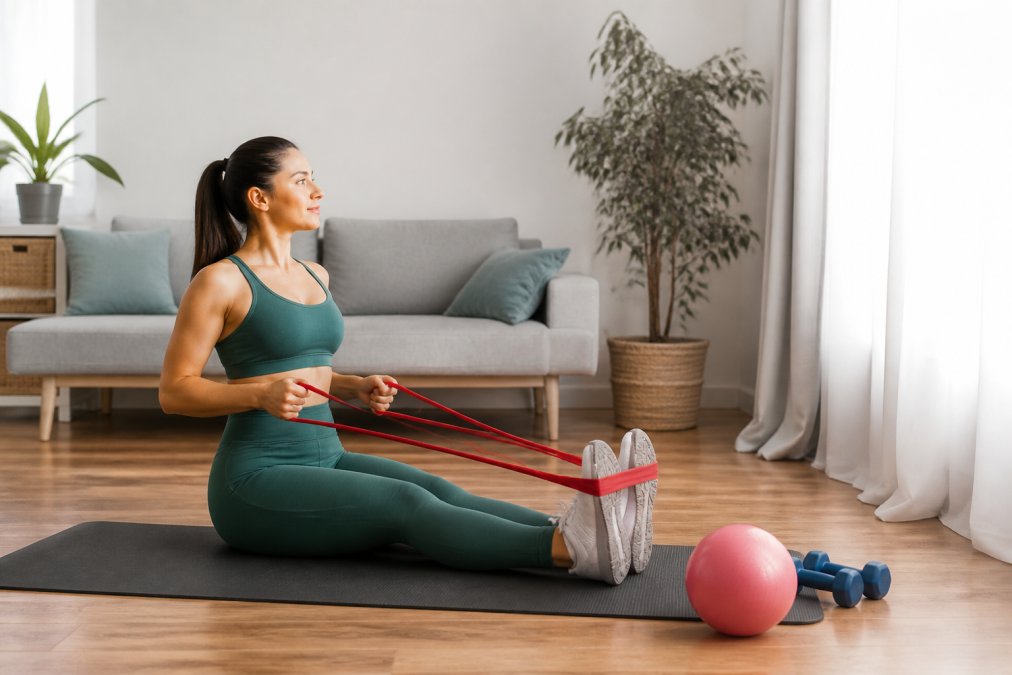
At thewellbeingshop.com, the equipment we carry is chosen around that principle. A Six-Tube Pedal Tension Rope at $10.00 covers rows, presses, and curls in one tool that stores under a couch. A 25cm Yoga Balance Ball at $10.00 adds core instability work and doubles as a desk seat for posture. For progressive loading, an Adjustable Dumbbell Set at $185.36 replaces an entire rack.
Equipment-Minimalist Strategies That Keep You Consistent
You do not need a full home gym to build strength. You need one tool that covers multiple movement patterns and stays within arm's reach.
- Choose one resistance tool and one stability tool, nothing more at first
- Store both where you train, not in a closet
- Add weight or resistance only when the current level feels easy for two full sessions
- Rotate one new movement in per week rather than changing the whole routine
4. Learn How to Build a Home Workout Habit That Sticks
Learning how to build a home workout habit that sticks comes down to attaching the new behavior to an existing one. Habit researchers call this habit stacking: after I pour my morning coffee, I do my 20-minute circuit. The existing routine becomes the trigger.
Start smaller than feels impressive. Two sessions a week, 15 minutes each, beats a five-day plan you abandon by Thursday. Frequency builds the neural pathway; intensity can wait.
The Home-Specific Mental Friction Nobody Warns You About
Most habit advice assumes you are training in a gym, where the environment does the psychological work for you. At home, the same room serves as your office, your living room, and your training space. That overlap creates a problem no scheduling tip solves: your brain has no clean boundary between "work mode" and "training mode," so the workout feels like one more task on a list that never ends.
A few patterns show up again and again:
- The unfinished-task pull. When your desk is visible from your training area, your attention drifts to the email you have not answered. The session feels like procrastination, and you cut it short.
- The invisible-start problem. There is no class start time, no locker room, no training partner waiting. Nothing external tells your brain the session has begun.
- The all-or-nothing rebound. A missed session at home feels like a personal failure rather than a scheduling conflict, because there is no external structure to blame.
These are design problems, and they have design fixes.
Four Fixes for Home-Specific Friction
- Create a physical boundary. Train in a different room than you work in, or at minimum turn your chair around and close the laptop. A visible change of scene signals to your brain that the mode has shifted.
- Build a two-minute on-ramp. A ritual that always precedes the session, filling a water bottle, laying out the mat, putting on the same playlist, becomes the external cue the gym used to provide.
- Name the session out loud. Saying "training starts now" sounds silly and works. It replaces the missing class start time with a verbal trigger.
- Separate the decision from the execution. Decide the night before what you will do and when. In the moment, you are not choosing whether to train; you are just following the plan you already made.
Why "Never Miss Twice" Actually Works
Skipping one session is a scheduling event. Skipping two in a row is where the identity shifts, you stop being someone who trains and start being someone who used to. The rule is not about perfection; it is about interrupting the story before it forms.
On a low-energy day, the goal is not a good session. The goal is a completed one. Five minutes of the warm-up and one round of Circuit A counts. You are protecting the habit, not the training effect.
The Two-Week Test
Before you add intensity, complexity, or a fifth session, prove the habit exists. For two weeks, the only goal is showing up on the days you planned. If you hit 80 percent of your planned sessions, the habit is forming and you can progress. If you hit less, the plan is too big, cut it in half and run the test again. Consistency is the prerequisite, not the reward.
5. Track Progress Without Obsessing Over Numbers
Track completion, not perfection. A simple log of sessions completed, resistance level used, and how you felt gives you the pattern data you need without turning training into a spreadsheet exercise.
Many people find that a basic fitness tracker or a paper calendar works better than a detailed app, because the goal is a visible streak, not a performance dashboard. What most guides miss is that over-measuring creates its own quitting trigger: when the numbers stall, motivation follows.
- Log one line per session: date, movements, resistance, energy level
- Review weekly, not daily
- Celebrate completed sessions, not personal records
6. Prevent Burnout With Recovery and Sustainable Pacing
Recovery is part of the program, not a break from it. Training volume that climbs every week without a deload leads to stalled progress, poor sleep, and the flat feeling that makes people stop entirely.
Sustainable pacing means planning lighter weeks. Every fourth week, cut your volume roughly in half and keep the schedule intact. Hydration and electrolyte balance matter here too; a Quinton Totum Sport Hypertonic Electrolyte Concentrate at $60.00 delivers 78 electrolytes in a 20ml sachet for days when sweat losses run high.
- Schedule one lighter week per month
- Keep sleep consistent, since recovery happens there
- Treat soreness as information, not failure
Frequently Asked Questions
How do I stay consistent with home workouts when I keep skipping them?
Start smaller than feels impressive. A 10-minute session you actually do beats a 45-minute plan you avoid. Schedule it at the same time daily, lay out your gear the night before, and attach the workout to an existing habit like your morning coffee. Tracking streaks in a simple log or fitness tracker also helps because seeing progress builds momentum. The goal is showing up, not perfection.
What is the 3-3-3 rule for workouts?
The 3-3-3 rule typically means three days of strength training, three days of cardio, and three rest or active recovery days per week. Some versions frame it as three exercises, three sets, three reps for beginners. Either way, the structure removes daily decision fatigue. You know what type of session is scheduled, which makes home workout consistency easier because you are not reinventing your routine every morning.
What equipment do I actually need for a consistent home routine?
Less than you think. A resistance band set like the Six-Tube Pedal Tension Rope ($10.00) covers full-body strength. A 25cm yoga balance ball ($10.00) adds core and stability work. If you want progressive overload, an Adjustable Dumbbell Set ($185.36) replaces a rack of fixed weights. Start with one or two pieces, use them consistently for a month, then add more only when your routine is already stable.
How long before a home workout habit feels automatic?
Research on habit formation suggests it varies widely, from about 18 to 254 days depending on the behavior and the person. Simple routines tied to a fixed cue tend to automate faster. The practical takeaway: do not wait to feel motivated. Repeat the same short workout at the same time for several weeks, and the decision to start becomes easier because it requires less deliberate thought.
Can I build a real routine with only 20 minutes a day?
Yes, if the 20 minutes are structured. A typical effective 20 minute home workout routine pairs a 3-minute warm-up, 12 minutes of circuit-style strength or bodyweight work, and a 5-minute cooldown. Use compound movements like squats, rows, and presses rather than isolation exercises. Twenty focused minutes, four to five days a week, is enough to build strength and support recovery when paired with adequate sleep and hydration.
Home workout consistency fails when the plan depends on daily motivation instead of a system. The Well Being Shop builds that system for you, with compact strength tools, mind-body training equipment, and recovery support designed for small spaces and short sessions. Start with one resistance tool, one stability tool, and a fixed 20-minute slot. Get started with thewellbeingshop.com and turn small daily habits into lasting home strength.