
Energy-Boosting Light Therapy Lamps: 2026 Review
Table of Contents
- Why Energy-Boosting Light Therapy Lamps Matter for Remote Workers
- How to Use Light Therapy Lamps for Energy: A Daily Protocol
- Lux Requirements for Light Therapy: What Brightness You Actually Need
- Light Therapy Lamp Safety Guidelines: Eye Health and UV Concerns
- Top Picks for Energy-Boosting Light Therapy Lamps
- Beyond Lamps: Supplements That Support Energy and Focus
- Conclusion: Building Your Energy Toolkit
- Frequently Asked Questions
Last Updated: September 17, 2026
Why Energy-Boosting Light Therapy Lamps Matter for Remote Workers
If your 3 p.m. slump now arrives at 10 a.m., you are not imagining it. An energy-boosting light therapy lamps review starts with a simple fact: remote work moved millions of people away from bright office windows and into dim spare bedrooms. Less morning light means a weaker signal to your biological clock, and a weaker signal means lower alertness, flatter mood, and a harder time waking up.
How to Use Light Therapy Lamps for Energy: A Daily Protocol
The best results come from consistency, not intensity. Use your lamp within the first hour of waking, sit close enough to catch the light in your field of view, and keep sessions short. Most people find that a fixed morning slot works better than squeezing sessions in whenever they remember.
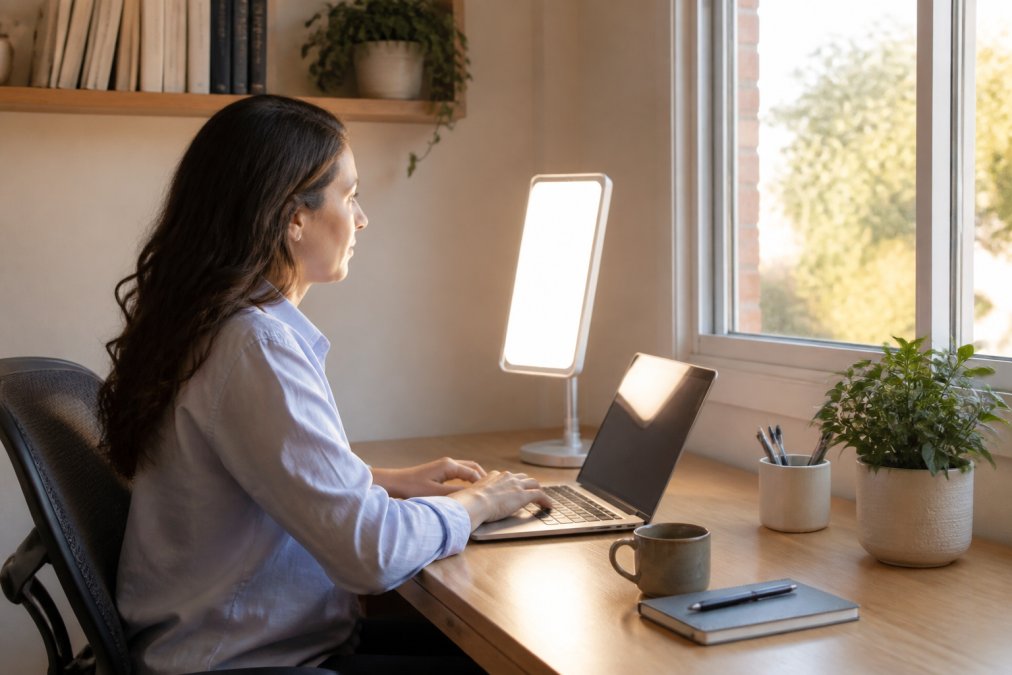
Here is a simple daily protocol:
- Wake at a consistent time, even on weekends
- Turn on the lamp within 60 minutes of waking
- Sit 16 to 24 inches from the screen, angled slightly to the side
- Start with 10 minutes and build to 20 to 30 minutes
- Keep your eyes open but do not stare directly into the light
- Pair the session with breakfast, email, or reading
- Track your energy for two weeks before judging results
Shift Worker Protocol: A Gap Most Reviews Skip
Standard morning-light advice assumes a 9-to-5 schedule. If you work nights, a fixed morning session can actually work against you. The goal for shift workers is to anchor light exposure to the start of your personal day, not the clock on the wall.
A common pattern for night-shift workers is:
- Use the lamp for 20 to 30 minutes immediately after waking, whenever that is
- If you flip between day and night shifts, keep the lamp session within 30 minutes of your target wake time for at least four consecutive days before switching
- Avoid bright light in the final two hours before your target bedtime, even if that bedtime is 8 a.m.
- Pair the session with a consistent meal to reinforce the signal
Remote Worker Protocol: Anchoring to Your First Meeting
Remote workers face a different problem: no commute, no office windows, and no external cue to start the day. A practical anchor is your first calendar event. Turn the lamp on when you open your laptop for that first meeting, and let the session run through your inbox triage.
- Keep the lamp on your desk, not across the room
- If you take calls on video, angle the lamp so it lights your face without blowing out the camera
- On low-motivation mornings, start with 10 minutes rather than skipping entirely
Troubleshooting: What to Adjust When It Is Not Working
If two weeks pass and you feel no difference, the issue is usually one of four things:
- Distance: You are sitting too far away. At 24 inches, a 10,000-lux lamp delivers roughly a quarter of its rated output at 12 inches. Move closer.
- Timing: You are using it too late. Morning exposure advances your clock; afternoon exposure does little for energy and can delay sleep.
- Duration: You are stopping at five minutes. Build to the full 20 to 30 minutes before judging results.
- Consistency: You are using it three days a week. The circadian system responds to daily signals, not occasional ones.
Lux Requirements for Light Therapy: What Brightness You Actually Need
The number that matters most is lux, the measure of light intensity at your eyes. A standard living room sits around 100 to 300 lux. A cloudy morning outdoors can hit 10,000 lux or more. That gap is why a desk lamp will not cut it.
| Lux Output | Typical Session Length | Best For |
|---|---|---|
| 10,000 lux | 20-30 minutes | Busy mornings, most users |
| 5,000 lux | 45-60 minutes | Flexible schedules |
| 2,500 lux | 60-90 minutes | Very gradual routines |
Light Therapy Lamp Safety Guidelines: Eye Health and UV Concerns
Follow these guidelines:
- Never stare directly into the lamp; let the light reach your eyes indirectly
- Stop and rest if you notice headaches, eye strain, or agitation
- People with bipolar disorder, retinal conditions, or light sensitivity should talk to a doctor before starting
- Take breaks if you use the lamp for more than 30 minutes daily
- Keep sessions in the morning; evening use can delay sleep
The FDA guidance on light therapy devices classifies these products as medical devices, which is why clear instructions and UV filtering are not optional extras.
Top Picks for Energy-Boosting Light Therapy Lamps
A lamp review that never names a lamp is not a review. Below are the categories that matter when you are shopping, the specs to verify before buying, and the trade-offs that separate a lamp you will use daily from one that ends up in a drawer.
What Separates a Good Lamp From a Great One
Four specs do most of the work:
- Rated lux at a stated distance. A lamp marketed as "10,000 lux" is only useful if the manufacturer states the distance at which that output is measured. Look for "10,000 lux at 12 inches" or "10,000 lux at 16 inches." If no distance is listed, treat the number as marketing.
- UV filtering. Quality lamps block ultraviolet light. If the product page does not mention UV filtering, assume it does not have it.
- Color temperature. Most therapy lamps sit between 4,000K and 6,500K, close to midday daylight. Warmer lamps (around 3,000K) are easier on the eyes but may feel less activating.
- Flicker-free driver. Visible flicker causes eye strain and headaches over repeated sessions. Look for "flicker-free" or "flicker-free driver" in the spec sheet.
Categories Worth Considering
Rather than rank specific models that change stock and pricing frequently, here is how the main categories compare on the specs that matter:
| Category | Typical Lux | Typical Price Range | Best For | Trade-off |
|---|---|---|---|---|
| Desktop panel | 10,000 lux at 12-16 in | $40-$120 | Most remote workers | Takes desk space |
| Compact travel | 10,000 lux at 6-12 in | $30-$80 | Frequent travelers | Smaller field of light |
| Floor lamp | 10,000 lux at 24-36 in | $100-$250 | Shared spaces | Higher upfront cost |
| Smart/app-controlled | 10,000 lux at 12-16 in | $80-$200 | Habit trackers | App dependency |
The Smart Home Angle Most Reviews Miss
A growing share of buyers want a lamp that integrates with the rest of their home. App-controlled and voice-activated lamps let you schedule sessions, track streaks, and adjust brightness without touching the device. If you already use a smart speaker or a home automation hub, a lamp that ties into that ecosystem removes one more decision from your morning.
What to check before buying a smart lamp:
- Does the app work without a subscription?
- Can you schedule sessions, or only turn the lamp on and off?
- Does it integrate with the voice assistant you already use?
- What happens to your routine if the app is discontinued?
Cost of Ownership Over Three Years
Most reviews stop at the sticker price. The real cost includes replacement bulbs, if the lamp uses them, and electricity. LED-based therapy lamps typically last tens of thousands of hours, which at 30 minutes a day works out to years of use without a bulb change. Older fluorescent models may need a replacement tube every one to two years, and those tubes can cost a meaningful fraction of the original lamp price.
Design-Forward Options for a Home Office
Clinical white plastic is not the only option anymore. Lamps designed for home offices now come in wood tones, matte finishes, and slim profiles that sit on a desk without dominating it. If your lamp lives on a video call, a design-forward model is more likely to stay in view and get used. Prioritize a lamp you do not mind looking at, because the best lamp is the one you actually turn on.
Beyond Lamps: Supplements That Support Energy and Focus
A lamp fixes your light exposure. It does not fix everything else. If your diet, hydration, and sleep are off, no lamp will rescue your afternoon. That is where targeted supplements earn their place.
Conclusion: Building Your Energy Toolkit
The hardest part of light therapy is not buying the lamp. It is showing up every morning for the first two weeks, when the results still feel invisible. Build the habit small, protect your morning window, and let consistency do the work.
Frequently Asked Questions
What is the most effective light therapy lamp for energy?
The most effective light therapy lamps deliver 10,000 lux at a sitting distance of 16 to 24 inches, with a color temperature between 4000K and 6500K. Look for flicker-free technology and UV filtering. A larger surface area reduces eye strain. Consistency matters more than brand: using the lamp daily for 20 to 30 minutes within an hour of waking produces the best results for energy and mood.
Do you get vitamin D from light therapy lamps?
No, light therapy lamps do not produce vitamin D. They emit visible light, not UVB, which is the wavelength your skin needs to synthesize vitamin D. Light therapy works by regulating your circadian rhythm and suppressing melatonin, which improves alertness and energy. For vitamin D, you need sunlight, UVB tanning beds, or supplements. Light therapy and vitamin D serve different purposes.
How many hours a day should you use a SAD lamp?
Most clinical guidelines recommend 20 to 30 minutes per day with a 10,000 lux lamp, ideally within the first hour after waking. Some people benefit from a second session in the early afternoon if energy dips. Start with 10 minutes and increase gradually. Using it too late in the day can delay sleep. Consistency is key: daily use for at least two weeks is needed to see noticeable effects.
Are there specific safety standards for light therapy lamps?
Yes, in the United States, light therapy lamps are regulated as Class II medical devices by the FDA if they make therapeutic claims. They must meet electrical safety and electromagnetic compatibility standards. Look for UL or ETL certification. The lamps should filter out ultraviolet (UV) radiation to protect your eyes and skin. Always follow the manufacturer's instructions for distance and duration to avoid eye strain or headaches.
How do light therapy lamps help with seasonal energy dips?
Light therapy lamps help with seasonal energy dips by mimicking natural sunlight, which regulates your circadian rhythm and suppresses melatonin production during the day. This improves alertness, mood, and energy levels, especially during darker months. A 2020 study in the Journal of Affective Disorders found that 10,000 lux light therapy reduced fatigue in 60% of participants with seasonal affective disorder. Consistent morning use is most effective.