
Top 5 Equipment Free Workouts for Weight Loss
Table of Contents
- Why Equipment Free Workouts Burn Fat
- How to Lose Weight Without Gym Equipment
- Workout 1: The 20-Minute HIIT Circuit
- Workout 2: Best Bodyweight Exercises for Fat Loss
- Workout 3: Effective 20 Minute Home Workout Routines
- Workout 4: Full-Body Circuit for Endurance
- Workout 5: Time-Efficient Micro-Workouts
- Psychological Barriers to Home Fitness
- Frequently Asked Questions
Last Updated: September 16, 2026
Why Equipment Free Workouts Burn Fat
The best fat-loss plan is the one you actually do, and equipment free workouts remove the two biggest excuses: cost and space. A caloric deficit drives weight loss, but movement is what widens that deficit without starving yourself.
The Science of Caloric Deficit and Metabolic Rate
A caloric deficit is the state in which you burn more calories than you consume, and it is the non-negotiable requirement for weight loss. No workout, however intense, overrides a surplus at the dinner table.
How to Lose Weight Without Gym Equipment
You lose weight without gym equipment by training consistently, progressively, and with enough total volume to matter. The method matters less than the habit.
Here is the framework I recommend:
- Train 4-5 days per week, mixing high-intensity days with lower-impact recovery days
- Track repetitions and sets, not just time, so you can add difficulty each week
- Keep rest intervals short (30-60 seconds) to hold exercise intensity high
- Stack movement into your day with short bursts between tasks
Progressive Overload Without Weights
Progressive overload is the principle of gradually asking more of your muscles over time, and you can apply it without a single weight. When the body adapts to a stimulus, it stops changing. You have to keep raising the demand.
Without dumbbells, you raise demand five ways:
- Add repetitions to a set before adding anything else
- Slow the tempo to increase time under tension
- Shorten rest intervals between sets
- Add range of motion, such as deeper squats or full push-up depth
- Shift to a harder variation, like moving from knee push-ups to full push-ups
Workout 1: The 20-Minute HIIT Circuit
HIIT, or high-intensity interval training, alternates short bursts of all-out effort with brief recovery, and it is one of the most time-efficient ways to burn fat. A 20-minute session can rival a much longer steady-state workout.
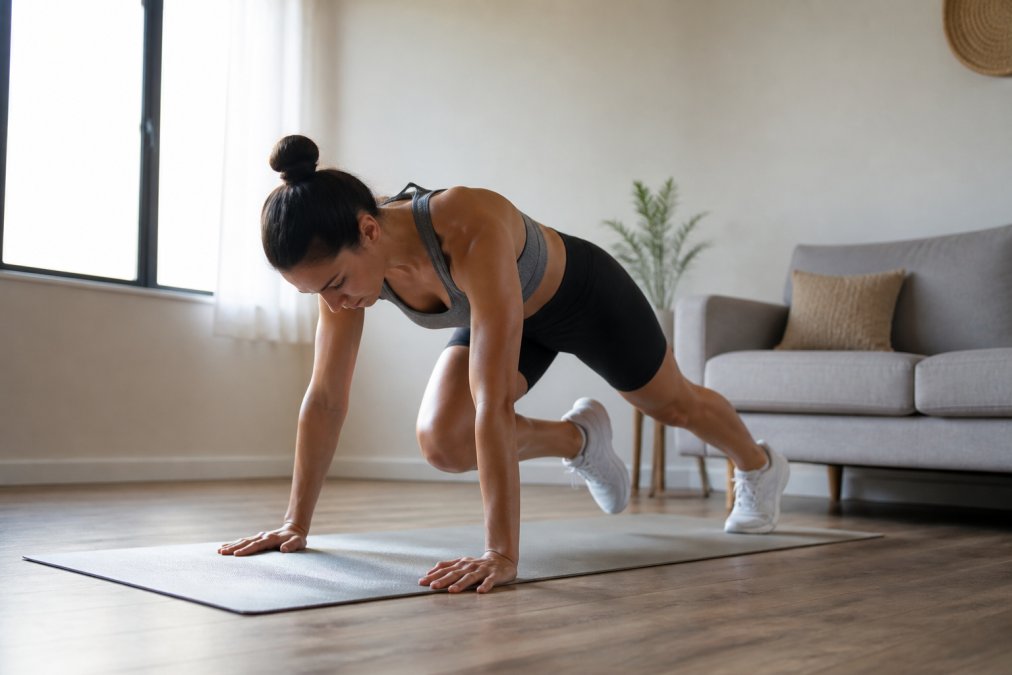
The circuit:
- Jump squats: 40 seconds on, 20 seconds rest
- Push-ups: 40 seconds on, 20 seconds rest
- High knees: 40 seconds on, 20 seconds rest
- Burpees: 40 seconds on, 20 seconds rest
- Plank hold: 40 seconds on, 20 seconds rest
Warm-Up and Cool-Down Routines
Never skip the bookends. A five-minute warm-up raises your core temperature and prepares your joints; a five-minute cool-down brings your heart rate down and supports active recovery.
Workout 2: Best Bodyweight Exercises for Fat Loss
The best bodyweight exercises for fat loss are compound movements that recruit large muscle groups, because they burn more calories per minute than isolation moves. Think squats, push-ups, lunges, and planks, not bicep curls. Integrating these high-intensity patterns into a consistent routine creates the most efficient foundation for sustainable exercises for weight loss.
The five that earn their place:
- Squats: quads, glutes, and core stability in one move
- Push-ups: chest, shoulders, triceps, and a braced core
- Reverse lunges: single-leg strength and balance
- Glute bridges: posterior chain and hip stability
- Plank: deep core engagement and functional movement
Low-Impact Modifications for Beginners
Low-impact does not mean low-effort. Swap jumping for stepping, and you protect your knees while still raising your heart rate.
- Replace jump squats with sit-to-stands
- Replace burpees with step-back lunges
- Replace high knees with fast marching
- Replace jump rope with cordless rope swings
Workout 3: Effective 20 Minute Home Workout Routines
An effective 20 minute home workout routine follows a simple structure: a short warm-up, three to four compound movements, and a brief cool-down. Done four times a week, that is enough to move the needle on body composition.
| Phase | Time | What You Do | Why It Works |
|---|---|---|---|
| Warm-up | 3 min | Arm circles, leg swings, marching | Raises core temperature |
| Strength block | 12 min | Squats, push-ups, lunges, rows | Builds muscle, raises metabolic rate |
| Finisher | 3 min | 30-second plank, 30-second high knees | Pushes heart rate up |
| Cool-down | 2 min | Stretch and breathe | Aids active recovery |
Workout 4: Full-Body Circuit for Endurance
A full-body circuit trains endurance by keeping your heart rate elevated across every muscle group with minimal rest. It builds aerobic capacity and muscular stamina at the same time, and because it never lets your heart rate fully recover, it also keeps total caloric burn high across the whole session rather than spiking and crashing.
- Bodyweight squats: 15 reps
- Push-ups: 10 reps
- Walking lunges: 12 reps per leg
- Plank shoulder taps: 20 reps
- Glute bridges: 15 reps
How to Progress This Circuit Without Adding Weight
Most home-fitness guides hand you a circuit and stop there. The circuit is the starting point, not the program. Here is how to make the same five moves harder over four weeks without touching a dumbbell:
- Week 1: Run the circuit as written. Log your total time and how many reps you completed in each round.
- Week 2, add time under tension. Slow every rep to a 3-second lowering phase. A 15-rep squat set now takes roughly 45 seconds instead of 20, which raises the metabolic demand without adding a single rep.
- Week 3, cut rest. Drop rest between rounds from 60 seconds to 45, then 30. Shorter rest keeps your heart rate in a higher zone and increases the cardiovascular load.
- Week 4, add a round or a harder variation. Go from three rounds to four, or swap standard push-ups for decline push-ups (feet on a couch) and standard squats for split squats.
Recovery and Post-Workout Nutrition for Fat Loss
What to do in the hour after:
- Prioritize protein. Aim for roughly 20-40 grams within a couple of hours of training. It supports muscle retention, and keeping muscle is what keeps your resting metabolic rate from drifting down during a caloric deficit.
- Do not 'earn' a treat. A 20-minute circuit might burn a few hundred calories. A single sports drink and a pastry can erase that in five minutes. The deficit is still the driver.
- Rehydrate with water, not sugar. Sweat loss is water and electrolytes, not a reason for a calorie-dense recovery shake unless you are training for hours.
- Keep the next meal balanced. Protein, fiber, and some complex carbohydrate will keep you full and blunt the hunger spike that hard training can trigger.
If you want light resistance for the upper body, a six-tube pedal tension rope adds smooth, consistent resistance for rows, presses, and curls while the foot pedals keep your lower body engaged. It folds away under a couch, which matters if your "home gym" is a corner of the living room.
Workout 5: Time-Efficient Micro-Workouts
Micro-workouts are short bursts of movement, usually two to five minutes, stacked throughout the day, and they are the most underrated fat-loss tool for busy people. You do not need a 45-minute block to make progress.
Try this daily stack:
- Morning: 20 bodyweight squats and 10 push-ups before your first coffee
- Mid-morning: 60-second plank between meetings
- Lunch: 3-minute walk plus 10 walking lunges
- Afternoon: 30 seconds of high knees to reset focus
- Evening: 2-minute stretch and breathing routine
Psychological Barriers to Home Fitness
The hardest part of home fitness is not the workout. It is the motivation to start, and most programs fail because they ignore this entirely.
Three barriers show up again and again:
- No accountability. Nobody notices if you skip. Fix it by scheduling sessions like meetings and telling someone your plan.
- All-or-nothing thinking. A 10-minute session feels pointless next to a 60-minute gym class. It is not. Consistency beats intensity.
- Decision fatigue. Choosing a workout every day drains willpower. Pick a fixed weekly schedule and stop deciding.
Frequently Asked Questions
What is the best free workout plan for weight loss?
The best free plan combines HIIT, bodyweight strength, and consistency. Try a 20-minute circuit of squats, push-ups, lunges, and planks three to four times weekly. Add 30 minutes of brisk walking on rest days. This approach creates a caloric deficit while preserving muscle. Track your workouts to ensure progressive overload without weights.
Can you lose weight with only bodyweight exercises?
Yes. Bodyweight exercises like squats, push-ups, and burpees build muscle and burn calories. When paired with a slight caloric deficit, they lead to fat loss. The key is progressive overload: increase reps, reduce rest intervals, or slow down the tempo to keep challenging your muscles. Consistency matters more than equipment.
How many minutes of exercise per day is needed for weight loss?
Aim for at least 20 to 30 minutes of moderate to vigorous exercise most days. The CDC recommends 150 minutes of moderate activity weekly for substantial health benefits. For weight loss, you may need 250 to 300 minutes weekly. Short, intense sessions like HIIT can be effective in less time.
What is the 3-3-3 rule for weight loss?
The 3-3-3 rule is a simple framework: eat three balanced meals daily, exercise three times per week, and drink three liters of water daily. It is not a magic formula, but it helps build consistent habits. Pair it with a caloric deficit and progressive bodyweight training for best results.
How do I structure a no-equipment workout for maximum fat loss?
Start with a dynamic warm-up. Then perform a circuit of compound exercises like squats, push-ups, lunges, and planks. Do each for 40 seconds, rest 20 seconds, and repeat the circuit three to four times. Finish with a cool-down and stretch. Keep rest intervals short to maintain a high heart rate.
Building a lasting routine is less about willpower and more about having the right tools within reach. At thewellbeingshop.com, we curate fitness and recovery equipment designed to support smarter, more intentional daily movement, from balance boards and kettlebells to compact core trainers that fit real homes. Our goal is to help you push your limits daily and turn small habits into big life shifts. Get started with thewellbeingshop.com and cultivate home strength that lasts.