


 Link label

20 Minute Home Workout Routines: Effective Plans for Busy Schedules
Table of Contents
- Why Effective 20 Minute Home Workout Routines Work for Busy Lives
- Benefits of 20 Minute Workouts: Time-Efficient Fitness Results
- Beginner 20 Minute Home Workout: Starting Your Journey
- 20 Minute Full Body Workout No Equipment Required
- 20 Minute HIIT Workout at Home: High-Intensity Interval Training
- Structuring Effective 20 Minute Home Workout Routines for Results
- Recovery and Post-Workout Nutrition for Home Training
- Modifications for Injuries and Limited Mobility
20 Minute Home Workout Routines: Effective Plans for Busy Schedules
Last Updated: July 31, 2026
Why Effective 20 Minute Home Workout Routines Work for Busy Lives
Time is your scarcest resource. A typical office worker loses 2-3 hours daily to commutes, meetings, and administrative tasks. Yet effective 20 minute home workout routines have emerged as the most realistic path to consistent training for professionals juggling competing demands. This guide from thewellbeingshop.com covers everything you need to build sustainable strength and cardiovascular capacity without stepping foot in a gym.
When your workout is 30 seconds from your bedroom, the friction that kills most fitness goals vanishes. Research shows that people who exercise at home maintain consistency rates 40% higher than gym members over a 12-month period. A 20-minute protocol fits between breakfast and work, during a lunch break, or after kids are asleep.
Benefits of 20 Minute Workouts: Time-Efficient Fitness Results
Short-duration sessions deliver measurable results when structured properly. Intensity compensates for duration.
Metabolic Conditioning and Cardiovascular Endurance
Twenty minutes at moderate to high intensity triggers post-exercise oxygen consumption (EPOC), also called the "afterburn effect." Your metabolism remains elevated for hours after the workout ends, burning additional calories during recovery. A 20-minute high-intensity session produces cardiovascular benefits comparable to much longer steady-state cardio. After 4-6 weeks of consistent training, you'll notice improved energy levels, better breathing during daily activities, and increased muscular endurance.
Sustainable Habit Formation and Consistency
Habit formation depends less on motivation and more on friction. When a behavior is easy to execute and fits naturally into your existing routine, you do it. Someone who completes three 20-minute workouts per week for a year accumulates 156 training sessions. That volume, sustained, builds real strength and conditioning regardless of session length.
Beginner 20 Minute Home Workout: Starting Your Journey
If you're returning to fitness after time off, a structured beginner protocol prevents injury and builds confidence. This routine requires no equipment and uses only your bodyweight.
Warm-Up Protocol (3 minutes)
A proper warm-up increases core body temperature and prepares your nervous system for effort.
-
Arm circles and shoulder rotations (30 seconds): Rotate your arms forward 15 times, then backward 15 times.
-
Leg swings (30 seconds): Hold onto a wall. Swing one leg forward and backward in a controlled arc, 10 times per leg.
-
Bodyweight squats (30 seconds): Perform 15-20 slow, controlled squats, focusing on depth and form.
-
Walking lunges (30 seconds): Take 8-10 steps forward, alternating legs.
-
Marching in place with high knees (30 seconds): Jog in place, bringing your knees to hip height.
Main Circuit (14 minutes)
Perform the following exercises in sequence with minimal rest between movements.
Round 1-3 (repeat three times):
-
Push-ups (40 seconds of work, 20 seconds rest): If standard push-ups are too challenging, perform them on your knees or against an elevated surface.
-
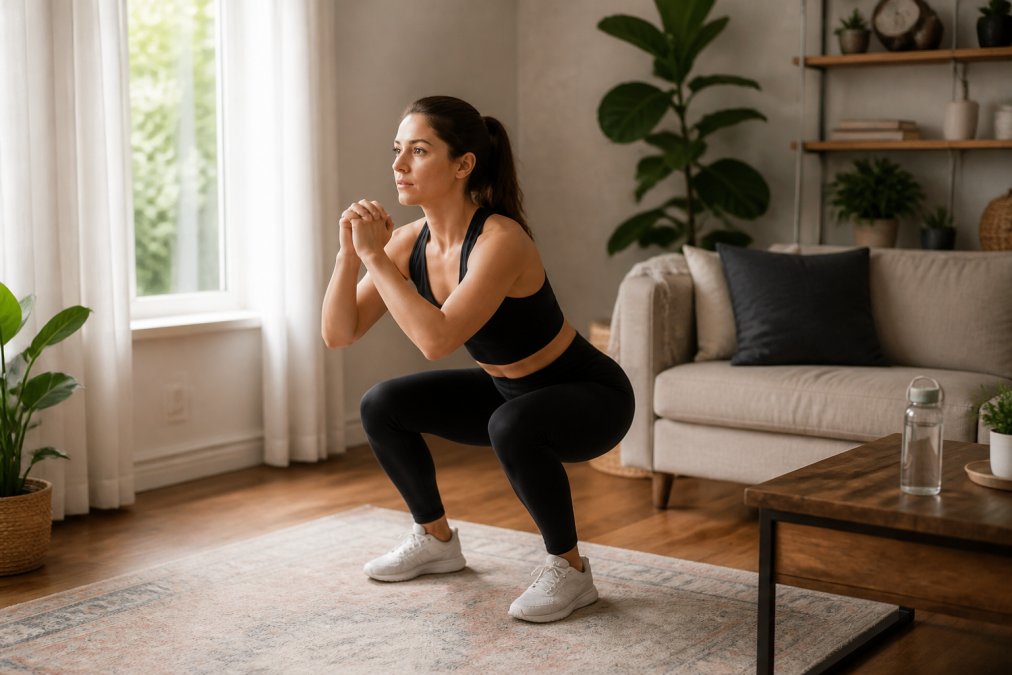
Squats (40 seconds of work, 20 seconds rest): Stand with feet shoulder-width apart, lower your hips back and down until your thighs are parallel to the ground, then drive through your heels to stand.
-
Burpees (40 seconds of work, 20 seconds rest): From standing, drop into a plank position, perform one push-up, then jump your feet back toward your hands and explosively jump upward. If explosive jumping feels too intense, step back instead of jumping.
-
Plank hold (40 seconds of work, 20 seconds rest): Hold a straight-line plank position, engaging your core to prevent your hips from sagging.
Rest 2 minutes between rounds.
Cool-Down and Active Recovery (3 minutes)
-
Walking in place (1 minute): Slow your movement to a gentle walk and breathe deeply.
-
Dynamic stretching (2 minutes): Perform slow, controlled movements through your range of motion. Hold each stretch for 15-20 seconds: quad stretch, hamstring stretch, shoulder stretch, and hip flexor stretch.
20 Minute Full Body Workout No Equipment Required
Once you've mastered the beginner routine, progress to a full-body circuit that increases intensity through exercise selection and reduced rest intervals.
Compound Movements for Maximum Efficiency
Compound movements engage multiple muscle groups simultaneously, delivering more work per minute than isolation exercises. Push-ups work your chest, shoulders, triceps, and core. Squats activate your quads, glutes, hamstrings, and stabilizer muscles. Progressive overload in bodyweight training comes through volume, tempo, and difficulty progression. A beginner doing regular push-ups progresses to archer push-ups, then one-arm push-ups.
Exercise Sequence and Rest Intervals
Start with movements requiring the most neurological demand and energy. Follow with higher-rep, lower-intensity work.
20-Minute Full Body No-Equipment Workout:
Warm-up (2 minutes): 30 seconds each of arm circles, leg swings, bodyweight squats, walking lunges, high knees.
Main circuit (16 minutes): Perform four rounds of the following sequence with 30 seconds rest between exercises and 90 seconds rest between rounds.
-
Push-ups (40 seconds): Maintain strict form over raw reps.
-
Jump squats (40 seconds): Explosive squat variation that increases cardiovascular demand and lower body power.
-
Reverse lunges (40 seconds): Step backward, which reduces knee stress. Alternate legs smoothly.
-
Plank shoulder taps (40 seconds): From plank position, tap your right shoulder with your left hand, then alternate.
Cool-down (2 minutes): Walking and dynamic stretching.
20 Minute HIIT Workout at Home: High-Intensity Interval Training
HIIT workouts alternate between maximum-effort bursts and recovery periods, maximizing cardiovascular benefit and metabolic demand in minimal time.
Understanding Anaerobic Threshold and Heart Rate Elevation
Your anaerobic threshold is the exercise intensity above which your body cannot maintain aerobic energy production. Training at or near this threshold triggers powerful adaptations: improved oxygen use, increased mitochondrial density, and enhanced cardiovascular capacity. A 30-second all-out effort should push you to 85-95% of your maximum heart rate. The recovery intervals allow your heart rate to drop but not completely recover, creating a sawtooth pattern that trains your cardiovascular system to handle stress and recover efficiently.
Sample HIIT Structure: Work-to-Rest Ratios
20-Minute Beginner HIIT Workout:
Warm-up (2 minutes): Light movement and dynamic stretching.
HIIT block (16 minutes): Perform four 4-minute rounds. Each round contains four 40-second work intervals with 20-second rest between intervals, followed by 1 minute of walking recovery.
Round 1:
- 40 seconds: High-knee marching
- 20 seconds: Rest/walk
- 40 seconds: Bodyweight squats
- 20 seconds: Rest/walk
- 40 seconds: Push-ups
- 20 seconds: Rest/walk
- 40 seconds: Burpees
- 20 seconds: Rest/walk
- 1 minute: Walking recovery
Repeat for rounds 2, 3, and 4. Vary the exercise selection each round to distribute fatigue across different muscle groups.
Cool-down (2 minutes): Walking and static stretching.
Structuring Effective 20 Minute Home Workout Routines for Results
Building sustainable strength and conditioning requires progression, tracking, and periodization.
Progressive Overload and Breaking Through Plateaus
Progressive overload means systematically increasing the demands placed on your muscles. Methods include: increasing volume, decreasing rest intervals, slowing tempo, progressing exercise difficulty, and adding complexity. Track which progression method you're using each week to prevent stagnation.
Tracking Progress Without a Gym
A simple notebook or phone notes app suffices.
| Tracking Method | What to Record | Frequency |
|---|---|---|
| Reps and sets | Exercises completed, reps per set, total volume | Every session |
| Rest intervals | Time between exercises | Weekly |
| Exercise difficulty | Standard push-ups vs. archer vs. one-arm | Monthly |
| Subjective effort | Rate of perceived exertion (1-10 scale) | Every session |
| Bodyweight trends | Body weight, measurements, how clothes fit | Weekly |
The simplest system: note the date, exercises, reps completed, and how you felt. After 4 weeks, review your notes to see higher reps, shorter rest periods, or harder exercise variations.
Recovery and Post-Workout Nutrition for Home Training
Training stimulus is only half the equation. Recovery is where adaptation occurs. Your muscles grow during rest periods when protein synthesis is elevated and inflammation is managed.
Mobility Drills and Dynamic Stretching
Active recovery on rest days prevents stiffness and maintains range of motion.
Post-Workout Mobility Routine (5-10 minutes):
-
Cat-cow stretches: On hands and knees, alternate between arching your back (cow) and rounding it (cat). Perform 10 slow repetitions.
-
90-90 hip stretch: Sit on the ground with one leg bent in front of you at 90 degrees and the other bent to the side. Fold forward gently over the front leg. Hold 20-30 seconds per side.
-
Inchworms: Stand, fold forward to touch your toes, then walk your hands forward into a plank. Walk your feet back and stand. Perform 8-10 repetitions.
-
Quadriceps stretch: Standing, pull one foot toward your glutes. Hold 20-30 seconds per leg.
-
Shoulder pass-throughs: Hold a light object at arm's length in front of you. Slowly move it overhead and behind your back, then reverse. Perform 10 repetitions.
Nutrition Timing and Recovery Support
Post-workout nutrition supports muscle protein synthesis and glycogen replenishment. Eating within 2-3 hours of training is sufficient for most people. A post-workout meal should contain protein and carbohydrates. Aim for 20-40 grams of protein and 40-80 grams of carbohydrates depending on your body size and training intensity.
Post-Workout Nutrition Examples:
- Chicken with rice and vegetables
- Greek yogurt with berries and granola
- Eggs with toast and fruit
- Protein shake with banana and oats
- Turkey sandwich with a glass of juice
At thewellbeingshop.com, we understand that recovery nutrition is as important as the workout itself. Our curated selection of nutritional support products is designed to complement your training and support the recovery process, helping you achieve faster adaptation and better results from your 20-minute sessions.
Modifications for Injuries and Limited Mobility
Not every body is the same. Injuries, joint limitations, or mobility restrictions require exercise modifications that maintain training stimulus without aggravating existing issues.
Low-Impact Alternatives to High-Intensity Movements
High-impact movements like burpees and jump squats place significant stress on your joints. Low-impact alternatives maintain cardiovascular demand without impact.
Common Modifications:
| High-Impact Movement | Low-Impact Alternative |
|---|---|
| Jump squats | Bodyweight squats or slow squats |
| Burpees | Step-back burpees or plank-to-squat |
| High-knee marching | Walking lunges or step-ups |
| Box jumps | Step-ups onto a chair or bench |
| Running in place | Marching or lateral shuffles |
The key principle: reduce impact without reducing intensity. A slow, controlled squat with a 3-second descent creates more muscular demand than a fast jump squat.
Range of Motion Adjustments and Core Stability Work
Limited range of motion often stems from tight muscles, mobility restrictions, or previous injuries. Work within your available range and gradually expand it.
Range of Motion Modifications:
-
Reduced squat depth: If full squats cause knee pain, squat to whatever depth feels comfortable. Over time, gradually deepen as mobility improves.
-
Elevated push-ups: Performing push-ups with your hands on a chair or counter reduces the range of motion, making the movement easier.
-
Isometric holds: Instead of moving through a range of motion, hold a challenging position. A wall sit builds strength without joint movement.
-
Core-focused variations: Planks, dead bugs, and bird dogs build core stability without spinal flexion or extension, making them safer for people with back issues.
Effective 20 minute home workout routines aren't a compromise, they're a practical recognition that consistency beats perfection. By removing friction, tracking progress, and prioritizing recovery, you create the conditions for real change. At thewellbeingshop.com, our curated fitness equipment and recovery tools are designed to support this journey, helping you build sustainable strength and conditioning without requiring a gym membership or hours of training time.
Frequently Asked Questions
Are 20 minute home workouts actually effective for building strength and muscle?
Yes. Effective 20 minute home workout routines using compound movements, high-intensity interval training, and progressive overload can build functional muscle and strength. The key is maximizing time under tension through proper exercise selection, minimal rest intervals, and consistent effort. While shorter than traditional gym sessions, these workouts deliver metabolic conditioning and muscle hypertrophy when structured with appropriate intensity.
What should I eat after a 20 minute home workout for recovery?
Post-workout nutrition should include protein and carbohydrates within 30-60 minutes of exercise. Protein supports muscle repair and recovery, while carbohydrates replenish glycogen stores depleted during your workout. Examples include Greek yogurt with fruit, a protein shake with banana, or chicken with rice. This timing optimizes post-exercise oxygen consumption and prepares your body for the next session.
Can I do a 20 minute HIIT workout at home if I have joint pain or limited mobility?
Yes, with modifications. Replace high-impact movements like jumping with low-impact alternatives such as step-touches, controlled lunges, or isometric holds. Focus on range of motion adjustments and core stability work to reduce stress on affected joints. Always warm up thoroughly with dynamic stretching, and consider consulting a healthcare provider before starting a new routine if you have significant mobility limitations.
How often should I do 20 minute home workout routines to see results?
Consistency is more important than frequency. Three to four sessions per week allows adequate recovery while building aerobic capacity and muscular endurance. Beginners may start with two sessions weekly and progress gradually. Include active recovery days with mobility drills and dynamic stretching. Avoid training the same muscle groups intensely on consecutive days to prevent overuse and maintain long-term sustainability.
This article was written using GrandRanker