


 Link label

Break Through Home Fitness Plateaus: 7 Proven Methods
Table of Contents
- What Causes Home Fitness Plateaus
- Implement Progressive Overload in Home Workouts
- Vary Home Workouts to Trigger New Adaptation
- Track Progress Home Fitness to Identify Stagnation
- Mental Strategies for Home Fitness Plateaus
- Deload Weeks and Central Nervous System Recovery
- Optimize Nutrient Timing and Recovery Support
- Break Through Your Home Fitness Plateau: Action Steps
Break Through Home Fitness Plateaus: 7 Proven Methods
Last Updated: August 2, 2026
When your home workouts stop delivering results, the problem isn't laziness, it's adaptation. Your body has learned to handle your current stimulus, and without deliberate progression, you'll stay stuck. This guide from thewellbeingshop.com explores how to break through home fitness plateaus by addressing the physiological, psychological, and practical barriers that halt progress in home-based training environments.
Most fitness enthusiasts hit a plateau within 8-12 weeks of starting a home routine. What separates people who push through from those who quit is understanding that fitness plateaus aren't failures, they're signals that your training needs to evolve.
What Causes Home Fitness Plateaus
Your body adapts faster than you might think. When you perform the same exercises at the same intensity week after week, your nervous system and muscles become efficient at that specific stimulus. Efficiency stops driving progress.
Home fitness plateaus stem from three interconnected causes. First, insufficient training stimulus: your current volume, intensity, or exercise selection no longer challenges your muscles enough to force adaptation. Second, metabolic adaptation: your body has adjusted to your caloric intake and activity level, making fat loss slower and strength gains harder. Third, recovery limitations: many home-based athletes underestimate the importance of sleep quality, nutrient timing, and active recovery, all of which directly impact your ability to adapt to training stress.
A fourth, often-overlooked cause is psychological burnout. Monotony in your exercise selection and routine structure can create mental fatigue that translates into reduced workout intensity and consistency.
Implement Progressive Overload in Home Workouts
Progressive overload is the cornerstone of breaking through fitness plateaus. It means systematically increasing the demands placed on your muscles and cardiovascular system over time. Without it, your body has no reason to adapt.
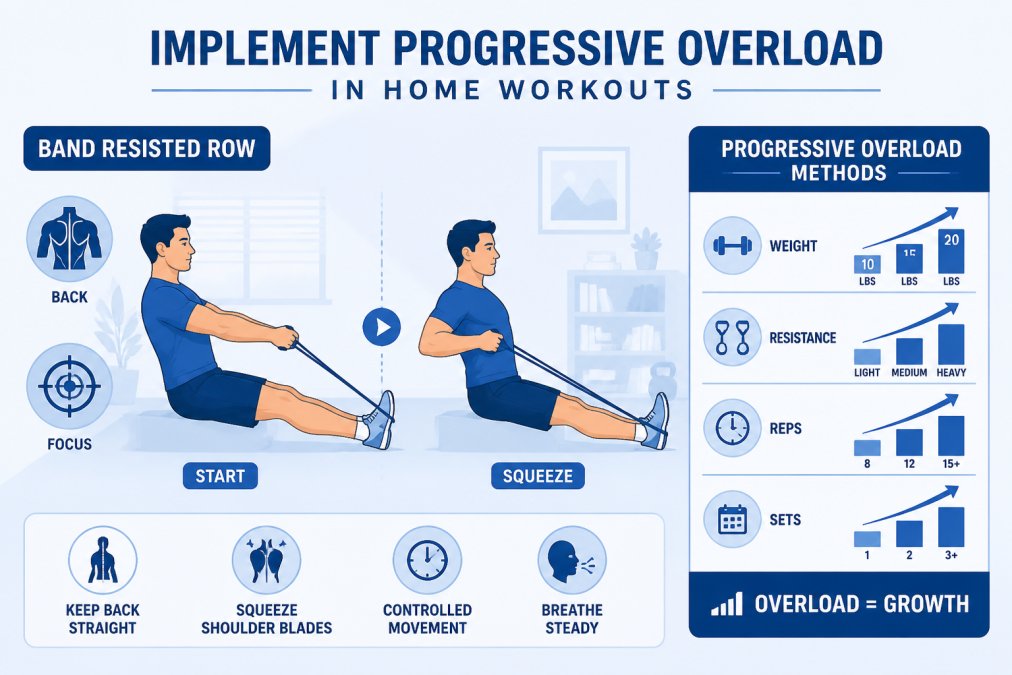
Adding Resistance Without a Full Gym
You don't need a barbell rack to add resistance. Dumbbells allow for progressive weight jumps and work well for isolation exercises. Resistance bands provide variable resistance that increases as you stretch them. Bodyweight progressions, moving from standard push-ups to archer push-ups to pseudo-planche push-ups, add difficulty without equipment.
Water jugs, sandbags, and books can serve as makeshift weights. The key is measurable progression: if you use a 20-pound dumbbell this week, use 22 pounds next week. Small increments compound into significant strength gains over months.
Tempo training adds resistance without weight increases. By slowing down the eccentric (lowering) phase of a movement to 3-4 seconds, you increase time under tension and metabolic stress, both drivers of muscle growth and strength adaptation.
Increasing Reps, Sets, and Time Under Tension
Progressive overload doesn't always mean heavier weight. Increasing reps or sets within your current load is valid. If you performed 3 sets of 8 reps last week, aim for 3 sets of 9 reps this week. Once you reach your target rep range, increase the weight and drop back to the lower end.
Time under tension, the total duration your muscles spend under load, directly correlates with muscle growth. Extend time under tension by slowing your tempo, pausing at the hardest point of the movement, or reducing rest periods between sets.
Rest period reduction is particularly effective for home training. Instead of resting 90 seconds between sets, reduce it to 60 seconds. Your muscles stay metabolically stressed, and you complete your workout faster.
Vary Home Workouts to Trigger New Adaptation
Monotony kills progress. Performing the same exercises in the same order for months signals to your body that no new adaptation is required. Variation forces your nervous system and muscles to respond to novel stimuli.
Periodization and Training Cycles
Periodization structures your training into phases, each with a specific focus. Linear periodization gradually increases intensity while decreasing volume over 4-8 weeks. You might start a cycle performing 4 sets of 12 reps at moderate weight, then progress to 4 sets of 8 reps at heavier weight by week 8.
Undulating periodization varies intensity and volume within each week. Monday might be a high-volume day (4 sets of 10-12 reps), Wednesday a moderate day (3 sets of 8 reps), and Friday a strength-focused day (5 sets of 3-5 reps).
Block periodization dedicates 2-4 week blocks to specific adaptations: one block emphasizes hypertrophy, another emphasizes strength, another emphasizes endurance. Each block prepares your body for the next, creating progression that prevents plateaus.
Exercise Selection and Movement Variation
Swap exercises every 3-4 weeks to prevent accommodation. If you've been doing dumbbell chest presses, switch to push-ups or resistance band chest presses. The movement pattern remains similar, but the stimulus is different enough to trigger new adaptation.
Include horizontal and vertical pulling movements. Resistance bands allow for lat pulldowns and rows without a pull-up bar. Inverted rows using a sturdy table work well too. A balanced pulling-to-pushing ratio prevents injury and ensures comprehensive strength development.
Single-limb variations increase difficulty and address imbalances. Single-leg squats, single-arm rows, and single-leg deadlifts demand more from your stabilizer muscles and core.
Track Progress to Identify Stagnation
You can't manage what you don't measure. Most home athletes train by feel, which often means they're not actually progressing.
Data-Driven Metrics Beyond the Scale
Weight is a crude metric. It doesn't distinguish between muscle and fat, and it fluctuates based on hydration and hormonal cycles. Instead, track performance metrics: reps completed at a given weight, workout duration, rest periods, and perceived difficulty.
A simple spreadsheet tracking your workouts reveals patterns. Record the exercise, weight used, reps completed, and sets performed. Over weeks, you'll see whether you're adding reps, increasing weight, or reducing rest periods.
Body composition changes matter more than scale weight. Take progress photos every 4 weeks from consistent angles and lighting. Measure key areas monthly. These measurements often show progress when the scale doesn't.
Strength benchmarks provide clear targets. Pick three movements: a lower body push (squat or lunge), an upper body push (push-up or press), and an upper body pull (row or pull-up progression). Test these monthly to track strength gains.
Mental Strategies for Home Fitness Plateaus
Plateaus aren't purely physical. The psychological component, motivation, variety, and mental engagement, directly impacts your ability to push through barriers.
Psychological Burnout vs. Physiological Plateau
Psychological burnout feels like a plateau but stems from different causes. You're bored, unmotivated, or dreading workouts. Your body hasn't actually adapted; your mind has disconnected from the process.
Physiological plateaus are different. You're still motivated, but your performance has genuinely stalled. Your body has adapted to your stimulus and requires new demands to progress.
Distinguishing between them matters. If you're burned out, adding more volume won't help. Instead, reduce training frequency temporarily, try new exercises, or take a scheduled deload week. If you're physiologically plateaued, increasing intensity or volume is the correct response.
Novelty breaks burnout. Change your workout time, rearrange your training space, try new music, or invite a training partner. Small environmental shifts can reignite motivation.
Sleep Hygiene and Hormonal Recovery
Sleep is where adaptation happens. During deep sleep, your body releases growth hormone, repairs muscle tissue, and consolidates neural adaptations from training. Poor sleep directly impairs your ability to break through plateaus.
Aim for 7-9 hours nightly. Consistency matters; sleep at the same time each night, even on weekends. Keep your bedroom cool (around 65-68°F), dark, and quiet. Avoid screens 30-60 minutes before bed, as blue light suppresses melatonin production. Caffeine consumed after 2 PM can disrupt sleep quality.
Elevated cortisol, your stress hormone, impairs muscle protein synthesis and promotes fat storage. Manage cortisol through adequate sleep, stress management (meditation, breathing work), and periodic deload weeks.
Deload Weeks and Central Nervous System Recovery
Deload weeks are intentional reductions in training volume and intensity, typically lasting 5-7 days. You're still training, but at 40-60% of your normal intensity.
Your central nervous system (CNS) fatigues like any other system. Continuous high-intensity training without recovery accumulates CNS fatigue, reducing your ability to produce force and recruit muscle fibers. Deload weeks allow CNS recovery, preventing overtraining and restoring your capacity for future progress.
Deload every 4-6 weeks of progressive training. During a deload, reduce weight by 40-50%, keep reps moderate (8-10), and focus on movement quality. You might use lighter dumbbells, perform more bodyweight exercises, or extend rest periods.
Many athletes resist deloads, fearing they'll lose progress. The opposite is true: deloads prevent injury, restore motivation, and allow you to return stronger. You'll often hit new personal records in the week following a deload.
Optimize Nutrient Timing and Recovery Support
Training creates the stimulus for adaptation. Nutrition provides the raw materials. Without proper nutrient timing and intake, even perfect training won't drive progress.
Protein intake directly supports muscle protein synthesis. Aim for 0.7-1 gram per pound of body weight daily, distributed across 3-4 meals. Consuming 20-40 grams of protein per meal optimizes muscle building in each feeding window.
Nutrient timing matters post-workout. Your muscles are primed to accept nutrients immediately after training. Consuming protein and carbohydrates within 1-2 hours post-workout accelerates recovery and muscle growth.
Carbohydrate intake supports training performance and recovery. Low carbohydrate availability impairs strength performance and reduces training volume capacity. For home athletes training 4-5 days weekly, consuming carbohydrates around workouts ensures adequate energy and recovery.
Micronutrient deficiencies impair recovery and adaptation. Iron, zinc, magnesium, and B vitamins are particularly important for athletes. If you suspect deficiencies, get bloodwork done.
| Recovery Factor | Impact on Progress | Home-Specific Considerations |
|---|---|---|
| Sleep (7-9 hours) | Critical for hormone production and muscle repair | Inconsistent schedules disrupt adaptation |
| Protein intake (0.7-1g/lb) | Essential for muscle protein synthesis | Easy to undershoot in home settings |
| Carbohydrate timing | Fuels performance and replenishes glycogen | Often neglected by home athletes |
| Hydration (half bodyweight in oz) | Supports nutrient transport and thermoregulation | Easy to forget during home workouts |
| Stress management | Reduces cortisol and improves hormonal balance | Home environment can increase stress |
| Active recovery (light movement) | Enhances blood flow and reduces soreness | Often skipped due to time constraints |
Break Through Your Home Fitness Plateau: Action Steps
You now understand the mechanisms behind fitness plateaus and the seven proven methods to overcome them. Implementation is where progress happens.
Start with one change this week. If your training has been stale, implement periodization with clear intensity and volume targets for the next 4 weeks. If you haven't tracked workouts, start recording reps, weight, and sets. If sleep has been poor, commit to 7.5 hours nightly for two weeks and observe the difference in your performance.
Combine methods for maximum impact. Progressive overload without variation leads to accommodation. Variation without progressive overload leads to busy work. Combine them: periodize your training while systematically increasing weight or reps.
At thewellbeingshop.com, we recognize that breaking through home fitness plateaus requires both the right training knowledge and the tools to support it. Our curated selection of resistance equipment, recovery tools, and nutritional support is designed to complement your training progression. Whether you're adding resistance bands to increase training difficulty, using foam rollers for active recovery, or optimizing nutrient timing with quality supplements, the right tools remove friction from your process and accelerate your results.
The plateau you're experiencing isn't permanent. It's a signal that your training needs to evolve. By implementing progressive overload, varying your exercises through periodization, tracking measurable progress, managing the psychological demands of home training, prioritizing recovery, and optimizing nutrition, you'll break through, and keep breaking through for years to come.
Home fitness plateaus are frustrating, but they're solvable. The challenge isn't your dedication, it's that your training needs intentional progression and variation. At thewellbeingshop.com, we provide the equipment and guidance to support your journey: resistance tools that enable progressive overload, recovery products that accelerate adaptation, and nutritional support that fuels your training. Start with one method this week, track your progress, and watch your results accelerate.
National Strength and Conditioning Association guidelines on periodization
American College of Sports Medicine recommendations on exercise progression
Sleep Foundation research on athletic recovery and sleep duration
Frequently Asked Questions
What causes a fitness plateau when working out at home?
Home fitness plateaus occur when your body adapts to your current training stimulus. Without progressive overload, consistent exercise variation, or adequate recovery, your muscles stop responding to the same stimulus. Metabolic adaptation, insufficient training volume, poor sleep, and psychological burnout also contribute. Home-specific limitations like equipment constraints can accelerate plateaus if not addressed strategically through creative exercise selection and periodization.
How do I track progress in home fitness without expensive equipment?
Track performance metrics that don't require gadgets: record reps, sets, rest intervals, and time under tension for each exercise in a simple spreadsheet or notes app. Photograph your form weekly to assess technique changes. Monitor how you feel (energy levels, recovery speed, motivation). Track body composition through how clothes fit or progress photos rather than scale weight alone. These data-driven methods reveal plateaus faster than guessing and help you adjust training frequency and intensity accordingly.
How often should I change my home workout routine to avoid a plateau?
Change isn't required as often as many think. Periodization typically uses 4-6 week training blocks before varying exercises or intensity. You can maintain the same exercises while implementing progressive overload through increased reps, sets, resistance, or reduced rest intervals. However, introducing new exercise variations every 3-4 weeks prevents psychological staleness and targets muscles from different angles. The key is varying the training stimulus itself, not necessarily the exercises.
Can sleep and nutrition actually affect home fitness plateaus?
Yes, significantly. Sleep deprivation impairs central nervous system recovery, hormonal balance, and muscle protein synthesis, directly limiting strength gains and muscle hypertrophy. Poor nutrient timing around workouts reduces recovery and adaptation. Inadequate macro-nutrients (especially protein) prevent muscle repair. Deload weeks combined with proper sleep and nutrition allow your body to fully recover and adapt to training stimulus. These recovery factors are often the difference between stalled progress and breakthrough gains in home training.
This article was written using GrandRanker