


 Link label

Best Home Wellness Tools for Busy Professionals
Table of Contents
- Quick Comparison: Top Home Wellness Tools at a Glance
- Best Wearable Health Trackers for Busy Professionals
- Stress Relief Tools for Professionals
- Wellness Apps for Busy Schedules
- Sleep Optimization and Recovery Tools
- Hydration and Wellness Ecosystem Integration
- How to Choose the Right Wellness Tools for Your Routine
- Micro-Wellness Routines: Building Habits That Stick
Last Updated: August 9, 2026
Quick Comparison: Top Home Wellness Tools at a Glance
Busy professionals know wellness matters but have 20 minutes daily, not two hours. The tools that work integrate into existing routines, require minimal setup, and deliver measurable results fast. The difference between professionals who stick with wellness and those who quit after week two isn't willpower, it's tool selection.
| Tool Type | Best Option | Key Benefit | Time Investment |
|---|---|---|---|
| Wearable tracker | Oura Ring Gen3 | Sleep and recovery insights | 0 minutes (passive) |
| Stress relief | Muse 2 | Real-time brain feedback | 3-10 minutes daily |
| Portable recovery | Theragun Mini | Muscle tension relief | 2-5 minutes as needed |
| Meditation app | Headspace | Structured 10-minute sessions | 10 minutes daily |
| Sleep optimization | Hatch Restore 2 | Smart wake-up and wind-down | 0 minutes (automated) |
| Aromatherapy | Vitruvi Stone Diffuser | Ambient focus enhancement | 0 minutes (passive) |
| Hydration | Hydro Flask | Temperature-controlled hydration | 0 minutes (passive) |
The pattern is clear: the best tools for busy professionals work in the background or compress results into micro-sessions.
Best Wearable Health Trackers for Busy Professionals
Wearables solve a specific problem: they collect data while you sleep, work, and move without requiring conscious effort. If it requires remembering to track, it fails.
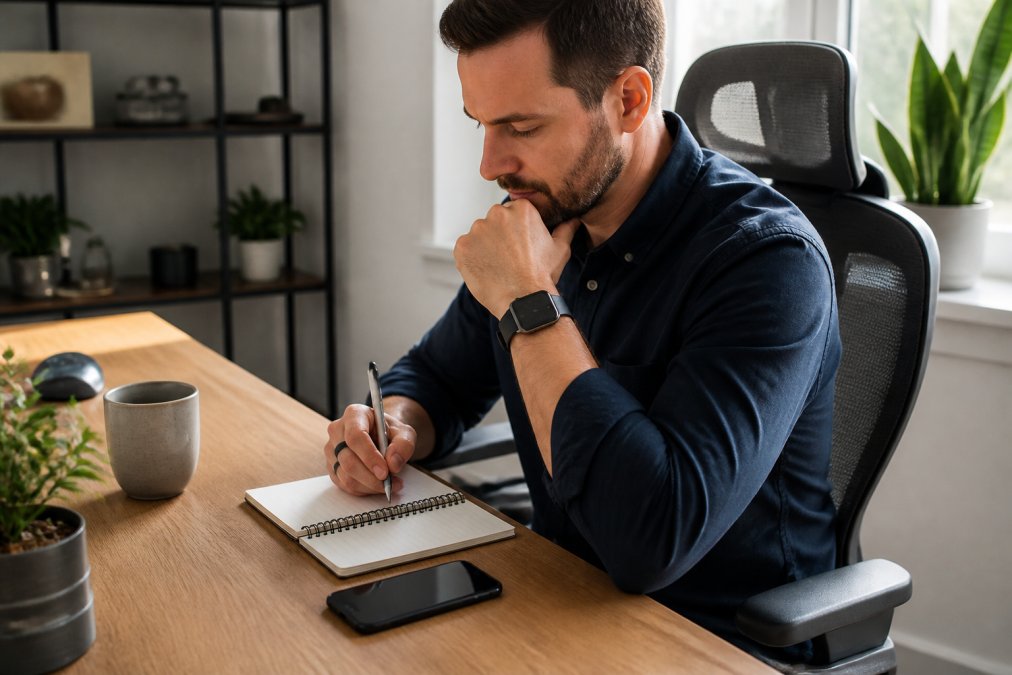
Oura Ring Gen3: Sleep and Recovery Intelligence
The Oura Ring Gen3 is a discreet alternative to smartwatches. It tracks sleep, activity, and readiness without a distracting screen or irritating wrist band.
Most wearables prioritize activity data. The Oura Ring prioritizes recovery, measuring heart rate variability, body temperature, and sleep stages, metrics that reveal whether you're actually recovering from stress. For remote workers whose "activity" means walking from bedroom to kitchen, this shift matters.
The ring tracks 24/7 heart rate, blood oxygen levels, and temperature trends. It integrates with Strava and Apple Health. Battery lasts 4-7 days and it's waterproof.
The catch: most features require a paid membership after the free trial. For professionals serious about understanding recovery patterns, the depth of insight justifies the cost.
Best for: Professionals who want passive, comprehensive health data without checking their wrist constantly.
WHOOP 4.0: Strain and Recovery Insights
WHOOP quantifies physiological strain and tells you whether you have recovery capacity for workouts or meeting-heavy days. It measures continuous heart rate, heart rate variability, skin temperature, and blood oxygen, synthesizing this into three metrics: Strain, Recovery, and Sleep.
WHOOP's algorithm learns your patterns and improves at predicting your recovery window, flagging when you're pushing too hard. For professionals juggling demanding schedules, this prevents burnout before it happens.
The tradeoff: WHOOP is subscription-only at $25 per month or $199 per year. If you cancel, the band becomes useless.
Best for: High-performers who want real-time feedback on whether they can push harder or need to recover.
Stress Relief Tools for Professionals
Stress relief works through three mechanisms: neurofeedback (telling your brain what it's doing), physical release (breaking muscle tension), or sensory input (scent, sound, light).
Muse 2: Brain-Sensing Meditation Headband
Muse uses EEG sensors to detect when your mind wanders and plays audio cues, birds chirping when focused, stormy weather when distracted. This turns meditation into a game with immediate feedback, solving the main reason people quit: they can't tell if they're doing it right.
Sessions can be 3, 5, or 10 minutes. You see your focus score afterward and watch your attention improve over time. The headband is comfortable for 10 minutes, and the app offers guided sessions or silent meditation with audio cues.
The device costs $249.99 upfront, with a premium subscription ($45 per year) unlocking advanced insights. For someone skeptical about meditation, that's a significant investment before knowing if it'll stick.
Best for: Professionals who need proof they're making progress and respond to data-driven feedback.
Theragun Mini: Portable Muscle Recovery
The Theragun Mini is 0.45 kilograms of percussive relief, small enough for a desk drawer yet powerful enough to break up muscle tension in 90 seconds. For remote workers, this solves the 2pm problem: neck and shoulders knotted from hunching over a keyboard.
It has three speed settings (1750, 2100, 2400 pulses per minute), three attachments, and 180 minutes of battery life. It's quieter than older models and looks professional on a desk.
At $219.99, it's premium-priced, but the build quality and motor consistency are noticeably better than cheaper alternatives.
Best for: Desk workers dealing with neck and shoulder tension who need quick, effective relief.
Vitruvi Stone Diffuser: Aromatherapy for Focus
The Vitruvi Stone Diffuser is a ceramic object on your desk that disperses essential oils using ultrasonic technology. Two timer settings (4 hours continuous or 8 hours intermittent) mean you set it and forget it. It covers up to 500 square feet and automatically shuts off when water runs out.
Scent affects focus and mood. Peppermint enhances alertness, lavender reduces stress, frankincense improves concentration. Unlike supplements or apps, it works passively while you work.
At $123.00, it's higher than generic diffusers, but the ultrasonic technology is more efficient and the design means you'll actually use it.
Best for: Professionals who want passive sensory support for focus and mood without adding another app or habit.
Wellness Apps for Busy Schedules
Apps compress meditation, sleep guidance, and relaxation into 10-minute sessions. The best ones give you a starting point and track consistency.
Headspace: Meditation in 10 Minutes or Less
Headspace is built for busy people with sessions of 10 minutes or less. The library includes over 500 guided meditations, sleep content, focus music, and movement exercises, structured around specific needs: stress, sleep, focus, relationships, work.
The standout feature for professionals: the "Wake Up" series delivers a 10-minute guided story with practical wisdom each morning. It's meditation without calling it meditation, and people who resist meditation often stick with this.
Pricing starts at $12.99 per month or $69.99 per year. The free trial gives limited access but enough to test whether the approach works.
Best for: Professionals seeking structured, time-efficient meditation with a focus on work stress and sleep.
Calm: Sleep Stories and Guided Relaxation
Calm positions itself as the sleep app with over 100 Sleep Stories, many narrated by celebrities, plus exclusive sleep music and meditations. For busy professionals, the appeal is clear: you don't have to think about what to listen to.
The stories are designed to be boring in the best way, they meander without plot tension, exactly what your brain needs at 11pm. Beyond sleep, Calm offers meditations, breathing exercises, and daily gratitude prompts.
Pricing is $14.99 per month or $69.99 per year, with periodic lifetime subscription options. If sleep is your primary goal, Calm's library is unmatched.
Best for: Professionals prioritizing sleep quality and seeking passive relaxation tools.
Sleep Optimization and Recovery Tools
Sleep is where recovery happens. Most professionals sacrifice sleep for productivity, then wonder why they're exhausted. The right tools automate sleep improvement.
Hatch Restore 2: Smart Sleep Assistant
The Hatch Restore 2 combines a sunrise alarm, sound machine, and guided sleep routines in a soft fabric cube. In the evening, set a wind-down routine: the light gradually dims while playing calming sounds or guided meditations, signaling your body to produce melatonin. At wake time, the light gradually brightens like a sunrise with optional gentle sounds.
People using sunrise alarms report feeling more alert in the morning and sleeping better at night. The gradual light shift works with your circadian rhythm instead of against it.
Basic features work without subscription, but the full routine library requires Hatch+ ($4.99 per month or $49.99 per year). The device costs $199.99. If you're waking up groggy and struggling with sleep consistency, this addresses both problems simultaneously.
Best for: Professionals with irregular sleep schedules who want to reset their circadian rhythm and wake up naturally.
Hydration and Wellness Ecosystem Integration
Dehydration impairs focus, increases fatigue, and worsens mood. The Hydro Flask water bottle solves this through design: it keeps water cold for 24 hours. If your water stays cold and refreshing, you drink more.
Starting at $29.95, it's a one-time purchase with no subscription. Most people who switch report drinking 30-50% more water within a week simply because the experience is better.
Pair it with a wearable tracker, which monitors hydration indirectly through heart rate variability and body temperature, for a complete recovery picture.
Best for: Professionals who want to improve hydration without adding complexity.
How to Choose the Right Wellness Tools for Your Routine
Choosing wisely means matching tools to your actual constraints, not your aspirational self.
Start with passive tools: wearables that track while you sleep, diffusers that scent your space, water bottles that keep hydration consistent. These require zero willpower.
Next, add one active tool, something you do deliberately for 10-30 minutes daily. Pick based on your biggest pain point. If sleep is terrible, start with Hatch Restore 2. If stress is the issue, choose Headspace or Muse 2. If muscle tension limits your focus, add Theragun Mini.
Test each tool for at least two weeks. Most wellness tools fail because people expect results in three days. Circadian rhythm changes take 7-10 days. Meditation benefits compound over weeks.
Consider ecosystem integration. If you're already using Apple Health or Strava, choose wearables that feed into those platforms. Fragmentation creates friction that kills consistency.
Your limited time forces prioritization. The tools that survive your schedule are the ones delivering the highest return on time invested.
Micro-Wellness Routines: Building Habits That Stick
Most wellness routines fail because they require too much. A busy professional can't commit to 60 minutes daily, but 10 minutes is doable.
Micro-wellness routines compress benefits into minimal time through strategic tool selection and habit stacking, attaching new behaviors to existing routines.
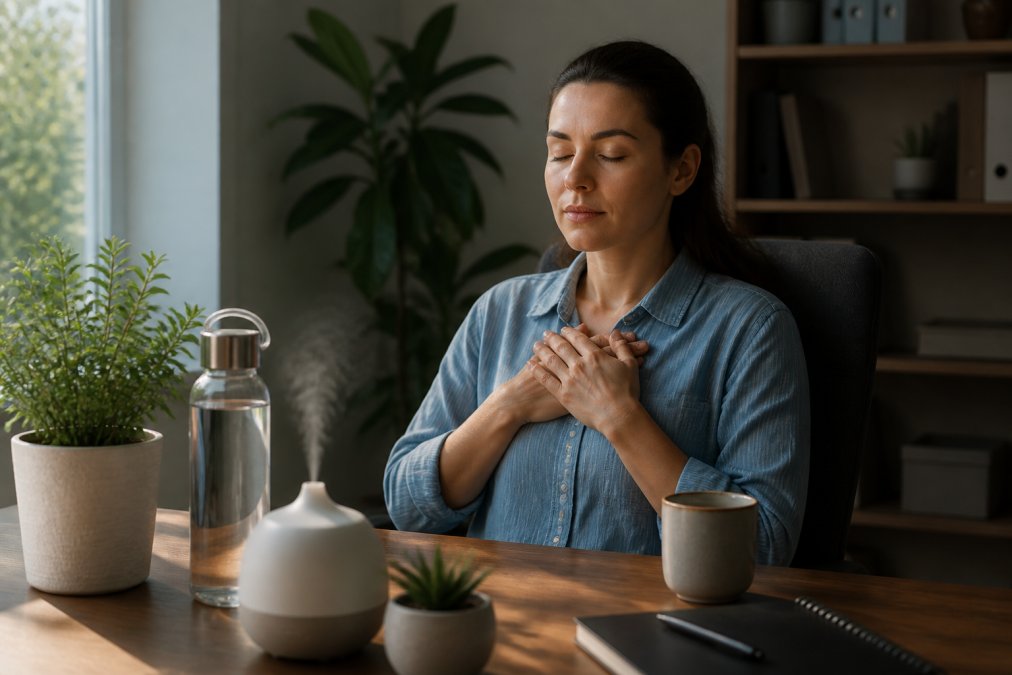
Morning routine (5 minutes):
- Hatch Restore 2 wakes you with light and sound (automated)
- Drink from your Hydro Flask while reviewing your Oura Ring readiness score (2 minutes)
- 3-minute Headspace meditation before opening email
Midday routine (5 minutes):
- Use Theragun Mini on neck and shoulders while on a call (2 minutes)
- Spray Vitruvi Stone Diffuser with peppermint oil (1 minute)
- Drink water (2 minutes)
Evening routine (10 minutes):
- Set Hatch Restore 2 wind-down routine (automated)
- 10-minute Calm Sleep Story
Total daily time: 20 minutes. This is achievable even during high-stress weeks.
You're not "doing wellness", you're doing your normal routine with better tools. The meditation isn't separate from your day, it's your morning. The muscle relief isn't a special session, it's something you do while working. This integration makes micro-routines stick when elaborate wellness plans fail.
Track consistency, not perfection. If you meditate 5 out of 7 days, that's 71% consistency. Most people quit after missing one day, but the actual pattern is you're doing this most days, and that's enough to see results.
In week one, you'll notice better sleep and slightly reduced stress. By week four, your focus improves and energy stabilizes. By week twelve, colleagues notice you seem calmer and more present. These are measurable physiological changes.
Building a sustainable wellness routine doesn't require overhauling your life. It requires tools designed for busy professionals that integrate into your existing schedule. At thewellbeingshop.com, we provide a curated selection of fitness equipment, mind-body training tools, and nutritional support designed to help you push your limits and achieve lasting life shifts. Start with one passive tool and one active habit. Track consistency over perfection. The routines that stick are the ones that fit your actual life.
Frequently Asked Questions
What are the best home wellness tools for someone with only 20-30 minutes per day?
Focus on tools that deliver results in short sessions: Muse 2 offers 3-minute guided meditations, Theragun Mini provides targeted muscle relief in under 5 minutes, and apps like Headspace have dedicated 10-minute routines. Wearables like Oura Ring and WHOOP 4.0 work passively in the background, tracking sleep and recovery without requiring active time. The key is choosing tools that integrate into your existing routine rather than adding time commitments.
Are wearable health trackers worth the investment for busy professionals?
Yes, when they solve a specific problem. Wearables provide objective data on sleep cycles, heart rate variability, and recovery status, metrics that help you make informed decisions about rest days and workout intensity. For busy professionals, this data prevents burnout and optimizes productivity. Oura Ring's discreet design and long battery life make it ideal for continuous monitoring without daily charging. WHOOP 4.0 emphasizes recovery metrics, helping you understand when your body is ready for strain.
How do wellness apps for busy schedules actually improve focus and energy?
Apps like Headspace and Calm reduce cortisol levels through guided meditation, which directly impacts mental clarity and sustained energy. Muse 2 uses real-time EEG biofeedback to train focus as a measurable skill. For energy management, light therapy devices like Hatch Restore 2 regulate circadian rhythm by mimicking natural sunrise, helping you wake alert and maintain consistent energy throughout the day. The key is consistency, even 5-10 minutes daily produces measurable improvements in cognitive function and stress-reduction.
What's the ROI of investing in home wellness tools if I'm skeptical about sticking with routines?
Start with habit-stacking tools that integrate into existing behaviors: pair Headspace with your morning coffee, use Theragun Mini after your shower, or set Hatch Restore 2 as your alarm. These require no additional time. Wearables like Oura Ring provide accountability through data, seeing your sleep score drop motivates behavior change naturally. The real ROI appears within 2-4 weeks: improved sleep quality reduces midday fatigue, better recovery allows consistent workouts, and stress-reduction tools improve focus. Choose one tool per category rather than buying everything at once.
This article was written using GrandRanker