
Best Meditation Cushions for Posture and Focus in 2026
Table of Contents
- Why Your Cushion Choice Decides Whether You Actually Sit
- Quick Comparison: Top Meditation Cushions for Posture and Focus
- Zafu vs Zabuton for Meditation: Which Shape Fixes Your Posture
- Meditation Cushion Height Guide: Matching Seat Height to Your Body
- How to Sit on a Meditation Cushion for Posture That Lasts Past 20 Minutes
- The Best Meditation Cushions for Posture and Focus: Our Top Picks
- Filling Materials and Firmness: What Actually Supports Your Spine
- Beyond the Cushion: Props That Complete Your Posture Setup
- Frequently Asked Questions
Last Updated: September 11, 2026
Why Your Cushion Choice Decides Whether You Actually Sit
Most people quit seated practice not because meditation is hard, but because their hips ache within ten minutes. The best meditation cushions for posture and focus solve that at the source: they tilt the pelvis forward, letting the spine stack itself instead of fighting gravity. At thewellbeingshop.com, we treat the cushion as equipment, not décor, and this guide breaks down shapes, heights, and fills so you can sit long enough for focus to arrive.
The core idea: when your hips sit higher than your knees, your pelvis rotates forward and your lumbar curve returns. When they don't, your lower back rounds, your breath shallows, and your attention follows your discomfort out the door.
Quick Comparison: Top Meditation Cushions for Posture and Focus
Match the cushion to your body and your floor: round zafus lift the hips for cross-legged sitting, flat zabutons protect the knees and ankles underneath, and mats create a stable base for both.
| Pick | Price | Best For | Standout Detail |
|---|---|---|---|
| Premium Buckwheat Meditation Cushion | $37.90 | Most sitters, most floors | Firm buckwheat fill, washable organic cotton cover |
| Premium Vibroacoustic Therapy Meditation Cushion Bundle | $699.99 | Nervous system reset, clinical or home use | Quad-transducer vibration, 20-200 Hz range |
| Cork & Natural Rubber Meditation Mat | $34.95 | Slippery floors, knees and ankles | Cork grip that improves as you warm up |
How We Evaluated These Cushions
We judged each option on hip elevation for neutral spinal alignment, fill durability over long sessions, breathability, and whether the cover is removable and washable. A cushion that flattens in three months is one you stop using, so we weighted natural fills and renewable materials above synthetic foam.
Zafu vs Zabuton for Meditation: Which Shape Fixes Your Posture
A zafu is the round, raised cushion that lifts your hips; a zabuton is the flat rectangular mat underneath that cushions knees and ankles. The zafu does the postural work; the zabuton prevents the joint pain that ends sessions early. Most sitters need both.
The zafu's job is pelvic tilt: a firm, elevated round cushion rotates the pelvis forward, restoring the lumbar curve so the vertebrae stack without muscular effort. A crescent shape suits sitters who get numb legs, since the cutout reduces pressure behind the knees. Buckwheat hulls hold their loft better than cotton batting, so the cushion keeps lifting you instead of compressing into a pancake.
The zabuton protects the contact points: on a hard floor, knees and ankles take the load, and a thin mat underneath turns a 15-minute sit into a 40-minute one.
Meditation Cushion Height Guide: Matching Seat Height to Your Body
Seat height is where most cushion purchases go wrong, and the reason is anatomical, not aesthetic. The goal is a slight anterior pelvic tilt, the top of your pelvis rolling forward so your lumbar curve returns and your vertebrae stack without effort (peer-reviewed research). How much lift that takes depends on how far your hip joint can open, governed by femoral neck orientation and hip flexor length. Two sitters of the same height can need very different cushions.
Diagnose your hip type before you buy
Sit on the floor cross-legged, with no cushion, and look at where your knees land relative to your hip crease.
- Knees well above the hips (tight hips): Your pelvis is rolling backward to compensate, flattening the lumbar curve. You need the most lift, 5 to 6 inches, sometimes more. This is the most common pattern in desk or car sitters, because prolonged hip flexion shortens the hip flexors and tightens the external rotators (PubMed).
- Knees roughly level with the hips (average): A standard zafu at 4 to 5 inches usually restores neutral, the range most round buckwheat cushions are built to.
- Knees below the hips (open hips): You already tilt forward on your own. Too much lift tips you backward and forces your core to grip to stay upright. Drop to 3 to 4 inches, or sit on a folded blanket.
- Kneeling or bench sitting: 6 to 8 inches so the hips clear the heels and the ankles aren't compressed.
The forward-fold test
To confirm your type, sit cross-legged and fold forward over your legs. If your torso barely clears your thighs and your lower back rounds hard, you have tight hips and need more elevation. If you fold easily and your belly reaches your thighs, you have open hips and need less. This predicts ideal cushion height more reliably than height or weight does.
Why more height isn't always better
An overstuffed cushion is the most common mistake. Past a certain point, extra loft doesn't tilt the pelvis forward, it raises you until your knees drop below your hips and you lean back to balance, reversing the lumbar curve and recruiting your spinal erectors to hold you up. Firm and correctly sized beats tall and plush every time.
Adjusting after you buy
If your buckwheat cushion arrives too tall, unzip the inner liner and scoop out hulls two cups at a time until your knees sit at or just below hip level. Store the removed hulls, as your hips open over weeks of practice, you'll likely want them back. This adjustability is a real advantage of buckwheat over foam.
How to Sit on a Meditation Cushion for Posture That Lasts Past 20 Minutes
Sit toward the front third of the cushion, cross your legs, and let the sit bones settle. Tilt the pelvis slightly forward until the lower back curve returns, then stack the spine. Shoulders roll back and down, chin tucks a hair, hands rest on the knees.
The posture that holds is the posture that requires the least work. If you're gripping your core to stay upright, you're fighting the cushion, not using it.
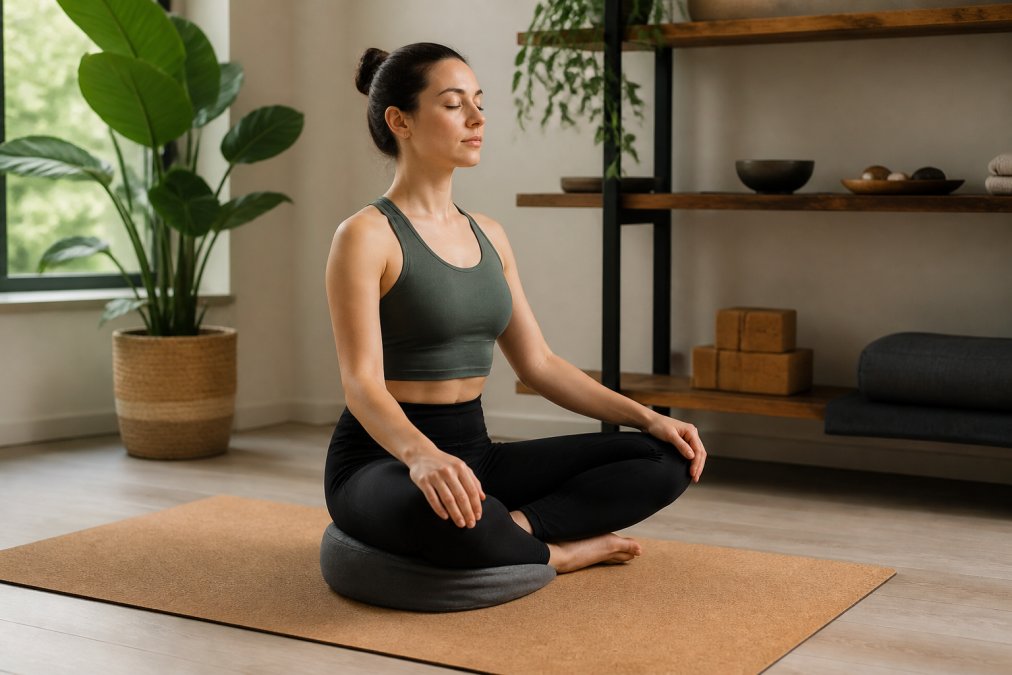
Three adjustments fix most discomfort:
- Lower back rounds: add height or scoot forward on the cushion.
- Knees ache: add a folded blanket or thin mat under them.
- Feet fall asleep: switch to a crescent cushion or lower your seat height.
Breath control follows alignment. When the spine stacks, the diaphragm has room to move, and the breath slows on its own. That's the mechanism behind the "focus" half of the equation: a supported spine produces a quieter nervous system, and a quieter nervous system is easier to concentrate.
The Best Meditation Cushions for Posture and Focus: Our Top Picks
Each of these three picks solves a different problem, and the right one depends on how you sit and what your body needs.
Premium Buckwheat Meditation Cushion: The Posture Workhorse
The Premium Buckwheat Meditation Cushion is our top pick for most sitters and the one I'd hand a beginner without hesitation. The buckwheat hull fill adapts to your body and holds its shape, so the cushion keeps providing hip elevation instead of flattening under you.
The organic cotton cover is removable and washable, which matters more than it sounds: a daily-use cushion collects sweat and dust, and washing the cover keeps it usable for years.
Pros:
- Firm buckwheat fill maintains hip elevation over time
- Removable, washable organic cotton cover
- Extra patterned cover included
- Works for cross-legged and kneeling postures
Cons:
- Buckwheat hulls shift and need occasional reshaping
- Heavier than foam alternatives
Premium Vibroacoustic Therapy Meditation Cushion Bundle: For Deep Nervous System Reset
If your problem isn't posture but a nervous system that won't settle, this bundle takes a different route. The Premium Vibroacoustic Therapy Meditation Cushion Bundle translates audio into physical vibration across a 20 Hz to 200 Hz range. It's a general wellness device, not a medical treatment, and the manufacturer is explicit that it isn't intended to diagnose or treat any condition.
Four tactile transducers deliver 60 watts RMS combined, with dual-layer memory foam that transmits vibration while cushioning pressure points. The 20" x 20" flat profile works on a chair, couch, or floor, and props vertically for lumbar support.
Pros:
- Deep mechanical vibration for grounding and relaxation
- Versatile flat profile for chair, couch, or floor use
- Removable, washable cover
Cons:
- Significant investment compared to a standard zafu
- Not suitable for people with pacemakers, during pregnancy, or with certain circulatory conditions
Cork & Natural Rubber Meditation Mat: The Sustainable Base Layer
The Cork & Natural Rubber Meditation Mat is the layer most people forget and then wish they'd bought first. Cork's subtle texture improves grip as you warm up, which matters on hard floors where a zafu slides and your knees take the punishment. The natural rubber base keeps the setup stable.
It's thin enough to sit under a zafu or bench but cushioned enough to soften contact points during kneeling or lying practice. Use it under your cushion, for light stretching, or as a defined area for breathwork.
Pros:
- Cork grip improves as it warms
- Natural rubber base stays put on hard floors
- Thin enough to layer under any cushion
- Renewable, eco-conscious materials
Cons:
- No hip elevation on its own; it's a base, not a seat
Filling Materials and Firmness: What Actually Supports Your Spine
Fill decides whether a cushion still supports you in six months. Here's how the common fills perform.
Buckwheat hulls
Buckwheat hulls are the best fill for posture because they interlock under your sit bones and hold firm, keeping the pelvis tilted forward instead of letting it sink (peer-reviewed research). They also let air move through, so the seat stays cooler than foam. The trade-off is maintenance: hulls shift and need occasional reshaping, and the cushion is heavier than foam.
Durability: Buckwheat is the longest-lasting common fill. Hulls don't compress the way batting does; they settle and can be topped up. A quality buckwheat zafu holds its loft for years with occasional refilling, while cotton and foam cushions in the same price band flatten within months of daily use. Over time hulls can crack into smaller pieces that pack tighter and reduce loft, at which point a partial refill restores the height.
Kapok fiber
Kapok is a plant fiber softer and lighter than buckwheat, suiting flexible sitters who want less lift and a plusher seat. It compresses faster than hulls under daily use, so it fits shorter or less frequent sessions better than a daily practice.
Cotton batting
Cotton batting is the softest and fastest to compress. It needs replacing soonest of any natural fill and offers the least postural support, bottoming out under the sit bones rather than holding them up.
Foam
Foam is the compromise: consistent density and no reshaping, but it loses rebound over time and eventually bottoms out. Memory foam can feel supportive on day one and dead by month six under a daily sitter.
Sustainability: what the labels actually mean
"Natural" on a product page tells you almost nothing. If sustainability matters, look for specific third-party certifications rather than marketing language:
- GOTS (Global Organic Textile Standard) on a cotton cover means the fiber was organically grown and processed to a verified standard, not just described as organic.
- Organic content claims on fill should be backed by a certification body; an uncertified "organic cotton" label is unverifiable.
- Natural rubber in a base layer is a renewable material, but check for a sustainability certification if the sourcing matters to you.
- Buckwheat and kapok are plant-based and biodegradable, which gives them an end-of-life advantage over synthetic foam.
Firmness is a posture decision, not a comfort preference
A firm cushion keeps your hips elevated through a full session; a soft one lets you sink until your lumbar curve disappears. If you can't test two cushions, take the firmer one. You can always remove buckwheat fill to soften the seat, but you can't add support to a cushion that's already flattened.
A note on long-term wear
Most reviews stop at the unboxing. The questions that matter are how the fill holds up after six months of daily sitting, whether the cover survives repeated washing, and whether seams and zippers stay intact. Look for a removable, washable cover and a fill you can top up or replace: that outlasts sealed, non-serviceable construction, regardless of material.
Beyond the Cushion: Props That Complete Your Posture Setup
Two additions close that gap: a mat under your cushion for knee and ankle comfort, and a posture corrector for the hours you're not sitting.
The Posture Corrector uses adjustable straps to pull the shoulders back and support spinal alignment during long sitting hours, and it's light enough to wear under clothing. The Posture Corrector Back Brace does the same job with a fit for both men and women. Neither replaces the cushion; they train the postural habits you bring to it.
For focus work off the cushion, the Ouroboros sensory meditation maze gives restless hands something to do while the mind settles, and a candle like the Forest State of Mind soy wax candle anchors a consistent start-of-session cue. Small habit triggers like these turn a cushion purchase into an actual practice.
Frequently Asked Questions
Do meditation cushions actually help with back pain?
They can help by raising your hips above your knees, which tilts the pelvis forward and restores the spine's natural curve. A buckwheat-filled cushion like the Premium Buckwheat Meditation Cushion adapts to your sit bones and holds firm, reducing the slumping that causes lower back strain. If pain persists past a few weeks, see a healthcare provider before assuming a cushion alone will fix it.
What is the difference between a zafu and a zabuton?
A zafu is the round or crescent cushion you sit on directly. It lifts your hips and supports the pelvis. A zabuton is a flat rectangular mat placed underneath the zafu to cushion your knees and ankles from the floor. Most people need both for longer sits, though a cork mat like the Cork & Natural Rubber Meditation Mat can serve a similar base-layer role.
How do I choose the right height for a meditation cushion?
Sit on the cushion and check whether your hips sit higher than your knees. If they don't, add height. A good starting point is 4 to 6 inches for most adults, with taller cushions for tighter hips or longer legs. Buckwheat filling lets you remove or add hulls to fine-tune the height, which is why adjustable cushions work better than fixed foam ones.
Are meditation cushions with back support better for focus?
Back support can help if you tend to slump after 15 minutes, since slouching triggers drowsiness and breaks concentration. But the goal is to build your own postural strength over time. A firm cushion that promotes spinal alignment, paired with a posture corrector for 30 to 60 minutes a day during desk work, trains the muscles you need to sit upright without relying on a backrest.
What is the best type of meditation cushion for beginners?
Beginners usually do best with a buckwheat zafu around 5 inches tall, placed on a mat or zabuton. Buckwheat holds its shape, so you won't sink and lose your pelvic tilt the way you might with soft foam. Start with 10-minute sits and add time as your hip flexors and back muscles adapt. If cross-legged sitting is uncomfortable, a crescent-shaped cushion takes pressure off the ankles.
Sitting still shouldn't hurt, and if it does, the fix is usually equipment, not willpower. The Well Being Shop curates mind-body tools built for exactly this problem: a firm buckwheat cushion that keeps your hips elevated, a cork and rubber mat that protects your knees on hard floors, and posture correctors that train alignment during the hours you're not sitting. Get started with thewellbeingshop.com and build a seated practice that lasts past the first twenty minutes.