
Resistance Bands vs Dumbbells for Home Fitness
Table of Contents
- Resistance Bands vs Dumbbells: Key Differences at a Glance
- How Resistance Bands and Dumbbells Compare for Muscle Building
- Joint Stress and Injury Prevention: Which Is Safer?
- Best Home Gym Equipment for Small Spaces: Storage and Portability
- Progressive Overload with Resistance Bands: Tracking and Techniques
- Effective 20 Minute Home Workout Routines Using Bands and Dumbbells
- Which Should You Choose? A Decision Framework
- Conclusion: Building Your Home Strength Setup
- Frequently Asked Questions
Last Updated: September 10, 2026
Resistance Bands vs Dumbbells: Key Differences at a Glance
The resistance bands vs dumbbells for home fitness debate comes down to one core distinction: dumbbells deliver constant load through a fixed mass, while bands deliver variable load that peaks at the end of each rep. That single mechanical difference shapes everything else, including joint stress, portability, and how you track progress. This guide from thewellbeingshop.com breaks down both tools so you can build a home setup that actually fits your space and your goals.
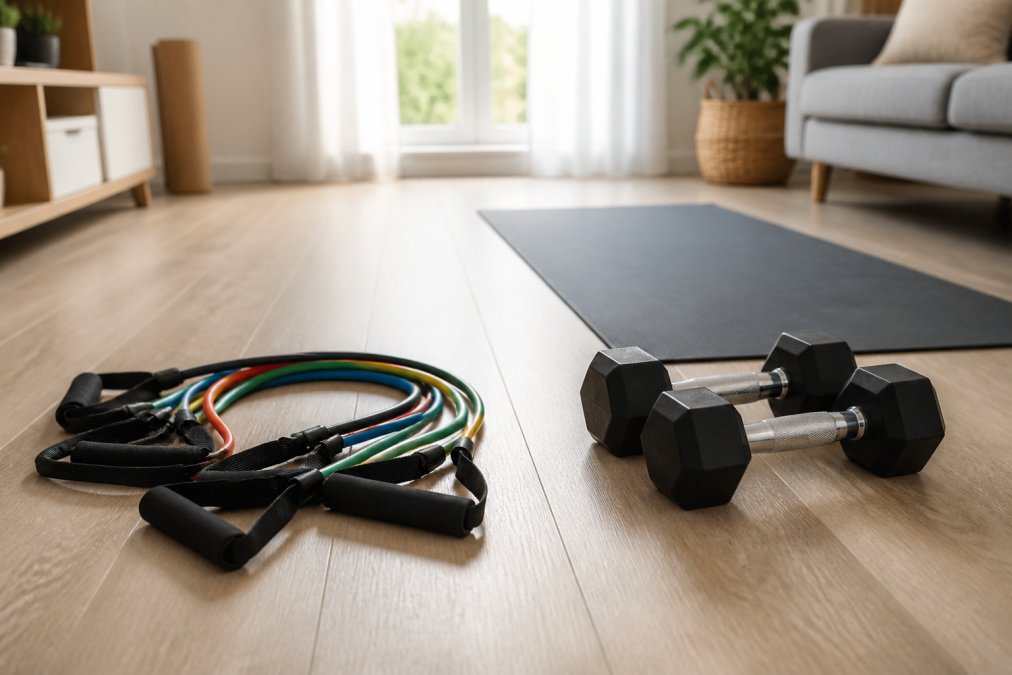
Here's what matters most before you buy either:
| Factor | Resistance Bands | Dumbbells |
|---|---|---|
| Resistance type | Variable (peaks at end range) | Constant (fixed mass) |
| Storage footprint | Folds into a drawer | Needs a rack or floor space |
| Joint stress | Lower at start, higher at lockout | Even throughout the rep |
| Best for | Portability, rehab, travel | Heavy loading, precise tracking |
The American Council on Exercise guide to resistance training notes that both tools build strength when progressive overload is applied consistently, which is the variable most people ignore.
How Resistance Bands and Dumbbells Compare for Muscle Building
Dumbbells win on raw hypertrophy potential because you can load them heavier and measure every increment. Bands still build muscle, but the resistance profile changes where the challenge lands within each rep, and that changes which muscles get the stimulus.
The Three Drivers of Hypertrophy
Muscle growth responds to three mechanical inputs: mechanical tension, metabolic stress, and muscle damage. Both tools can produce all three, but they distribute them differently.
- Mechanical tension is the primary driver. Dumbbells apply constant tension from the concentric phase through the eccentric phase, so the hardest point of the lift is wherever your leverage is weakest, usually the mid-range or the bottom. Bands do the opposite: tension is lowest at the start and highest at full contraction. That means band training emphasizes the lockout, while dumbbells challenge the mid-range where most muscle fiber recruitment happens.
- Metabolic stress comes from rep volume and short rest. Bands are excellent here because you can run high-rep sets to failure with almost no setup time between exercises. A band set of 20 lateral raises takes seconds to reset; a dumbbell set requires re-racking and re-gripping.
- Muscle damage is driven by loaded stretch under tension. Dumbbells let you load a deep stretch position (think a dumbbell fly at the bottom) with heavy weight. Bands can't match that because tension drops to near zero when the band is slack at the start of the range.
Strength Curves: Why the Tool Should Match the Lift
Every exercise has a strength curve, the point in the range where you're mechanically strongest. A dumbbell bench press is hardest at the bottom (chest stretched, poor leverage) and easiest at lockout (arms stacked, triceps engaged). A band bench press is the reverse: easy at the bottom, hardest at lockout.
That mismatch is why serious lifters pair the tool to the lift:
- Dumbbells for lifts that are hardest at the bottom: bench press, overhead press, Romanian deadlift, bent-over row.
- Bands for lifts that are hardest at the top: banded squats, banded hip thrusts, band pull-aparts, face pulls, and any movement where you want accommodating resistance at lockout.
Rep Ranges and Loading
For hypertrophy, most practitioners target 6-20 reps per set taken close to failure. Dumbbells make this easy to program because you can add 5 pounds and know exactly what changed. Bands make it harder because the same band produces different tension at different lengths, a light band stretched to 100% of its length can feel heavier than a medium band stretched to 50%.
A practical rule: treat a band set as effective if the last 2-3 reps are a genuine struggle and you can't complete another rep with clean form. If you can grind out 5 more, the band is too light or you're standing too close to the anchor.
Hypertrophy and Strength Gains: The Honest Verdict
For measurable strength gains on compound lifts, dumbbells have the edge because load is quantifiable and repeatable. You can add 5 pounds and know exactly what changed. Bands stretch out over time, so the same band may feel different after months of use, a real problem for tracking.
For muscle size, the gap narrows. A review of resistance training research found that band training produces hypertrophy comparable to free weights when volume and effort are equated, the tool matters less than whether you're pushing close to failure (PubMed). Many lifters find that a hybrid approach works best: heavy dumbbells for compound movements and bands for accessory work, stabilizer muscles, and high-rep finishers.
Joint Stress and Injury Prevention: Which Is Safer?
Bands are generally gentler on joints at the start of a movement, which makes them a common tool in rehabilitation. Dumbbells load the joint evenly, which builds tolerance but punishes poor form.
The trade-off is real. Band resistance is lowest when your joint is most vulnerable (the bottom of a press, for example) and highest at lockout, where the joint is stacked and stable. Dumbbells do the reverse: maximum stress at the bottom, minimum at lockout. For anyone with existing joint stress or returning from injury, bands let you train through a fuller range of motion with less risk. For healthy lifters chasing strength, dumbbells build the connective tissue resilience that bands can't replicate.
Best Home Gym Equipment for Small Spaces: Storage and Portability
Bands beat dumbbells on space, full stop. A full set of bands fits in a shoebox; a comparable dumbbell range needs a rack and a corner of the room.
If you live in a small apartment or share your workout space with a home office, this matters more than any performance metric. A CDC overview of physical activity for adults reinforces that the best routine is the one you can actually do consistently, and equipment you have to move out of the way every session gets skipped.
For a middle ground, an Adjustable Dumbbell Set ($185.36) replaces a whole rack with one pair that dials from light to heavy. Pair it with a compact Six-Tube Pedal Tension Rope ($10.00) for band-style variable resistance, and you cover both profiles without surrendering your floor.
Progressive Overload with Resistance Bands: Tracking and Techniques
Progressive overload with resistance bands requires tracking variables other than weight, because the band itself doesn't tell you how hard you're working. This is the biggest gap in most band-training advice, and the reason most band users plateau within eight weeks.
Why Bands Break Standard Progression
With dumbbells, progression is simple: add weight, add reps, or add sets. With bands, the resistance at any moment depends on three things at once, the band's rated tension, how far it's stretched, and how many bands you've stacked. Change any one and the load changes. That's why "just use a heavier band" is bad advice: a heavier band stretched less can produce less tension than a lighter band stretched more.
A Quantifiable Tracking Framework
You don't need a force gauge to track band progression. You need to fix the variables you can control and log them consistently. Use this four-column log:
| Column | What to record | Example |
|---|---|---|
| Band + color | Which band, and how many stacked | "Red medium + green light" |
| Anchor distance | Distance from anchor to your hands or feet, in inches | "36 inches" |
| Reps × sets | Total reps completed with clean form | "3 × 12" |
| RPE | Rate of perceived exertion, 1-10 | "8" |
With those four columns, you can progress in a measurable way even without poundage numbers. Moving your feet 6 inches further from the anchor is a real load increase you can repeat next week. Adding a second band is a real load increase. Slowing the eccentric to four seconds is a real increase in time under tension.
The Four Progression Levers, In Order
Apply these in sequence. Don't jump to the next lever until the current one stalls.
- Reps and sets: Add one rep per set each week before adding resistance. When you hit 3 × 15 with clean form, move to lever two.
- Anchor distance: Step 6 inches further from the anchor point. This increases stretch and therefore tension at every point in the range. Re-test your rep max at the new distance.
- Band stacking or upgrade: Add a second lighter band to your working band, or move up one color. Re-test again.
- Tempo and range of motion: Slow the eccentric phase to three or four seconds and increase the stretch at the start of each rep. This is the last lever because it's the hardest to quantify.
Marking Your Anchor Point
Tape a small mark on the floor where your anchor sits, and a second mark where your feet or hands start each set. Note the distance in your log. Without those marks, you'll drift, most people unconsciously shorten their stance when a set gets hard, which quietly reduces the load and stalls progress.
When to Switch Tools
If you've maxed out all four levers on a given exercise and still aren't progressing, that's your signal to move to dumbbells for that movement. Bands are excellent for the first 8-12 weeks of a program and for accessory work indefinitely, but heavy compound lifts eventually need quantifiable external load to keep driving adaptation.
Effective 20 Minute Home Workout Routines Using Bands and Dumbbells
Effective 20 minute home workout routines work when they pair a compound movement with bands and a dumbbell movement that hits the same pattern from a different angle. Twenty minutes is enough if you cut rest and keep the intensity honest.
Here's a template that alternates both tools:
- Minutes 0-4: Band squats, 3 sets of 12
- Minutes 4-8: Dumbbell floor press, 3 sets of 10
- Minutes 8-12: Band rows, 3 sets of 12
- Minutes 12-16: Dumbbell Romanian deadlifts, 3 sets of 10
- Minutes 16-20: Band lateral raises and core work, 2 rounds
This structure hits every major muscle group and keeps your heart rate up. Adjust the dumbbell weight so the last two reps of each set feel genuinely hard.
Which Should You Choose? A Decision Framework
Choose dumbbells if your priority is measurable strength and heavy compound movements. Choose bands if portability, joint comfort, or limited space drives your decision. Most home lifters get the best results from both.
Run your situation through these questions:
- Do you have under 10 square feet of storage? Bands.
- Are you chasing a specific strength number? Dumbbells.
- Are you rehabbing a joint? Bands first, then dumbbells.
- Do you want one purchase that covers everything? An adjustable set.
The honest answer for most people is a hybrid: a pair of adjustable dumbbells for the main lifts and a band set for warm-ups, accessory work, and travel days.
Conclusion: Building Your Home Strength Setup
The hardest part of home strength training isn't choosing between resistance bands vs dumbbells. It's building a setup you'll actually use past week two. The Well Being Shop curates equipment for exactly that problem, from adjustable dumbbells that replace a full rack to compact tension tools that store under a couch. Start with one tool, log every session, and add the second once the habit sticks. Get started with thewellbeingshop.com and build a home strength routine that lasts longer than your motivation.
Frequently Asked Questions
Can I build muscle with just resistance bands?
Yes, research shows that resistance bands can stimulate muscle growth when you apply progressive overload and train close to failure. A review found similar hypertrophy outcomes between bands and weights when training volume and effort are matched. The key is using enough resistance and controlling the eccentric phase to create mechanical tension. Bands work best for high-rep sets and accessory movements, while dumbbells still hold an edge for heavy compound lifts like squats and presses.
Are resistance bands safer than dumbbells for beginners?
Bands are generally more forgiving because resistance increases gradually as you stretch them, reducing joint stress at the start of a movement. This makes them a good choice for rehabilitation and for people with sensitive joints. Dumbbells, however, teach proper bracing and stabilizer muscle engagement, which can prevent injuries long-term. Beginners should start with light bands or 10 lb dumbbells and focus on controlled range of motion before adding load.
What are the downsides of resistance bands compared to dumbbells?
Bands offer variable resistance, meaning the tension peaks at the end of the range of motion, which can make it harder to track progress precisely. They also wear out over time and can snap if damaged. Dumbbells provide constant linear resistance and are easier to measure with exact weights. For heavy lower-body lifts like deadlifts or squats, dumbbells are more practical because bands may not provide enough load for advanced lifters.
How do I use progressive overload with resistance bands?
You can progress with bands by choosing thicker bands, doubling up bands, shortening the band to increase tension, or slowing down the eccentric phase to extend time under tension. Tracking reps and sets in a journal helps you apply progressive overload just as you would with dumbbells. For example, if you can complete 3 sets of 15 band rows with ease, move to a heavier band or add a pause at peak contraction.
Which is better for a small home gym: bands or dumbbells?
Bands win on pure space efficiency because they fold into a drawer and cost a fraction of dumbbells. However, adjustable dumbbells like the Adjustable Dumbbell Set replace an entire rack and take up about the same footprint as a pair of shoes. For most small spaces, a hybrid approach works best: one set of adjustable dumbbells for heavy compound movements and a set of bands for mobility, warm-ups, and isolation exercises.
This article is for general information only and is not medical advice. Consult a qualified healthcare provider before starting a new exercise program, especially if you have an existing injury or health condition.