
Plant-Based Protein vs Whey for Women Over 50
Table of Contents
- Plant-Based Protein vs Whey for Women Over 50: A Direct Comparison
- Protein Requirements for Women Over 50: How Much Do You Actually Need?
- Digestibility of Whey vs Plant Protein: What Changes After 50
- Best Protein Powder for Muscle Mass After 50: Key Selection Criteria
- Bone Density Support: The Nutrient Profile That Matters Most
- Protein Interactions With Common Medications for Women Over 50
- Conclusion
- Frequently Asked Questions
Last Updated: September 12, 2026
Plant-Based Protein vs Whey for Women Over 50: A Direct Comparison
The protein women over 50 conversation changes after 50, and it changes differently for women. Muscle mass declines roughly 1% per year after age 50, and women lose muscle faster than men during the menopause transition, according to research summarized by the National Institute on Aging. This guide from thewellbeingshop.com compares plant-based protein powders and whey head-to-head for women over 50, so you can pick the option that actually supports muscle, bone, and daily energy.
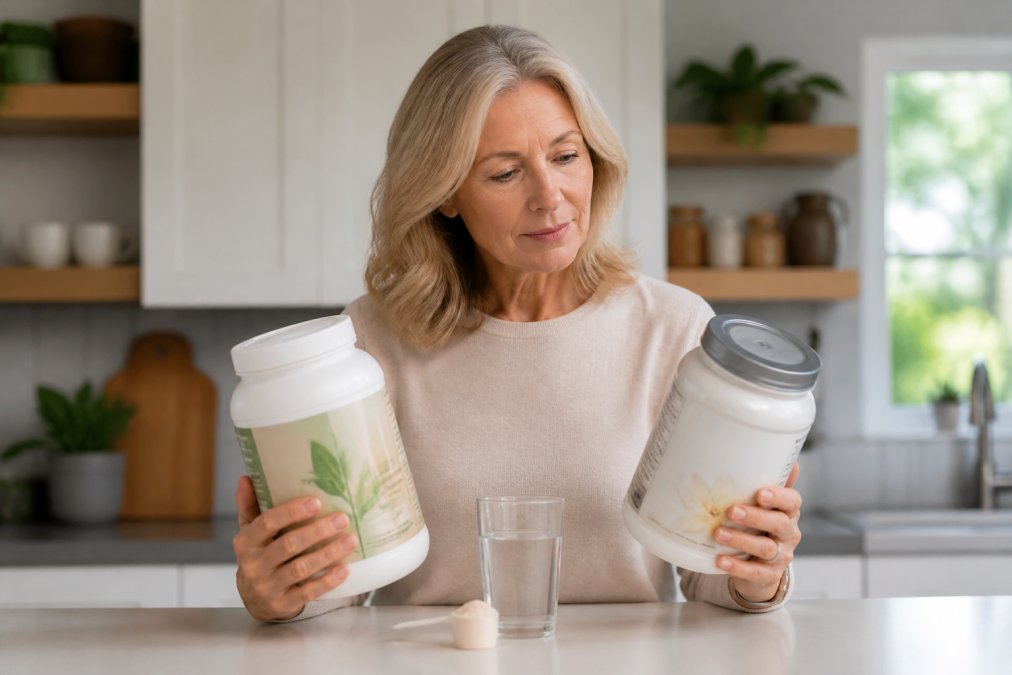
Here is the short version: whey wins on leucine content, absorption rate, and muscle protein synthesis. Plant blends win on fiber, phytonutrients, and digestive comfort for lactose-sensitive women. The right pick depends on your gut, your goals, and your medication list.
| Factor | Whey Protein | Plant-Based Protein |
|---|---|---|
| Amino acid profile | Complete, high leucine | Variable; blends needed |
| Bioavailability | Fast absorption | Slower, lower |
| Fiber | Little to none | Prebiotic fiber present |
| Lactose | Present in concentrate | Naturally lactose-free |
| Best for | Muscle preservation | Gut comfort, plant diets |
The Hormonal Shift That Changes Everything
Estrogen decline after menopause reduces the body's ability to build muscle from the same protein dose. This is called anabolic resistance, and it means protein women over 50 need more leucine per meal to trigger muscle protein synthesis. Whey isolate delivers leucine densely in a small scoop. Most single-source plant proteins, including pea and brown rice, fall short unless blended.
Protein Requirements for Women Over 50: How Much Do You Actually Need?
Most women over 50 need more protein than the standard adult recommendation, not less. A common target is 1.2 to 1.6 grams per kilogram of body weight daily, spread across three or four meals, with 25 to 30 grams per meal to clear the leucine threshold (PubMed). A woman weighing 70 kilograms lands around 84 to 112 grams per day. Hitting that on food alone is hard, which is why a protein powder earns its place in a daily routine.
Anabolic Resistance and the Leucine Threshold
Leucine is the amino acid that flips the muscle-building switch. Younger adults respond to roughly 2.5 grams per meal; post-menopausal women often need closer to 3 grams because of anabolic resistance. Whey isolate clears that bar easily. Pea protein sits lower per gram, so plant users typically need a larger scoop or a blended formula combining pea, soy, and brown rice to reach the same trigger.
Digestibility of Whey vs Plant Protein: What Changes After 50
Digestibility is where the comparison flips. Whey isolate absorbs fast, but it carries lactose unless it is specifically filtered to remove it. Plant proteins bring prebiotic fiber and are naturally lactose-free, which matters because lactose intolerance becomes more common with age. Many women find plant blends produce less gastrointestinal distress, though pea and soy can cause bloating in the first week as gut bacteria adjust.
Lactose Intolerance, Bloating, and Gastrointestinal Distress
If dairy leaves you bloated or gassy, whey isolate is a better bet than whey concentrate, and plant protein is better still. Start with a half scoop for the first week regardless of type. Sudden full doses of any powder, plant or whey, are the most common cause of the bloating people blame on the protein itself.
Best Protein Powder for Muscle Mass After 50: Key Selection Criteria
The best protein powder for muscle mass after 50 is a whey isolate or a blended plant formula with at least 2.5 to 3 grams of leucine per serving. Check these five things before you buy:
- Leucine per serving: aim for 2.5g minimum, ideally 3g
- Protein per scoop: 20 to 25 grams
- Third-party testing: look for heavy metal screening on plant proteins
- Added sugar: keep it low, especially if managing blood sugar
- Mixability: a powder you dread drinking gets abandoned
For women who want a whey option with verified specs, the Optimum Gold Standard Isolate Protein 930 Gr delivers 25 grams of isolate protein, 5.5 grams of BCAAs, and 11.4 grams of essential amino acids per serving, with only 1.3 grams of carbohydrate. That amino acid density is exactly what the leucine threshold demands.
Heavy Metal Testing in Plant Proteins
Plant proteins absorb heavy metals from soil, so cadmium and lead can appear in rice and pea crops. This is a real gap most comparison guides skip. Choose brands that publish third-party lab results, and rotate your plant sources rather than relying on brown rice protein alone. Whey is not immune, but it generally tests cleaner because dairy is more tightly regulated.
Bone Density Support: The Nutrient Profile That Matters Most
Bone loss and muscle loss travel together after menopause, and most protein comparison articles ignore the connection entirely. That is a mistake. Bone mineral density drops sharply in the first five to seven years after the final menstrual period, and protein is one of the few dietary levers that supports both the muscle that pulls on bone and the bone matrix itself.
Why Protein Matters for Bone, Not Just Muscle
Roughly half of bone by volume is protein, mostly type I collagen, and the rest is mineral, primarily calcium and phosphate. Protein intake supports the osteoblasts that build new bone, and it supports the muscle mass that loads the skeleton and signals bone to stay dense. Women who lose muscle after menopause tend to lose bone on a similar timeline.
A common target is 1.0 to 1.2 grams of protein per kilogram of body weight daily for bone support, which overlaps neatly with the 1.2 to 1.6 grams per kilogram target for muscle preservation. In other words, the same daily protein goal serves both systems. The question is which powder helps you hit it without leaving gaps in the supporting nutrients.
What Whey Brings to the Bone Equation
Whey is a dairy protein, and dairy carries calcium naturally. A 25-gram scoop of whey isolate typically contributes a modest amount of calcium, often in the 100 to 150 milligram range depending on the filtration method, plus the full complement of essential amino acids. It does not carry vitamin D unless it is fortified, and it does not carry vitamin K. Those have to come from elsewhere in the diet or from a separate supplement.
What Plant Proteins Bring, and What They Miss
Plant proteins are naturally low in calcium unless they are fortified. Pea and rice isolates contribute very little on their own. Many commercial plant blends add calcium carbonate or calcium citrate to close the gap, but the label does not always make the fortification obvious, so read the supplement facts panel rather than the front of the tub.
Plant proteins do have one bone-relevant advantage: leafy green sources and some blends carry vitamin K, which is involved in osteocalcin activation, the process that binds calcium into the bone matrix. The trade-off is that vitamin K interacts with warfarin and other vitamin K antagonist blood thinners, which is covered in the medication section below.
| Bone-Support Nutrient | Whey Isolate (typical 25g scoop) | Plant Blend (typical 25g scoop) |
|---|---|---|
| Calcium | Naturally present, ~100-150 mg | Low unless fortified |
| Vitamin D | Only if fortified | Only if fortified |
| Vitamin K | Minimal | Present in green-source blends |
| Magnesium | Low | Higher in some blends |
| Complete amino acids | Yes | Only if blended |
The Practical Routine
Whichever powder you choose, bone support is a stack, not a single ingredient. Protein from the shake, calcium from food or a supplement, vitamin D from sun exposure or a supplement, and weight-bearing exercise together do more than any one of them alone. A woman who hits her protein target with whey but never lifts a weight is not protecting her bone density as well as a woman who hits the same target with a fortified plant blend and trains twice a week.
Protein Interactions With Common Medications for Women Over 50
Protein powders can interact with common medications, and most articles ignore this entirely. Whey and plant proteins both contain calcium, which can interfere with thyroid medication and some antibiotics if taken at the same time. High-dose protein also matters for women on blood thinners, because vitamin K in green plant blends can shift INR readings. Separate your protein shake from thyroid medication by at least four hours, and tell your pharmacist what supplements you take.
For women juggling a busy schedule, the 2-in-1 Whey Protein Isolate + Creatine Travel Packets make consistent dosing simple: 25 grams of whey isolate with 5.9 grams of BCAAs and 5 grams of creatine monohydrate per single-serve packet, no scooping required. Creatine pairs well with protein for supporting muscle and, as research on creatine and aging muscle suggests, may help preserve strength with age.
Conclusion
Choosing between plant-based protein powders and whey for women over 50 comes down to your gut, your goals, and your medication list, not marketing. Whey isolate wins on leucine and muscle support; plant blends win on digestive comfort and fiber. Whichever you choose, pair it with a routine that supports the whole body, not just the scoop.
Frequently Asked Questions
Is whey or plant protein better for muscle retention after 50?
Whey protein generally supports muscle retention more efficiently because it has a higher leucine content and faster absorption rate. Leucine triggers muscle protein synthesis, which becomes harder to activate after 50 due to anabolic resistance. That said, plant-based blends combining pea and rice protein can deliver a complete amino acid profile with adequate leucine if you choose a quality product. The best protein powder for muscle mass after 50 is one you will actually use consistently, whether that is whey isolate or a well-formulated plant blend.
Does whey protein cause more bloating for women over 50?
Whey protein can cause gastrointestinal distress in women who are lactose intolerant, a condition that becomes more common with age. Whey isolate contains very little lactose compared to whey concentrate, so it is often tolerable. Plant proteins like pea and brown rice are naturally lactose-free and may cause less bloating. If you experience discomfort, try a whey isolate first, and if symptoms continue, switch to a plant-based protein powder.
How much protein do women over 50 need daily?
Research suggests women over 50 need more protein than younger adults to preserve muscle mass. General guidelines recommend 1.2 to 1.6 grams of protein per kilogram of body weight daily, compared to 0.8 grams for younger adults. For a 150-pound woman, that is roughly 82 to 109 grams per day. Spreading intake across three to four meals, with 25 to 30 grams per meal, helps overcome anabolic resistance and supports muscle protein synthesis more effectively than one large dose.
Are plant-based proteins complete proteins?
Most single-source plant proteins are not complete proteins because they lack one or more essential amino acids. Pea protein is low in methionine, while brown rice protein is low in lysine. However, blending complementary plant sources, such as pea and rice, creates a complete amino acid profile comparable to whey. Soy protein and hemp protein also offer broader profiles. Check the label for a blend rather than a single source if completeness matters to you.
What should women over 50 look for in a protein powder label?
Focus on protein content per serving (aim for 20 to 30 grams), leucine content (at least 2.5 grams to trigger muscle protein synthesis), and added nutrients like calcium and vitamin D for bone mineral density. Check for third-party testing to confirm heavy metal testing in plant proteins. Avoid products with excessive added sugar. Lactose-free options or whey isolate work well for sensitive stomachs. A product like Optimum Gold Standard Isolate Protein offers 25 grams of protein with 5.5 grams of BCAAs per serving.
The real challenge is not picking a powder. It is building a daily routine you will actually keep. thewellbeingshop.com curates the tools that make that routine stick, from verified whey isolate with the amino acid density your muscles need to herbal formulas like Bella® that support hormonal balance and calcium absorption through the menopause transition. Get started with thewellbeingshop.com and turn small, intentional habits into lasting strength.