


 Link label

Can 20-Minute Workouts Build Real Strength? The Science Explained
Table of Contents
- Can 20-Minute Workouts Build Real Strength? What the Science Shows
- The Minimum Effective Dose for Muscle Growth
- Progressive Overload in Short Workouts
- Full-Body Dumbbell Workouts for Maximum Efficiency
- Consistency Over Duration: Why Frequency Matters More Than Length
- Overcoming the 'More Is Better' Myth in Strength Training
- Real Strength Gains from 20 Minutes: What Success Actually Looks Like
- Conclusion
Last Updated: August 4, 2026
Can 20-Minute Workouts Build Real Strength? What the Science Shows
Whether 20-minute workouts build real strength depends on how you structure those minutes, the intensity you bring, and your consistency over time. Research from American College of Sports Medicine confirms that properly structured short workouts can stimulate muscle growth and strength adaptation when intensity and exercise selection are optimized. The key differentiator is progressive overload, the systematic increase in training demand over weeks and months.
A focused 20-minute session using compound movements and high intensity produces measurable strength gains comparable to longer, lower-intensity workouts. This article breaks down the physiology, shows you how to structure these sessions for maximum efficiency, and addresses the specific objections that keep people from committing to short-duration training.
How Intensity Compensates for Shorter Duration
Time is not the limiting factor in strength development; stimulus is. When you compress your workout into 20 minutes, you must increase intensity to create sufficient training stimulus. A 30-minute moderate-intensity session and a 20-minute high-intensity session can produce nearly identical strength adaptations if total training load remains similar.
High-intensity interval training and time-under-tension protocols work because they force your muscles to recruit more motor units in less time. When you perform a compound movement at 80-85% of your maximum effort with minimal rest, your nervous system activates more muscle fibers than a lighter movement performed longer. This activation triggers muscle protein synthesis, mitochondrial growth, and neural adaptation.
Rest intervals matter enormously in 20-minute sessions. Traditional strength training uses 2-3 minute rest periods between heavy sets. In a condensed session, use 45-60 second rest intervals instead. This forces higher intensity per rep and greater metabolic conditioning without sacrificing strength gains.
:::pro tip If you're moving slowly between exercises or resting longer than 90 seconds in a 20-minute session, you're wasting time you don't have. Set a timer, know your exercises in advance, and treat transitions like part of the workout. :::
Muscle Fiber Recruitment in Condensed Sessions
Your muscles contain three primary fiber types. Type I fibers (slow-twitch) activate at low intensity. Type II fibers (fast-twitch) activate only when demand is high. Building strength requires recruiting Type II fibers consistently, which happens naturally when intensity is high enough.
In a 20-minute session, you need to reach high intensity quickly and maintain it. This forces earlier recruitment of Type II fibers compared to longer, lower-intensity sessions, resulting in greater muscle fiber recruitment per minute of training.
Compound movements amplify this effect. Exercises like goblet squats, dumbbell deadlifts, and push-ups recruit multiple muscle groups simultaneously, activating more total motor units than isolation exercises. In a time-constrained session, compound movements are non-negotiable because they deliver maximum stimulus per exercise.
Research from Journal of Applied Physiology shows that total muscle fiber recruitment, not duration, predicts strength adaptation. A 20-minute session using heavy compound movements recruits as many muscle fibers as a 45-minute session using lighter isolation exercises.
The Minimum Effective Dose for Muscle Growth
Building muscle requires a minimum training stimulus. Below that threshold, adaptation doesn't occur. Research indicates that a single set of an exercise performed to near-maximum effort produces measurable strength gains. Multiple sets accelerate adaptation, but the difference between one set and three sets performed at high intensity is smaller than the difference between zero sets and one set.
Time-under-tension, the total seconds a muscle spends under load during a set, is critical. A set lasting 30-45 seconds creates sufficient mechanical tension and metabolic stress to trigger adaptation. In a 20-minute session, you might perform 8-12 total sets across all exercises, each lasting 30-50 seconds, totaling 4-10 minutes of actual time-under-tension.
Moderate rep ranges (8-12 reps) are ideal for condensed workouts because they allow shorter rest intervals while maintaining high intensity, unlike heavy strength training (3-6 reps) which requires longer recovery periods.
Progressive Overload in Short Workouts
Strength gains plateau without progressive overload, the systematic increase in training demand over time. You can progress in a 20-minute session through multiple mechanisms: adding weight, increasing reps, decreasing rest intervals, increasing total sets, or improving movement quality.
In a 20-minute constraint, decreasing rest intervals is often the most practical progression method. If you rested 90 seconds between sets last week and 75 seconds this week, you've increased training density, more total work in the same timeframe.
Track the weight, reps, and rest interval for each exercise after every session. Review weekly. If any number increased, you've created progressive overload. Consistency in tracking is more important than sophisticated metrics.
| Progression Method | How to Apply | Timeframe |
|---|---|---|
| Increase weight | Add 5-10% load each week when you hit target reps | Weekly |
| Increase reps | Perform one extra rep per set each session | Each workout |
| Decrease rest | Reduce rest interval by 15 seconds each week | Weekly |
| Increase range | Deepen squat depth or extend push-up range | Each workout |
| Add volume | Perform one extra set per exercise each week | Weekly |
Full-Body Dumbbell Workouts for Maximum Efficiency
Dumbbells are ideal for 20-minute strength training because they allow fast transitions, require minimal setup, and demand stabilizer muscle recruitment. The core movements for a full-body dumbbell session are goblet squats, dumbbell deadlifts, dumbbell rows, and dumbbell chest presses.
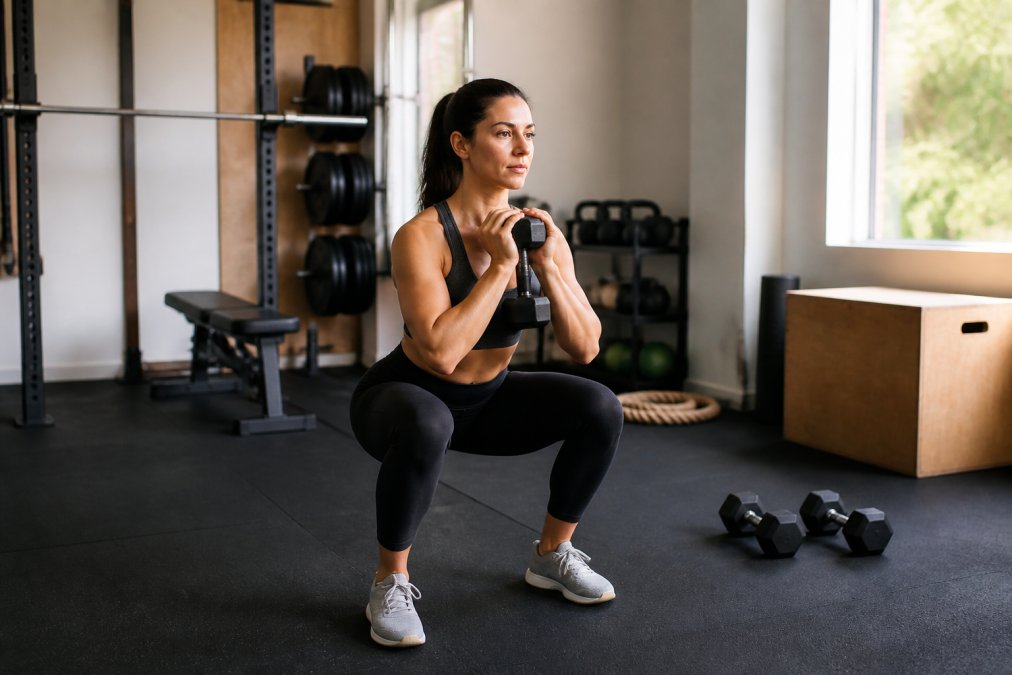
A sample 20-minute structure: perform each exercise for 40-50 seconds at high intensity, rest 60 seconds, then move to the next exercise. Complete two rounds of four exercises, taking approximately 18-20 minutes including transitions. This delivers 8 total sets with sufficient rest to maintain quality form and intensity.
Round 1 & 2:
- Goblet squats: 45 seconds (target 12-15 reps)
- Rest: 60 seconds
- Dumbbell rows: 45 seconds (target 10-12 reps per side)
- Rest: 60 seconds
- Dumbbell chest press: 45 seconds (target 10-12 reps)
- Rest: 60 seconds
- Dumbbell deadlifts: 45 seconds (target 8-10 reps)
- Rest: 60 seconds
Choose a dumbbell weight heavy enough that you reach near-maximum effort by the final reps. Target 1-3 reps remaining in reserve at the end of each set.
:::pro tip Set up your space before starting. Have dumbbells positioned where you need them, clear the floor of obstacles, and know your sequence. Wasted setup time cuts into training time and kills momentum. :::
Consistency Over Duration: Why Frequency Matters More Than Length
A 20-minute workout performed three times per week produces greater strength gains than a 60-minute workout performed once per week. Frequency matters more than duration for building strength. The adaptation response to training lasts 48-72 hours. Training three times per week keeps you in a constant state of stimulus and adaptation.
Remote workers and busy professionals often choose between "something short I can do three times per week" and "nothing because I don't have 60 minutes." The 20-minute session wins because it's actually sustainable.
Recovery protocols for high-intensity short sessions are straightforward: adequate sleep (7-9 hours), sufficient protein intake (0.7-1 gram per pound of body weight), and basic hydration. These fundamentals drive adaptation far more than supplementation or recovery gadgets.
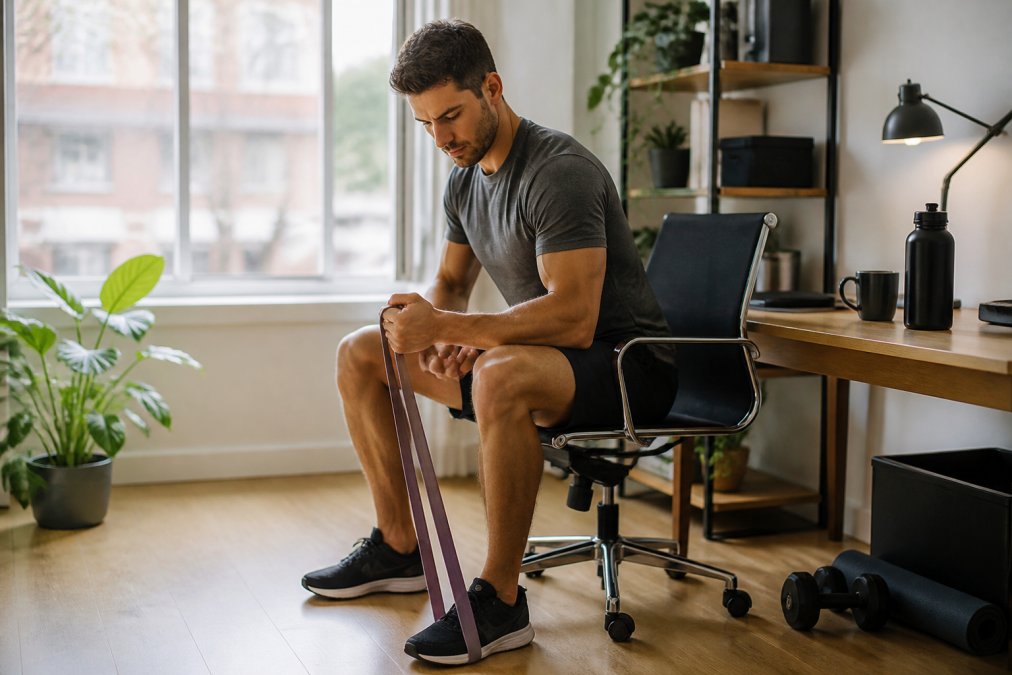
Commit to three 20-minute sessions per week for eight weeks. Track your weights and reps. Most people see measurable strength improvements within this timeframe.
Overcoming the 'More Is Better' Myth in Strength Training
The belief that more training produces more results persists despite evidence to the contrary. Neuromuscular fatigue accumulates from high-intensity training. Exceed your nervous system's recovery capacity repeatedly, and performance decreases instead of improving.
You cannot maintain maximum intensity for 90 minutes. A 20-minute session allows you to maintain 80-90% intensity throughout. A 90-minute session forces you to reduce intensity in later stages to avoid complete neuromuscular fatigue. The total stimulus from the 20-minute session is often greater because intensity is higher.
Research from International Journal of Sports Medicine shows that training volume predicts strength gains, but only within a range. Beyond approximately 10-15 total sets per muscle group per week, additional volume produces minimal additional gains. A 20-minute session performing 8-10 sets is often sufficient when performed three times per week.
Real Strength Gains from 20 Minutes: What Success Actually Looks Like
Strength gains manifest in measurable ways: increased maximum weight you can lift for a single rep, increased reps at a fixed weight, decreased time to complete a set at fixed intensity, and improved movement quality.
Body composition changes take longer than strength gains. You might increase your deadlift by 20 pounds within four weeks, but visible muscle growth takes 8-12 weeks. Strength gains come first; visible muscle growth follows.
Age-specific adjustments matter for sustainable results. Older adults benefit from slightly longer rest intervals (75-90 seconds instead of 60 seconds) and may need an extra rest day between sessions. Females and males both build strength through identical mechanisms; males typically build muscle faster due to higher testosterone.
A realistic three-month progression: establish baseline weeks 1-2, see first strength increases weeks 3-4, achieve consistent progression weeks 5-8, and experience visible muscle growth and significant strength gains (15-25% total increase) weeks 9-12. This assumes consistent three-times-per-week training and adequate nutrition.
Conclusion
Can 20-minute workouts build real strength? Yes, when structured correctly. Three 20-minute sessions per week, performed with high intensity and progressive overload, produces measurable strength gains comparable to longer, lower-intensity approaches.
At thewellbeingshop.com, the curated selection of fitness equipment, dumbbells, resistance bands, and recovery tools removes friction from starting. The thewellbeingshop.com approach emphasizes mind-body harmony and sustainable habits rather than unsustainable intensity. With properly selected equipment and a clear progression framework, you can cultivate real strength in the time you actually have available.
Start with a single pair of dumbbells and three 20-minute sessions this week. Track your weights and reps. In eight weeks, compare your numbers to today. The data will tell you whether 20 minutes is enough, and for most people, it is.
Frequently Asked Questions
Can 20-minute workouts build real strength, or do I need longer sessions?
Yes, 20-minute workouts can build real strength when structured correctly with compound movements and progressive overload. The key is intensity and consistency rather than duration. Research shows that shorter, high-intensity sessions create the same muscle fiber recruitment and training stimulus as longer moderate-intensity workouts when volume and frequency are matched. Most people see measurable strength gains within 4-6 weeks of consistent 20-minute sessions performed 3-4 times per week.
What's the minimum effective dose for muscle growth in a short timeframe?
The minimum effective dose involves 2-3 sets of compound movements per muscle group per week, with adequate rest intervals between sets. Time-under-tension of 30-60 seconds per set and rep ranges of 6-12 reps create sufficient training stimulus. For a 20-minute session, this typically means 3-4 compound exercises with 2-3 sets each, plus 1-2 minutes of rest between sets. Consistency matters more than perfection; even slightly suboptimal volume becomes effective when maintained weekly.
How do I apply progressive overload in short workouts without access to a gym?
Progressive overload in short workouts means gradually increasing weight, reps, or sets over time. With dumbbells, this means adding 2-5 pounds when you complete all reps comfortably. You can also increase reps before adding weight, reduce rest intervals between sets, or add an extra set. Track your performance weekly; even small increases in reps or weight compound into significant strength gains. Home dumbbells in adjustable sets allow you to progress without needing expensive equipment.
What recovery protocols help maximize results from high-intensity 20-minute workouts?
Recovery between sessions is critical for strength gains. Space workouts 48 hours apart to allow neuromuscular recovery, especially for the same muscle groups. Within each session, rest 1-2 minutes between compound movement sets and 30-60 seconds between lighter exercises. Post-workout, prioritize adequate protein intake (0.7-1g per pound of body weight daily) and sleep 7-9 hours nightly. Between sessions, light movement like walking or gentle stretching aids recovery without interfering with adaptation.
This article was written using GrandRanker