


 Link label

How to Progress Home Strength Training: A Step-by-Step Guide
Table of Contents
- Why Progressive Overload Is Essential for Home Strength Training
- Progressive Overload Techniques You Can Use at Home
- How to Track Strength Training Progress Without a Gym
- Bodyweight Exercise Variations for Continuous Adaptation
- Recovery Protocols and Rest Periods for Home Athletes
- Overcoming Psychological Barriers to Consistent Home Training
- Structuring Your Home Workout Frequency and Duration
- Common Mistakes That Stop Home Strength Progress
Last Updated: August 3, 2026
Why Progressive Overload Is Essential for Home Strength Training
Learning how to progress home strength training separates those who see meaningful results from those who plateau within weeks. Without progressive overload, gradually increasing the demands placed on your body during training, your muscles adapt to the same stimulus and stop responding.
Progressive overload doesn't require heavier dumbbells or a fully equipped gym. It means systematically making your workouts harder through volume, intensity, tempo, or exercise variation. Research from the American College of Sports Medicine on resistance training guidelines emphasizes that progressive overload remains the cornerstone of strength development across all training environments. The difference between someone who transforms their physique in six months and someone who looks the same after a year is usually this single factor.
Progressive Overload Techniques You Can Use at Home
The methods for creating progressive overload at home are more flexible than most people realize. You need only a clear understanding of which training variables you can manipulate and how to adjust them systematically.
Increasing Volume and Sets
Volume, the total amount of work performed in a session, is the most straightforward lever you can pull. If you're doing three sets of ten push-ups, that's 30 total repetitions. Next week, aim for 35. This approach removes the pressure of needing harder exercises immediately and works because a beginner can add volume by performing an extra set or two each week.
Add one set every two weeks rather than jumping dramatically. Reducing rest between sets from 90 seconds to 75 seconds also increases training density, forcing your muscles to adapt to compressed stimulus.
Tempo Training and Isometric Holds
Tempo training manipulates how quickly you move through each repetition. Slowing a push-up from two seconds down and one second up to four seconds down and two seconds up increases time under tension, a powerful driver of muscle growth and strength.
Isometric holds, pausing in the most challenging position of a movement, create a different adaptation stimulus. Hold the bottom of a push-up for five seconds, then complete the rep. These techniques shine for bodyweight exercises because they cost nothing and require no equipment.
Exercise Modification and Unilateral Movements
When volume and tempo plateau, exercise modification becomes your next tool. Standard push-ups progress to archer push-ups, then to single-arm push-ups. Unilateral movements, exercises performed one limb at a time, are more challenging because you lose stability assistance and must generate more force per side.
The progression path for major muscle groups typically follows: bilateral bodyweight → bilateral with added resistance → unilateral bodyweight → unilateral with resistance. Each step represents a meaningful jump in difficulty that keeps your nervous system and muscles adapting.
How to Track Strength Training Progress Without a Gym
Tracking is the invisible backbone of progression. You can't progress what you don't measure. A basic training log contains four columns: date, exercise, sets x reps, rest period. This simple act forces you to notice patterns and reveals when you're ready to increase difficulty.
Range of motion and movement quality reveal whether your strength is genuine. A push-up performed with full range of motion, chest nearly touching the floor and full arm extension at the top, is more valuable than ten shallow push-ups. Video yourself occasionally and compare your form to previous months. You'll often notice improved stability, better posture, or smoother movement patterns, that's progress too.
Bodyweight Exercise Variations for Continuous Adaptation
The beauty of bodyweight training is the endless progression paths available. You're never truly "done" with an exercise.
Compound Exercises and Major Muscle Groups
Compound exercises, movements that involve multiple joints and muscle groups, should form the foundation of your home training. Push-ups work the chest, shoulders, and triceps. Squats work the quads, glutes, and core. Rows work the back and biceps. These movements are efficient because they create stimulus across multiple muscle groups in one exercise.
Functional fitness improves alongside strength because compound movements train your body to work as an integrated system. A person who can perform a single-leg squat has not only strong legs but also excellent balance, core stability, and coordination.
Progression Paths for Common Movements
Understanding the progression path for each movement prevents you from getting stuck. Here's what a realistic progression looks like:
Push-up progression: Wall push-ups → incline push-ups → standard push-ups → diamond push-ups → archer push-ups → pseudo-planche push-ups → planche push-ups.
Squat progression: Assisted squats → bodyweight squats → pistol squat negatives → assisted pistol squats → full pistol squats → weighted pistol squats.
Row progression: Inverted rows with feet on ground → inverted rows with feet elevated → single-arm inverted rows → pull-up negatives → assisted pull-ups → full pull-ups.
Each progression typically takes 2-4 weeks to master before moving to the next step.

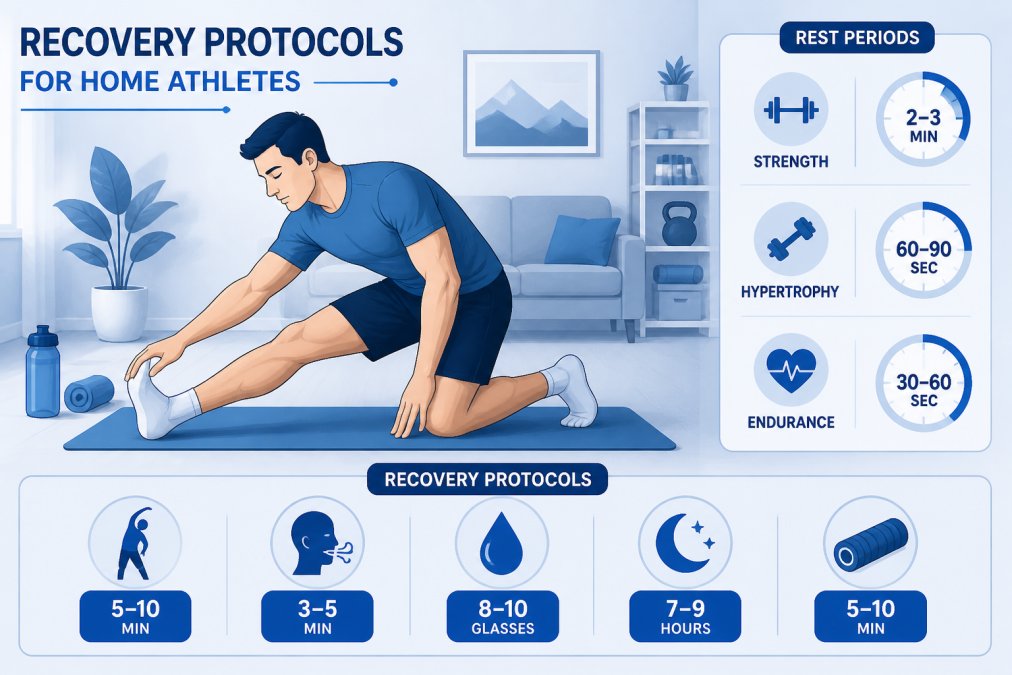
Recovery Protocols and Rest Periods for Home Athletes
Progression happens during recovery, not during the workout. Your muscles adapt and rebuild during rest periods, making recovery protocols as important as training itself.
Rest between sets directly impacts your next set's performance. Rest 60-90 seconds between sets of compound movements, 30-60 seconds between isolation or accessory work. Sleep quality matters enormously, most strength adaptations occur during deep sleep when growth hormone is elevated. Aim for seven to nine hours nightly.
Nutrition also belongs in any recovery discussion. Your muscles need protein and calories to rebuild after training. Aim for roughly 0.7-1 gram of protein per pound of bodyweight daily. Active recovery on rest days, light walking or stretching, accelerates recovery without adding training stress.
Overcoming Psychological Barriers to Consistent Home Training
The physical principles of progression are straightforward. The psychological barriers are what derail most people.
Training alone at home lacks the social accountability of a gym. The fix is mechanical consistency, not motivation. Build training into your daily routine the same way you brush your teeth, same time, same place, same sequence. This removes motivation from the equation entirely.
Avoid comparing yourself to others. Instead, compare yourself only to your own training log from last month. Another barrier is perfectionism, missing one workout doesn't undo your progress. The goal is consistency over time, not perfection.
Tracking progress visually helps overcome psychological barriers. Print out your training log monthly and tape it somewhere visible. Seeing the progression reinforces that the work is paying off.
Structuring Your Home Workout Frequency and Duration
Three to four training sessions per week is optimal for strength development in home athletes. This frequency allows sufficient training stimulus while providing adequate recovery time. Session duration should be 30-60 minutes including warm-up and cool-down, with actual strength work taking 20-40 minutes.
A practical weekly structure:
| Day | Focus | Duration | Notes |
|---|---|---|---|
| Monday | Upper body strength | 45 min | Push-ups, rows, shoulder work |
| Tuesday | Lower body strength | 45 min | Squats, lunges, single-leg work |
| Wednesday | Rest or active recovery | 20 min | Stretching, mobility, light walking |
| Thursday | Upper body power | 40 min | Explosive push-ups, plyometrics |
| Friday | Lower body power | 40 min | Jump squats, explosive lunges |
| Saturday | Full-body or weak points | 40 min | Address lagging muscle groups |
| Sunday | Rest | Complete recovery day |
A five-minute dynamic warm-up prepares your nervous system and joints. A five-minute cool-down helps your heart rate return to baseline and begins recovery.
Common Mistakes That Stop Home Strength Progress
Most people who fail at home strength training don't fail because the principles are wrong. They fail because they make predictable mistakes.
Mistake one: no progression strategy. Training the same workout every week indefinitely. Your body adapts within 3-4 weeks. The fix is having a clear plan for how you'll make each session harder.
Mistake two: inconsistent tracking. Training hard but not recording what you did. Without data, you can't notice patterns or identify when you're ready to progress.
Mistake three: impatience with progressions. Jumping between variations too quickly. Master one variation fully before moving to the next, typically 2-4 weeks per step.
Mistake four: ignoring recovery. Training hard every day without adequate sleep or nutrition. Rest is when progress happens.
Mistake five: comparing timelines. Expecting to look like someone who's been training for two years when you're three months in. Strength development is a long game.
Mistake six: not measuring range of motion. Doing more reps but with progressively shallower range of motion. Full range of motion matters for genuine strength development.
Mistake seven: poor exercise selection. Focusing only on isolation movements instead of compound exercises. Compound movements should form the foundation of your training.
Building sustainable strength at home requires more than good intentions, it demands a deliberate system for progression and accountability. At thewellbeingshop.com, we understand that home athletes need tools and strategies designed specifically for their environment. Our curated selection of fitness equipment, mind-body training tools, and nutritional support helps you implement the progressive overload principles covered here, turning consistent effort into measurable strength gains. Start with the progression framework outlined above, track your work systematically, and let your training log guide your decisions. That combination, smart progression strategy plus proper recovery support, is what transforms home training from a casual routine into a legitimate strength-building practice.
Frequently Asked Questions
What is the best way to apply progressive overload at home without expensive equipment?
Progressive overload at home works through multiple methods beyond adding weight. Increase your training volume by adding more sets and repetitions, slow down your tempo to increase time under tension, hold exercises longer using isometric holds, or modify movements to make them harder (like progressing from knee push-ups to standard push-ups). You can also reduce rest periods between sets or switch to unilateral movements that challenge one side at a time. The key is consistent adaptation: pick one method per week and track your progress so you know when to advance further.
How do I know when it's time to increase the difficulty of my home strength training workout?
Track when you can complete all your planned sets and repetitions with good form and still have energy left. If your last set feels as easy as your first, it's time to progress. Most people find they're ready to advance every 2-3 weeks if they're training consistently. You can also monitor how your muscles feel during the workout: if you're not reaching muscle fatigue by your final reps, intensity needs to increase. Write down your workouts so you have a clear record of when you hit these milestones.
Can you build significant muscle mass using only bodyweight exercises and minimal home equipment?
Yes, bodyweight exercises and minimal equipment can build muscle when you apply progressive overload consistently. Compound exercises like push-ups, squats, and pull-ups (or assisted variations) work major muscle groups effectively. The challenge isn't the equipment; it's ensuring your training volume, intensity, and recovery time support hypertrophy. You'll need to progress deliberately by increasing reps, slowing your tempo, or adding difficulty through exercise modifications. Consistency over months matters more than the tools you use.
How often should I change my home workout routine to avoid plateaus and keep progressing?
You don't need to change your entire routine frequently. Instead, progress within the same exercises for 4-8 weeks using progressive overload techniques. After that period, swap out 1-2 exercises per muscle group to provide new stimulus while keeping your core movements. Changing too often prevents adaptation; staying too long without any change causes plateaus. The real driver of progress is consistency and tracking, not constant variety. Focus on advancing your current exercises before redesigning your whole program.
This article was written using GrandRanker