


 Link label

Daily Yoga Practice at Home: Benefits That Actually Stick
Table of Contents
- Why Daily Yoga Practice at Home Works for Remote Workers and Busy Professionals
- How to Start a Home Yoga Practice: From Zero to Consistent
- The Physical Benefits of a Daily Yoga Practice: Strength, Flexibility, and Posture
- Mental Health and Nervous System Benefits: Stress Relief Through Pranayama and Mindfulness
- Sleep Quality and Recovery: How Evening Yoga Regulates Your Body
- The Benefits of 15 Minute Daily Yoga: Real Results in Limited Time
- Best Yoga Equipment for Home: Tools That Support Consistent Practice
- Building the Habit: Overcoming Common Barriers to Daily Home Practice
- Frequently Asked Questions
Last Updated: September 26, 2026
Why Daily Yoga Practice at Home Works for Remote Workers and Busy Professionals
Remote work has created a paradox: we're closer to fitness than ever, yet further from consistent movement, which is why a daily yoga practice home routine solves what gym memberships cannot. Your yoga mat sits in the corner while your back tightens at your desk by 2 p.m.
A daily yoga practice at home changes everything. Unlike gym routines that require planning and travel, a home practice integrates into your existing rhythm with no friction.
Remote professionals who establish a consistent daily yoga practice at home report measurable shifts in focus, energy, and physical comfort within the first two weeks. The barrier isn't understanding the benefits, it's building the habit.
A consistent daily yoga practice at home addresses the specific problems remote work creates: postural collapse, mental fatigue, and the blurred boundary between work and recovery.
How to Start a Home Yoga Practice: From Zero to Consistent
Choose a specific time: 6:30 a.m. before work, 12:15 p.m. after lunch, or 6 p.m. after closing your laptop. Specificity creates automaticity and drops resistance.
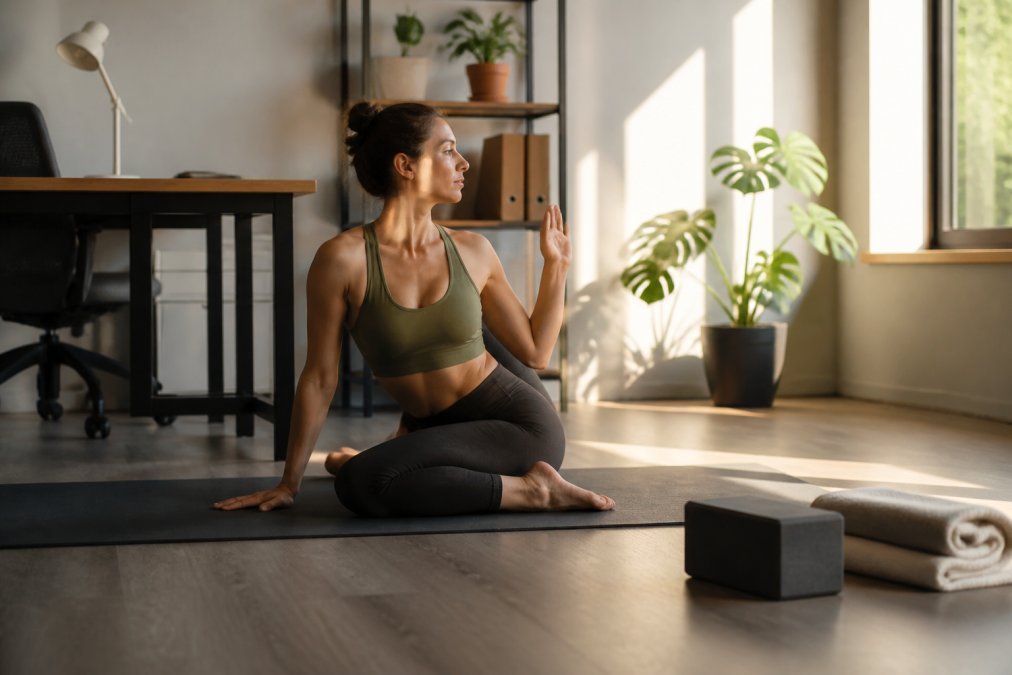
Designate a space, a corner of your bedroom or section of your living room. The psychological effect of a dedicated space primes you for practice.
Choose one resource, a YouTube channel, app, or video series, and commit to it for 30 days. Switching resources kills momentum.
Remove decision-making by planning your flows in advance. When you step onto your mat, you already know what's happening.
Don't treat the first week like a test. Your only job is showing up. Benefits compound over weeks and months, not days.
The Physical Benefits of a Daily Yoga Practice: Strength, Flexibility, and Posture
Remote work creates a specific postural profile: rounded shoulders, forward head position, and compressed lower back. A consistent daily yoga practice at home reverses it.
Physical benefits operate on multiple levels: nervous system calming, full joint range of motion, simultaneous muscle lengthening and strengthening, and postural reset.
Building Muscle Tone and Joint Health
Yoga builds functional strength through body-weight resistance and isometric holds, strengthening connective tissue, stabilizer muscles, and joints together for resilience.
Poses like Chaturanga, Warrior III, and Bridge build muscle endurance. Over weeks, you notice increased arm definition, core stability, and leg tone.
Yoga moves joints through full range of motion, circulating synovial fluid and maintaining cartilage health. This prevents the stiffness that leads to injury.
Improving Range of Motion and Injury Prevention
Flexibility is a side effect of regular practice. The real benefit is range of motion, moving joints freely without pain or restriction.
You don't need to touch your toes. You need hips open enough to sit comfortably, shoulders rotating fully to reach overhead without pain, and spine extending and flexing without restriction.
Hip openers like Pigeon Pose and Low Lunge release sitting-related tightness. Shoulder openers restore mobility. Spinal twists and forward folds decompress vertebrae.
This mobility prevents injury by allowing joints to move freely and muscles to stay balanced.
Mental Health and Nervous System Benefits: Stress Relief Through Pranayama and Mindfulness
Mental shifts from a daily yoga practice at home often arrive before physical changes. Within the first week, many report clearer thinking and reduced anxiety.
Movement interrupts the stress cycle by signaling safety to your nervous system. Gentle movement shifts you from sympathetic (fight-or-flight) to a relaxed state.
Pranayama (intentional breathing), such as extended exhale breathing, directly activates your parasympathetic nervous system, lowering heart rate and settling your mind (pubmed.ncbi.nlm.nih.gov).
Yoga Block | Balsa Wood + Beeswax →
Mindfulness emerges naturally as your mind anchors to the present moment. This break from rumination is therapeutic and extends mental clarity into your workday.
Many remote professionals use midday yoga as their reset, returning to work with clearer thinking and lower anxiety.
Daily yoga practice creates measurable changes in stress response. Situations that triggered frustration become manageable as your nervous system recalibrates.
Sleep Quality and Recovery: How Evening Yoga Regulates Your Body
Evening yoga creates a bridge between work and rest, signaling your body that the day has ended and preventing work tension from disrupting sleep.
A gentle evening practice with restorative poses, forward folds, and hip openers signals downregulation: your nervous system shifts to parasympathetic, cortisol drops, and body temperature lowers, conditions that precede sleep.
An evening practice creates a psychological boundary between work and rest, allowing your brain to truly relax.
Many people find that a consistent evening yoga practice eliminates the "mind racing" problem at bedtime. Your nervous system is already downregulated. Your mind has had a break from stimulation. Sleep comes more easily.
The recovery benefit extends beyond sleep quality. Yoga poses that invert your body (like Legs Up the Wall or Shoulder Stand) improve circulation and lymphatic drainage. Gentle twists aid digestion. Forward folds calm your nervous system. These recovery practices accelerate how quickly your body bounces back from the day's stress.
The Benefits of 15 Minute Daily Yoga: Real Results in Limited Time
The most common objection to starting a daily yoga practice at home is time. "I only have 15 minutes." This is actually the ideal starting point, not a limitation.
Fifteen minutes is enough to warm up, move through several poses, practice breathing, and close intentionally. It's long enough to create real benefit and short enough to be sustainable. A 15-minute practice fits into any schedule. Before work. During lunch. After work. The consistency matters more than the duration.
The benefits of a daily yoga practice home routine accumulate quickly when practiced for 15 minutes. Within two weeks, you'll notice improved posture and reduced back tension. Within a month, sleep quality often improves. Within two months, you'll have noticeably increased flexibility and strength.
The psychological benefit arrives first. You've kept a commitment to yourself. You've proven you can build a habit. This confidence extends into other areas. If you can maintain a consistent yoga practice, you can maintain other intentions too.
Many practitioners find that 15 minutes becomes their non-negotiable time. It's the one thing they protect. Work expands or contracts, but the practice remains. This consistency is what creates transformation.
Best Yoga Equipment for Home: Tools That Support Consistent Practice
The right equipment removes barriers and deepens your practice. You don't need much, but what you choose should support your specific needs.
A yoga mat is the foundation.
These tools create an environment that supports consistency. When your space is set up, your mat is rolled out, and your props are accessible, the friction to practice drops dramatically.
Building the Habit: Overcoming Common Barriers to Daily Home Practice
The benefits of daily yoga practice at home are real, but they only materialize if you actually practice. Most people fail not because yoga doesn't work, but because they don't build the habit.
| Barrier | Solution | Outcome |
|---|---|---|
| No designated time | Schedule practice at specific time daily | Automaticity develops; practice becomes non-negotiable |
| Decision fatigue | Plan flows in advance (Mon/Tue/Wed rotation) | Reduced friction; increased follow-through |
| Perfectionism | Accept missed days; resume next day | Sustainable consistency; reduced guilt |
| Boredom | Planned variety within structure | Long-term engagement; continued progress |
| Isolation | Join online class or accountability group | Psychological commitment; higher adherence |
| Unrealistic expectations | Commit to 90 days; trust the process | Real results; lasting transformation |
Frequently Asked Questions
What happens if you practice yoga every day?
Daily yoga practice builds cumulative benefits across your physical and mental health. Your body develops stronger muscles, improved flexibility, and better posture over time. Your nervous system becomes more regulated, reducing stress and cortisol levels. Sleep quality improves, and you develop better body awareness. Most practitioners report increased mental clarity and emotional stability within 2-3 weeks of consistent daily practice. The key is consistency, even 15 minutes daily produces measurable results.
How many minutes of daily yoga are needed to see real results?
The benefits of 15 minute daily yoga are significant and well-documented. You'll notice improved flexibility and reduced muscle tension within 1-2 weeks. Mental benefits like stress relief and better focus appear within days for many people. For deeper strength building and postural changes, aim for 20-30 minutes daily. The science shows that consistency matters more than duration, a 15-minute daily practice outperforms sporadic longer sessions. Even beginners see measurable improvements in range of motion and balance within the first month.
Can a home yoga practice be as effective as a studio class?
Yes, home yoga practice delivers the same physical and mental benefits as studio classes when you maintain consistency and proper form. The advantage of home practice is elimination of barriers, no commute, no class schedule constraints, no self-consciousness. You control the environment, music, temperature, and pacing. Home practice actually supports better habit formation because it removes friction. The best yoga equipment for home, like balsa wood blocks and meditation cushions, helps you maintain proper alignment just as effectively as studio props. The real difference is your commitment to showing up daily.
How long does it take to see physical changes from daily yoga?
You'll notice the first changes within 1-2 weeks: improved flexibility, reduced muscle soreness, and better posture awareness. Visible muscle tone and strength improvements typically appear within 4-6 weeks of consistent daily practice. Sleep quality often improves within days. Mental benefits like reduced anxiety and improved focus can appear immediately. More significant body composition changes take 8-12 weeks. The timeline depends on your starting point, practice intensity, and consistency. Tracking your practice with a simple log helps you recognize progress that might not be immediately obvious in the mirror.