


 Link label

Exercise Bike Buying Guide: Types, Features & Setup
Table of Contents
- What Makes an Exercise Bike Right for Your Home
- Upright Exercise Bikes: Performance and Posture
- Recumbent Exercise Bikes: Comfort and Low-Impact Training
- Indoor Cycling and Air Bikes: High-Intensity Options
- Best Exercise Bike for Home Use: Key Selection Criteria
- Exercise Bike Workout for Beginners: Getting Started Right
-
Common Mistakes and How to Avoid Them
- Mistake 1: Comparing sticker price instead of total cost of ownership
- Mistake 2: Ignoring warranty terms and parts availability
- Mistake 3: Skipping the maintenance schedule
- Mistake 4: Buying a bike you cannot mount safely
- Mistake 5: Assuming "smart" means "better"
- Mistake 6: Not planning for repairability
- Frequently Asked Questions
Last Updated: October 12, 2026
What Makes an Exercise Bike Right for Your Home
An exercise bike is a stationary cycling machine for indoor cardiovascular workouts without a gym membership or outdoor conditions. At thewellbeingshop.com, we help you find equipment that fits your actual life.
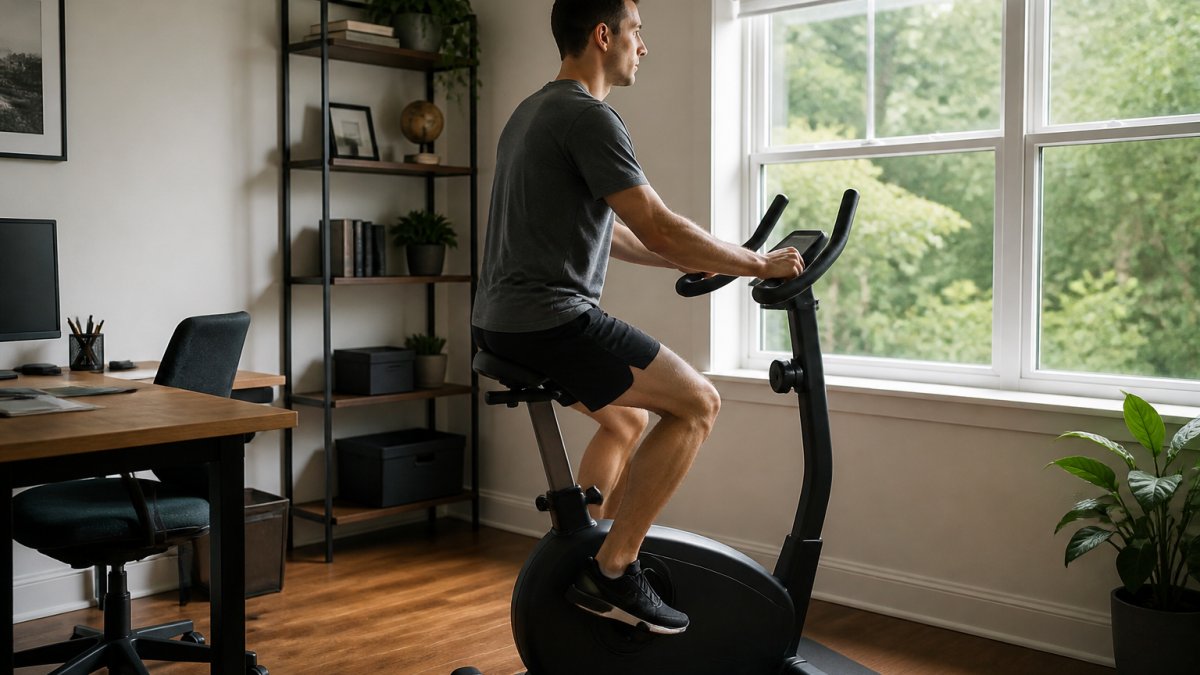
The real question isn't whether an exercise bike works, it's whether the type matches your body, space, and commitment level.
Home exercise bikes come in four main categories. An upright exercise bike mimics a road bike position. A recumbent exercise bike offers back support with a reclined seat.
Upright Exercise Bikes: Performance and Posture
An upright exercise bike positions you sitting vertically, like a standard road bicycle. It builds leg strength and cardiovascular endurance while using minimal floor space.
Upright bikes mimic outdoor cycling mechanics: your core engages more than on recumbent models, and you can adjust intensity quickly.
The trade-off is comfort during longer sessions. Upright bikes put pressure on your sit bones and lower back, especially with existing back pain or limited flexibility.
Resistance systems vary. Magnetic resistance is smooth, quiet, and offers many adjustable levels.
Recumbent Exercise Bikes: Comfort and Low-Impact Training
A recumbent exercise bike positions you in a semi-reclined seat with legs extended in front of you.
Recumbent bikes excel at low-impact cardiovascular training, letting you sustain longer sessions comfortably.
The downside is footprint: recumbent bikes take up more floor space due to the extended leg position.
Recumbent bikes are your best option if you're managing back pain, recovering from injury, or prefer comfort over intensity.
Indoor Cycling and Air Bikes: High-Intensity Options
Indoor cycling bikes, often called spin bikes, feature a heavy flywheel and an aggressive riding position.
These bikes demand commitment. The heavy flywheel creates momentum you must control, and you can't coast, stopping the pedals stops the bike instantly.
Air bikes add wind-based resistance: pedal faster and air resistance increases exponentially, so you control intensity through speed and effort.
The catch: both require a learning curve.
They're compact, and high intensity means shorter workouts, so you don't need 45 minutes to see results.
Best Exercise Bike for Home Use: Key Selection Criteria
Most buying guides say to "match the bike to your needs" and stop there, which is useless at the point of purchase. What separates a bike you keep from one you sell six months later is whether five measurable specs line up with your body and your room. Use the comparison below as a decision tool.
Side-by-side comparison across bike types
| Criterion | Upright | Recumbent | Indoor cycling (spin) | Air bike | Mini bike |
|---|---|---|---|---|---|
| Typical footprint (L x W, inches) | 40-50 x 20-24 | 55-70 x 24-28 | 48-54 x 20-24 | 48-55 x 24-28 | 20-24 x 16-20 |
| Seat adjustability | Height + fore/aft | Height + fore/aft + recline | Height + fore/aft | Height only (most models) | None (floor unit) |
| Typical user height range | 4'11" to 6'5" | 4'11" to 6'5" | 4'11" to 6'5" | 4'10" to 6'6" | 4'10" to 6'6" |
| Typical weight capacity | 250-350 lb | 300-400 lb | 250-350 lb | 300-350 lb | 220-250 lb |
| Step-through frame available | Sometimes | Usually | Rarely | Rarely | N/A |
| Resistance type | Magnetic or friction | Magnetic | Friction (felt pad) or magnetic | Fan / air | Magnetic |
| Noise level at moderate effort | Low (magnetic) | Low | Moderate (friction) | Moderate to high | Low |
| Best workout style | Steady-state, light intervals | Long steady-state | HIIT, threshold | HIIT, cross-training | Desk / chair cardio |
| Assembly time (typical) | 45-90 min | 60-120 min | 45-90 min | 45-75 min | Under 15 min |
| Best for | Riders who want a road-bike feel | Back support, longer sessions | Performance and intensity | Full-body conditioning | Small spaces, mobility limits |
Match the bike to the user, not the marketing
- Beginners returning after years off: upright or recumbent with magnetic resistance and at least 8 resistance levels. Skip air bikes until you can hold 20 minutes of steady effort.
- Older adults and anyone with back or joint concerns: recumbent with a step-through frame and a backrest that reaches mid-shoulder blade. Look for weight capacity at least 50 lb above your body weight so the frame stays stable during mounting.
- Limited mobility or balance issues: recumbent with a low step-over height (under 12 inches) or a mini bike used from a chair. Avoid spin bikes, which require standing and quick transitions.
- Small homes and apartments: upright, spin, or mini bike. Measure the footprint plus 24 inches of clearance behind the pedals and 18 inches on each side for safe mounting.
- Performance-focused riders: indoor cycling bike with a flywheel of at least 30 lb and a resistance system that lets you hold a target cadence. Air bikes work if you want upper-body engagement.
Fit and ergonomics checklist
Before you buy, confirm the bike's published specs against these numbers:
- Seat height range must reach your inseam plus a slight knee bend at the bottom of the pedal stroke. If the bike's minimum seat height is above your inseam, you will not fit.
- Weight capacity should exceed your body weight by at least 30-50 lb for stability during hard efforts.
- Handlebar reach should be adjustable fore/aft on upright and spin bikes; fixed handlebars force taller and shorter riders into compromised posture.
- Pedal type matters: toe cages fit street shoes, SPD clips require cycling shoes. Most home riders are better served by dual-sided pedals.
- Step-over height on recumbents should be under 12 inches if balance or hip mobility is a concern.
What the specs will not tell you
Two bikes with identical footprints can feel completely different. Flywheel weight, frame material, and seat padding determine whether a 30-minute ride feels smooth or jarring. A heavier flywheel (30 lb and up) produces more consistent momentum and a smoother pedal stroke; a lighter one feels choppy at low resistance.
Test a floor model if you can. If not, prioritize bikes with published seat dimensions, flywheel weight, and weight capacity, since those three numbers predict comfort more reliably than any marketing claim.
Exercise Bike Workout for Beginners: Getting Started Right
An exercise bike workout for beginners should feel sustainable, not punishing. Most people fail because they start too hard and quit too fast.
Start with 15-20 minute sessions at moderate intensity, where you can hold a conversation.
Set the bike up correctly first.
Resistance should feel light initially while you build cardiovascular fitness and get comfortable with the pedaling motion.
Track something simple, duration or distance, not intensity. Watching your time increase from 15 to 20 to 25 minutes builds confidence.
Common Mistakes and How to Avoid Them
Most exercise bike failures are purchasing and ownership failures, not fitness failures. The mistakes below recur in return data, warranty claims, and secondhand listings, and each has a concrete fix.
Mistake 1: Comparing sticker price instead of total cost of ownership
The purchase price is only the first line item. Budget for the full picture:
| Cost category | Typical range | Notes |
|---|---|---|
| Bike purchase | $200-$2,500 | Magnetic upright and recumbent models cluster at the low end; connected spin bikes at the high end |
| Delivery | $0-$150 | Many retailers offer free curbside; in-home delivery costs extra |
| Assembly | $0-$200 | Most bikes ship partly assembled; professional assembly is optional |
| Subscription (if connected) | $0-$40/month | Only applies to bikes with a built-in screen and app ecosystem |
| Maintenance parts | $20-$80/year | Felt pads, belts, pedal straps, seat replacement |
| Replacement bike (if abandoned) | Full purchase price | The real cost of buying the wrong type |
A $400 bike with a $15/month subscription costs $580 in year one; a $900 bike with no subscription costs $900. Over three years, the cheaper bike can cost more, so run the math before assuming the higher sticker price is the expensive option.
Mistake 2: Ignoring warranty terms and parts availability
Warranty coverage varies more than most shoppers realize. Common structures:
- Frame: 1-10 years, sometimes lifetime on premium brands
- Parts and electronics: 90 days to 2 years
- Labor: 90 days to 1 year, often excluded entirely
Before buying, check whether the warranty covers labor or parts only, whether replacement parts are sold directly to consumers, and whether the manufacturer has a US-based service network. A 10-year frame warranty with no parts availability in year three is a warranty on a paperweight.
Mistake 3: Skipping the maintenance schedule
Exercise bikes are low-maintenance, not no-maintenance. A realistic schedule:
- Weekly: Wipe down frame and seat; check pedal tightness
- Monthly: Inspect belt or chain tension; tighten bolts on the seat post and handlebars
- Quarterly: Lubricate friction resistance pads (if applicable); check flywheel alignment
- Annually: Replace worn pedal straps, seat padding, and any felt resistance pads
Friction-resistance bikes need more attention than magnetic ones because the pad wears against the flywheel. Magnetic bikes have fewer wear points but still need bolt checks, since vibration loosens fasteners.
Mistake 4: Buying a bike you cannot mount safely
Step-over height, weight capacity, and seat adjustability determine whether you can mount and dismount without assistance. This matters most for older adults, anyone recovering from surgery, and riders with balance concerns. A recumbent with a step-through frame and low seat height solves most of these problems; a spin bike with a high top tube does not.
Mistake 5: Assuming "smart" means "better"
Connected bikes add a screen, app, and subscription, but not resistance quality, frame stability, or comfort. If you already pay for a fitness app, a Bluetooth-enabled bike without a built-in screen may serve you better for less. If you want guided classes and live metrics, a connected bike earns its premium. Decide which you want before paying.
Mistake 6: Not planning for repairability
Before you buy, answer three questions:
- Can I buy replacement pedals, seats, and resistance pads directly from the manufacturer?
- Is there a published parts diagram or service manual?
- Does the brand have a US service partner, or will I ship a 100-lb frame for repair?
If any answer is no, the bike is effectively disposable. That's fine at $200, not at $1,200.
Frequently Asked Questions
What is the difference between an upright exercise bike and a recumbent exercise bike?
Upright exercise bikes mimic traditional road cycling with an upright riding position that engages your core and upper body. Recumbent bikes have a reclined seat and backrest, distributing weight across a larger surface area for comfort and lower-impact movement. Upright bikes suit riders seeking performance and intensity; recumbent bikes work better for people with back pain or those wanting extended, comfortable sessions. Both deliver effective cardiovascular workouts.
What should I look for when buying an exercise bike?
Prioritize resistance type (magnetic offers smooth adjustments; friction requires maintenance), seat comfort and adjustability, console features like distance and calorie tracking, stability and frame construction, and available space in your home. Consider your fitness goals: beginners benefit from adjustable resistance and comfort features, while experienced cyclists may prefer higher resistance levels and performance metrics. Test the seat if possible, as comfort directly impacts consistency.
How do I start an exercise bike workout for beginners?
Begin with 15-20 minute sessions at low resistance to build familiarity with the machine and develop cycling rhythm. Focus on steady cadence (pedal revolutions per minute) rather than speed or intensity. Adjust the seat so your knee is slightly bent at the bottom of the pedal stroke. Start with 3 sessions per week, gradually increasing duration and resistance as your fitness improves. Proper form prevents injury and builds sustainable habits.
Is an exercise bike effective for working from home and improving posture?
Yes, short movement breaks on an upright exercise bike can strengthen your core and back muscles, supporting better seated posture during work hours. Even 5-10 minute sessions between meetings activate stabilizer muscles and improve circulation. However, the bike alone won't fix posture; combine it with ergonomic desk setup, regular stretching, and mindful sitting habits. Many remote workers find that consistent bike use reduces afternoon back fatigue and boosts afternoon focus.