


 Link label

Daily Movement Exercises for Remote Workers
Table of Contents
- Why Daily Movement Exercises Matter for Remote Workers
- Desk Exercises for Remote Workers You Can Do Anytime
- Work-From-Home Stretches to Reduce Stiffness
- Movement Breaks During Work: A Practical Schedule
- Quick At-Home Workouts for Energy and Focus
- Exercise Modifications for Different Mobility Levels
- Building a Sustainable Movement Habit
- Frequently Asked Questions
Last Updated: October 12, 2026
Why Daily Movement Exercises Matter for Remote Workers
Remote work offers flexibility, but comes with a hidden cost: prolonged sitting. Stiffness creeps into your neck and shoulders by mid-morning, your lower back tightens, and energy dips by 2 PM. That's where daily movement exercises for remote workers become essential.
The problem isn't laziness. Sitting compresses your spine, reduces blood flow, and weakens stabilizer muscles, compounding into chronic pain, poor posture, and reduced focus. Daily movement exercises for remote workers interrupt this cycle with strategic breaks that reset your body and sharpen your mind.
The solution is consistent, targeted movement throughout your workday. The exercises here take 5-10 minutes per session and need nothing beyond your desk and chair.
Desk Exercises for Remote Workers You Can Do Anytime
The best daily movement exercises for remote workers are ones you'll actually do, so they must fit into your workday without disrupting your flow. These require only a chair and a few minutes.
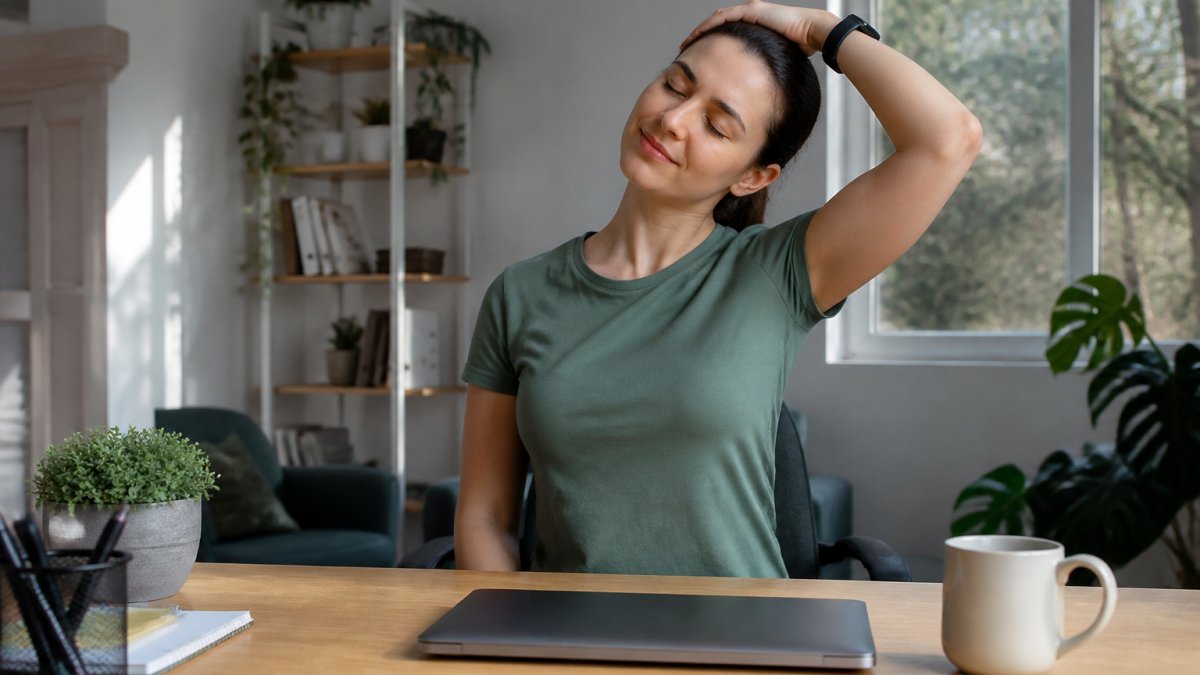
Seated Neck and Shoulder Mobility
Neck stiffness is the remote worker's most common complaint. Your head weighs about 11 pounds, and when it drifts forward during screen focus, your neck muscles work overtime.
Neck Rotation: Sit upright. Slowly turn your head right, feeling the stretch on the left side of your neck. Hold 15-20 seconds. Return to center, repeat left.
Shoulder Shrugs: Lift your shoulders toward your ears, hold 2 seconds, then drop. Perform 12-15 reps slowly. This engages your upper trapezius.
Chin Tucks: Sit with good posture. Draw your chin straight back (not down), creating a double-chin appearance. Hold 3 seconds, release. Perform 10 reps. This strengthens your deep neck flexors.
Chair-Based Leg and Hip Movements
Your hip flexors tighten from sitting. Chair-based leg exercises restore hip mobility and engage your core.
Seated Marching: Sit upright. Lift one knee toward your chest, then lower it. Alternate legs in a marching motion. Perform 20-30 reps (10 per leg). This activates your hip flexors and core.
Seated Glute Squeezes: Sit upright. Clench your glutes as hard as you can. Hold 3 seconds, release. Perform 15 reps. Sitting deactivates your glutes; this reactivates them.
Figure-Four Stretch: Sit upright. Cross one ankle over the opposite knee, creating a "4" shape. Gently lean forward until you feel a hip stretch. Hold 20-30 seconds, switch sides.
Core Engagement at Your Desk
Your core stabilizes your spine. These seated exercises strengthen your core without leaving your chair.
Seated Torso Twists: Sit upright with hands behind your head or crossed over your chest. Slowly rotate your torso right, then left. Perform 12-15 reps per side. This engages your obliques.
Desk Push-Ups: Place your hands on your desk edge. Step your feet back so your body is at an angle. Lower your chest toward the desk, then push back up. Perform 8-12 reps.
Seated Knee Lifts: Sit upright. Lift one knee toward your chest while tightening your core. Lower it, alternate legs. Perform 20 reps (10 per leg). This engages your hip flexors and core simultaneously.
Work-From-Home Stretches to Reduce Stiffness
These target the areas that tighten most from sitting.
Upper Trapezius and Levator Scapulae Stretches
These two muscles are the primary sources of neck and shoulder stiffness.
Upper Trapezius Stretch: Sit upright. Tilt your head toward your right shoulder. Gently place your right hand on your head and apply light pressure. Hold 20-30 seconds. Repeat opposite side. Perform 2 reps per side.
Levator Scapulae Stretch: Sit upright. Drop your chin toward your chest. Rotate your head 45 degrees right. Gently apply pressure with your right hand on the back of your head. Hold 20-30 seconds.
Cross-Body Shoulder Stretch: Sit upright. Bring your right arm across your body. Use your left hand to gently pull your right elbow toward your chest. Hold 20-30 seconds. Repeat opposite side.
Hip Flexor and Hamstring Stretches
Sitting shortens your hip flexors and tightens your hamstrings. These stretches restore length and mobility to both.
Seated Hamstring Stretch: Sit upright. Extend one leg straight in front of you. Hinge at your hips and reach toward your toes. Hold 20-30 seconds. Repeat opposite side.
Seated Hip Flexor Stretch: Sit upright on your chair. Extend one leg behind you, resting your foot on the floor. Lean your torso forward slightly. Hold 20-30 seconds. Repeat opposite side.
Butterfly Stretch: Sit upright. Bring the soles of your feet together, letting your knees fall to the sides. Gently press your elbows against your inner thighs. Hold 20-30 seconds.
Movement Breaks During Work: A Practical Schedule
The key to sustainable daily movement exercises for remote workers is consistency.
10:30 AM - Mid-Morning Break: Stand up. Walk around your home for 3-5 minutes.
12:00 PM - Lunch: Take a 10-minute walk outside if possible; if not, walk around your home.
exercises with elastic bands →
2:00 PM - Afternoon Slump: Perform 5 minutes of seated core and hip exercises (seated marching, glute squeezes, figure-four stretches).
3:30 PM - Late Afternoon Break: Stand and perform 3-5 minutes of stretching (upper trapezius, hamstring, hip flexor stretches).
5:00 PM - End of Day: Perform 5-10 minutes of full-body stretching.
| Time | Duration | Focus | Exercise Type |
|---|---|---|---|
| 9:00 AM | 5 min | Neck & shoulders | Mobility |
| 10:30 AM | 5 min | Full body | Walking + resistance |
| 12:00 PM | 10 min | General movement | Walking |
| 2:00 PM | 5 min | Core & hips | Engagement |
| 3:30 PM | 5 min | Stiffness relief | Stretching |
| 5:00 PM | 5-10 min | Full body | Stretching |
This schedule totals 35-40 minutes of movement spread across your workday.
Quick At-Home Workouts for Energy and Focus
When you have 20-30 minutes, these at-home workouts deliver real results for remote workers who lack gym access but want structured exercise beyond desk movements.
20-Minute Full-Body Routine
This routine requires no equipment and targets all major muscle groups.
Warm-up (2 minutes): March in place for 1 minute. Perform arm circles and leg swings for 1 minute.
Main Circuit (15 minutes): Perform each exercise for 40 seconds with 20 seconds rest. Complete 3 rounds.
- Bodyweight squats: Stand with feet shoulder-width apart. Lower your body by bending your knees and hips. Push through your heels to stand. This targets your quads, glutes, and core.
- Push-ups: Place your hands on the floor shoulder-width apart. Lower your body until your chest nearly touches the floor. Push back up. Modify by performing them on your knees if needed.
- Lunges: Step forward with one leg. Lower your body until both knees are bent at 90 degrees. Push back to starting position. Alternate legs. This targets your quads, glutes, and hamstrings.
- Plank holds: Support your body with your forearms and toes. Keep your body in a straight line. Hold without letting your hips sag. This strengthens your core.
- Jumping jacks: Stand with feet together. Jump while spreading your legs and raising your arms. Return to starting position. This elevates your heart rate.
Cool-down (3 minutes): Perform stretches from the stretching section above, focusing on areas that feel tight.
Resistance Band and Dumbbell Options
If you want to add resistance, these options scale your workouts. The exercises with elastic bands foot pedal resistance band trainer ($92.92) adds resistance to arm and leg movements without bulky equipment.
Resistance Band Routine (20 minutes):
- Banded squats: Place the band under your feet. Hold the handles at shoulder height. Perform squats with added resistance. Perform 12-15 reps for 3 sets.
- Banded chest press: Anchor the band at chest height. Press forward against the resistance. Perform 12-15 reps for 3 sets.
- Banded rows: Anchor the band at chest height. Pull toward your body against the resistance. Perform 12-15 reps for 3 sets.
- Banded lateral raises: Stand on the band. Raise your arms out to the sides against the resistance. Perform 12-15 reps for 3 sets.
Alternatively, adjustable dumbbells like the water-filled dumbbells ($16.18) offer portable resistance. Fill them with water to adjust the weight, making them convenient for home workouts and easy to store.
Dumbbell Routine (20 minutes):
- Dumbbell squats: Hold dumbbells at your sides. Perform squats. Perform 12-15 reps for 3 sets.
- Dumbbell rows: Hinge at your hips. Row the dumbbells toward your chest. Perform 12-15 reps for 3 sets.
- Dumbbell shoulder press: Hold dumbbells at shoulder height. Press overhead. Perform 12-15 reps for 3 sets.
- Dumbbell deadlifts: Hold dumbbells at your sides. Hinge at your hips, lowering the dumbbells toward the floor. Stand back up. Perform 12-15 reps for 3 sets.
Exercise Modifications for Different Mobility Levels
Not everyone starts at the same fitness level. These modifications ensure daily movement exercises for remote workers meet you where you are.
For Beginners or Limited Mobility:
- Replace push-ups with wall push-ups. Stand facing a wall. Place your hands on the wall. Step back and perform push-ups against the wall.
- Replace lunges with step-backs. Step one leg back instead of forward. This reduces the demand on your knees.
- Replace plank holds with wall planks. Place your hands on a wall at chest height. Step back to create an angle. Hold. This reduces core demand.
- Perform stretches with gentle pressure instead of deep stretches. Never push into pain, stretch to mild tension only.
For Intermediate Fitness Levels:
- Perform standard versions of all exercises as described above.
- Add resistance bands for additional challenge.
- Increase reps or sets as exercises become easier.
For Advanced Fitness Levels:
- Add dumbbells to bodyweight exercises (weighted squats, weighted lunges, weighted push-ups).
- Increase reps, sets, or reduce rest periods between exercises.
- Progress to more challenging variations (single-leg squats, diamond push-ups, pistol squats).
- Incorporate the detachable home gym dumbbell ($160.72), available in weights from 10kg to 40kg, for serious strength training at home.
Building a Sustainable Movement Habit
The best daily movement exercises for remote workers are the ones you'll do consistently. Consistency matters more than intensity.
Start Small: Don't commit to 40 minutes of movement daily. Start with 10 minutes.
Anchor Movement to Existing Routines: Perform stretches after your morning coffee. Do desk exercises after checking email.
Track Your Progress: Write down which exercises you perform and when. Tracking creates accountability and shows progress, even when subtle.
Remove Friction: Set up your workout space the night before. Have resistance bands or dumbbells visible and accessible.
Focus on How You Feel: Movement should feel good, not like punishment.
Remote work doesn't have to mean a sedentary lifestyle.
Frequently Asked Questions
How often should remote workers take movement breaks?
Aim for a 5-10 minute movement break every 30-60 minutes of focused work. Short, frequent breaks are more effective than one long break. Set phone reminders or use your calendar to prompt movement, consistency matters more than duration. Even 3-5 minutes of stretching or walking helps reduce stiffness.
What are the best desk exercises for remote workers with limited space?
Seated exercises require minimal space and no equipment: neck rolls, shoulder shrugs, seated spinal twists, seated hamstring stretches, and seated marches work well at your desk. Standing exercises like calf raises, wall push-ups, and hip circles use only your immediate workspace. If you have a resistance band (like the foot pedal resistance band trainer at $92.92), you can perform seated rows and leg presses without leaving your desk area. Focus on controlled movements rather than speed.
Can a 20-30 minute daily movement routine really improve my remote work experience?
Yes. A consistent 20-30 minute routine addressing cardiovascular fitness, strength, and mobility can be beneficial throughout your workday. Breaking this into smaller sessions (three 10-minute blocks) is equally effective. The key is consistency, daily movement builds habits faster than sporadic longer workouts.
What equipment do I need to do daily movement exercises at home?
You need nothing to start: bodyweight exercises like push-ups, squats, and stretches work without equipment. For added variety, a resistance band ($92.92), adjustable dumbbells ($16.18 per water dumbbell or $160.72 for detachable sets), or an ab roller ($54.45) expand your options. A hydraulic stepper ($655.30) adds cardio if space allows. Start with bodyweight movements and add equipment only when you're ready to progress, most beginners benefit from resistance bands first.