


 Link label

Home Fitness Worth the Cost: A 2026 Analysis
Table of Contents
- Home Fitness Worth the Cost: Breaking Down the Real Numbers
- Home Gym vs Gym Membership Cost Comparison
- Average Cost of Home Gym Equipment and ROI
- How to Build a Budget Home Gym Without Overspending
- The Hybrid Model: Combining Home and Gym Training
- Motivation, Consistency, and Training Environment
- Is Home Fitness Right for Your Goals and Lifestyle?
- Conclusion
Last Updated: August 5, 2026
Home Fitness Worth the Cost: Breaking Down the Real Numbers
When deciding whether home fitness is worth the cost, you're asking three questions: Can I afford it? Will I use it consistently? Does it deliver better results than a gym membership?
Home fitness equipment ranges from a yoga mat under $50 to smart gym systems exceeding $4,000. Gym memberships typically cost $20-$200 monthly. The real question isn't which is cheaper in isolation, but which delivers sustained value for your situation. Most people overestimate gym commitment and underestimate home gym consistency. Convenience matters far more than equipment quality.
Home Gym vs Gym Membership Cost Comparison
The financial crossover happens around 18-24 months. If you commit to a home gym for two years, total cost usually undercuts a gym membership, but only if you actually use it.
| Factor | Home Gym | Gym Membership |
|---|---|---|
| Initial Investment | $200-$4,000+ | $0-$200 enrollment |
| Monthly Cost | $0-$50 (optional classes) | $40-$300 |
| Total Year 1 Cost | $200-$4,000+ | $480-$3,600 |
| Space Required | 50-200 sq ft | None (external) |
| Commute Time | 0 minutes | 10-30 minutes |
| Equipment Variety | Limited (upgradeable) | Extensive |
| Motivation Factor | Self-directed | Community-based |
| Resale/Depreciation | 30-50% of purchase | N/A |
Initial Investment and Upfront Capital
Most people buy too much equipment at once. A smarter approach: start with $150-$300 in resistance bands, a yoga mat, and bodyweight training. Add equipment only after training consistently for 8-12 weeks. This tests actual commitment before serious money is spent.
Premium equipment like Peloton Bike+ ($2,495), Tonal ($3,995), or Hydrow Arc ($2,295) targets people who've already proven they'll use cardio or strength equipment. Gym memberships typically require no upfront capital, meaning lower financial risk but also less psychological commitment.
Recurring Monthly Costs and Long-Term Expenses
Home gym recurring costs are minimal if you own equipment outright. You might pay $10-$50 monthly for streaming fitness classes, but this is optional. Hidden recurring costs appear over time: replacement resistance bands ($20-$40 annually) and occasional maintenance.
Gym memberships have predictable recurring costs: $60 monthly equals $720 annually; premium facilities reach $200+ monthly. Long-term math favors home fitness if you train 4+ times weekly. For casual users (1-2 times weekly), a gym membership often costs less because you're not maintaining expensive equipment you barely use.
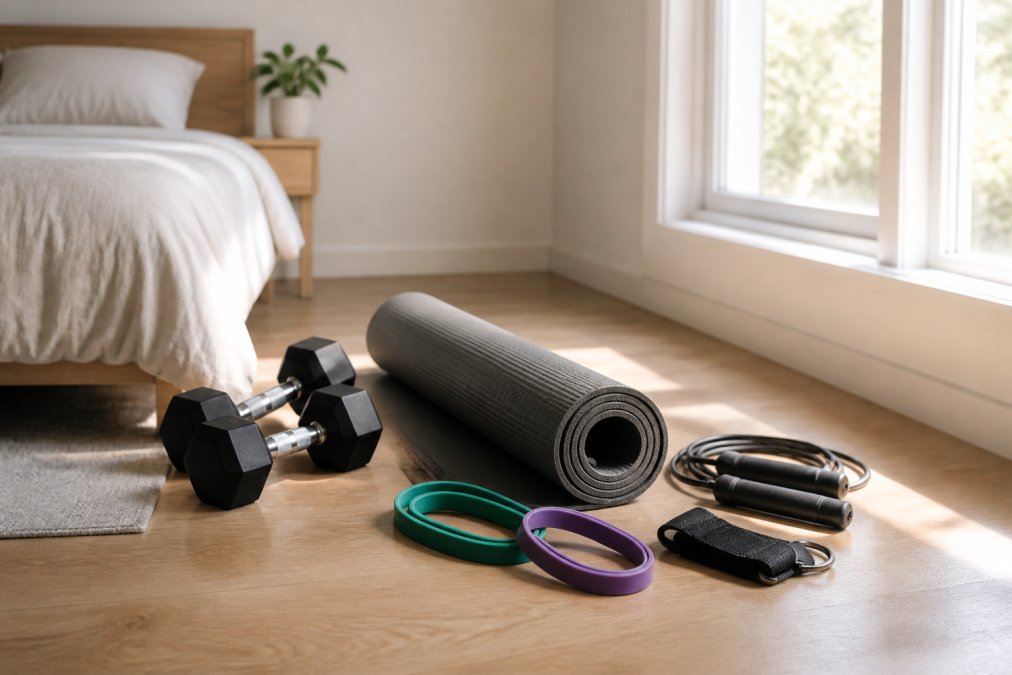
Average Cost of Home Gym Equipment and ROI
Average home gym cost varies dramatically by training style. ROI depends on how you measure returns: fitness results, time saved, or financial value.
Essential Equipment Categories and Price Points
Resistance Training Setup ($300-$800): Dumbbells, a bench, and a pull-up bar cover most strength training needs. Adjustable dumbbells cost $300-$500. A flat bench runs $100-$300. A pull-up bar adds $50-$150.
Cardio Equipment ($500-$3,000+): Basic treadmills cost $500-$1,200. Stationary bikes range from $300 (budget) to $2,500+ (smart bikes). Rowing machines span $300-$2,500. Cardio equipment has higher depreciation and maintenance costs than resistance gear.
Mind-Body Tools ($100-$500): Yoga mats ($30-$100), resistance bands ($20-$50), foam rollers ($20-$50), and meditation cushions ($30-$100) support flexibility, recovery, and intentional practice. These align with thewellbeingshop.com's focus on mind-body harmony and require minimal space.
Smart Fitness Systems ($995-$3,995): Lululemon Studio Mirror ($995) streams live and on-demand classes. Tonal ($3,995) provides AI-powered strength training. Peloton Bike+ ($2,495) and Hydrow Arc ($2,295) offer immersive cardio. These include mandatory monthly subscriptions ($10-$40).
Cost-per-workout, home equipment wins decisively after 6-12 months of consistent use. For time saved (no commute), home fitness saves 5-10 hours monthly for people driving 20-30 minutes each way.
Equipment Depreciation and Resale Value
Dumbbells and resistance bands hold 90-100% of their value indefinitely. Benches, racks, and barbells hold 70-80% of value. Cardio equipment depreciates faster: a $800 treadmill might fetch $300-$400 used after 3-5 years. Smart fitness systems depreciate heavily, a Peloton Bike+ now sells used for $800-$1,200 (originally $2,495). If you buy a $3,000 smart system and use it for 3 years, actual cost after resale is $1,200-$1,500 ($33-$42 monthly), competitive with a $60 gym membership.
How to Build a Budget Home Gym Without Overspending
Most people fail at home fitness because they buy wrong equipment that doesn't match their training style, available space, or current fitness level. The path to a sustainable home gym is incremental.
Phase 1 (Weeks 1-4): Test Your Commitment ($50-$150) Buy a yoga mat ($30-$50), resistance bands ($20-$40), and a jump rope ($15). Train 4+ times weekly for 4 weeks. If you do use them consistently, you've built the habit and can invest in better equipment.
Phase 2 (Weeks 5-12): Add Strength Training ($200-$400) Invest in adjustable dumbbells or a barbell set. Strength training with progressive overload works at home or in a gym. Consistency matters more than location.
Phase 3 (Months 4+): Expand Based on Actual Needs ($300-$1,000) After 12 weeks of consistent training, you'll know what you actually need. Build from there based on what you've proven you'll use.
This phased approach prevents the common mistake: buying a $2,000 setup, using it for 3 months, then abandoning it.

Space Optimization and Footprint Considerations
Space is the real constraint for most people, not money. A full gym setup requires 150-200 square feet. Most home workouts fit in 50-100 square feet if you're strategic.
Vertical storage solves most space problems. Wall-mounted pull-up bars, resistance band hooks, and dumbbell racks free up floor space. Adjustable dumbbells take 1/10th the space of a full set. Smart systems like Tonal mount on a wall and require only 6x8 feet of floor space.
A common mistake is underestimating space needs. A stationary bike takes 3x6 feet permanently. A barbell and squat rack need 8x8 feet minimum. If you don't have that space, these equipment choices won't work.
Maintenance and Repair Costs Over Time
Resistance bands last 1-3 years with regular use before losing elasticity. Replacement bands cost $20-$50 per set. Dumbbells and barbells rarely need repair and essentially last forever.
Cardio equipment requires the most maintenance. Treadmill belts wear out after 2-3 years; replacement costs $200-$400. Stationary bike seats wear out; replacements cost $50-$150. Smart fitness systems have the highest maintenance costs, screens can crack ($500-$1,000 to replace).
Budget $100-$300 annually for cardio equipment maintenance. Budget $50-$100 annually for resistance training setups.
The Hybrid Model: Combining Home and Gym Training
Most people don't choose home OR gym. They choose both in varying proportions. Maintain a minimal home setup (resistance bands, dumbbells, a mat) for consistency and convenience. Maintain a gym membership for equipment variety, social accountability, and occasional serious training. Do 70% of training at home, 30% at the gym.
This costs more than either option alone but delivers benefits neither provides individually. The hybrid model works financially if your gym membership is affordable ($40-$60 monthly) and you use it 1-2 times weekly.
Motivation, Consistency, and Training Environment
Home fitness requires self-directed motivation. You set the schedule, push yourself, decide when to stop. This works brilliantly for self-motivated people with clear goals. It fails for people needing external accountability, community, or structured guidance.
Gym training provides environmental motivation through other people training, scheduled classes, and the commitment of paid membership. Research shows people who train at home need one of three things to succeed: (1) a pre-existing strong habit, (2) clear, measurable goals tracked daily, or (3) external accountability (training partners, online coaching, or group challenges).
The thewellbeingshop.com approach emphasizes mind-body harmony and intentional practice.
Is Home Fitness Right for Your Goals and Lifestyle?
Home fitness is worth the cost if you meet at least three of these criteria:
You have a pre-existing training habit. If you've trained consistently (4+ times weekly) for 6+ months, you're likely to maintain that habit at home.
Your goals align with home training. Strength training, flexibility work, and low-impact cardio all work at home.
You have 30-60 minutes daily for training. Home training works best for focused, efficient sessions.
You value convenience over community. If you train to stay healthy, home works. If you train for social connection, a gym is worth the cost.
Your space supports it. If you have 50-100 square feet available, home training is feasible.
You can afford the initial investment. If you can't spend $300-$500 on starter equipment without financial stress, a gym membership's lower upfront cost might be better.
You're willing to be intentional about your practice. If you approach training as part of your intentional wellness routine, home fitness works.
Home fitness is worth the cost if you're the right person and approach it strategically. The financial advantage is real: over 2+ years, home training typically costs less than a gym membership. But this advantage only matters if you actually use the equipment.
The real decision isn't home versus gym. It's whether you're committed to training consistently, whether your goals match what home training can deliver, and whether you have the space and resources to set it up properly. Start small, test your commitment, and expand only when you've proven you'll use it. That's the path to home fitness that's actually worth the cost. For support building a sustainable wellness practice, thewellbeingshop.com's curated selection of fitness tools and recovery equipment can help you establish a home practice that lasts.
Frequently Asked Questions
Is a home gym cheaper than a gym membership in the long run?
It depends on your timeline and usage. A basic home gym requires significant upfront capital but eliminates monthly recurring costs. A gym membership spreads costs over time but adds up quickly, a typical membership costs $50-100 monthly, which equals $600-1,200 annually. A home gym with essential equipment (dumbbells, resistance bands, mat) can cost $300-$1,000 upfront and requires minimal ongoing expenses. After 2-3 years, most home gym setups become more cost-effective, especially if you use them consistently. The key is committing to regular workouts to justify the initial investment.
What are the hidden costs of maintaining a home gym?
Beyond equipment purchase, expect costs for replacement items (worn-out mats, broken resistance bands), repairs for electronic equipment (damaged screens on smart bikes), storage solutions (shelving, racks), and occasional upgrades to prevent training plateaus. Smart equipment like Peloton or Tonal requires monthly subscriptions ($39-$44) to access classes and coaching. Floor protection, ventilation improvements, and mirrors also add up. Budget 10-15% of your initial investment annually for maintenance and upgrades to keep your home gym functional and engaging long-term.
Does a home gym increase the resale value of your home?
Most home gyms do not significantly increase resale value because they are considered personal fitness spaces rather than structural improvements. However, a well-designed, unobtrusive home gym (like a wall-mounted Tonal or a yoga corner) may appeal to health-conscious buyers. The real value lies in reselling the equipment itself, quality dumbbells, resistance bands, and stationary bikes retain 40-60% of their original value on the secondhand market. Focus on choosing durable, versatile equipment with strong resale demand rather than expecting the home gym setup itself to boost your property's market value.
How do I calculate the ROI of home fitness equipment?
Calculate ROI by dividing total cost savings over time by your initial investment. For example: if a home gym costs $1,000 upfront and saves you $100 monthly in gym membership fees, your ROI breaks even in 10 months. After that, every month adds profit. Factor in equipment depreciation (typically 40-50% value loss over 5 years) and maintenance costs. Also measure non-financial ROI: time saved on commute, consistency gains, and convenience. Most home gym equipment reaches positive ROI within 12-24 months for consistent users, making it a solid long-term investment if you maintain commitment.
This article was written using GrandRanker