


 Link label

Resistance Bands for Full Body Workouts: Complete Benefits Guide
Table of Contents
- What Resistance Bands Do for Full-Body Workouts
- How Resistance Bands Work: Variable Resistance and Tension Profiles
- Resistance Bands vs Weights: Strength Gains Without the Bulk
- Resistance Band Exercises for Beginners: Starting Your Full-Body Practice
- 20-Minute Resistance Band Workout for Busy Professionals
- Best Resistance Bands for Full-Body Workouts: Progressive Overload Strategies
- Recovery, Mobility, and Long-Term Results
- Conclusion: Building Sustainable Strength at Home
- Frequently Asked Questions
Last Updated: October 20, 2026
What Resistance Bands Do for Full-Body Workouts
Resistance bands full body workouts deliver real strength gains without expensive equipment or a gym.
The core appeal is simple: bands create tension through elastic resistance, so your muscles work harder as the band stretches. Unlike static weights, you're fighting increasing tension throughout every repetition.
What makes resistance bands effective for full-body training is their versatility. A single band targets your chest, back, shoulders, arms, legs, and core.
How Resistance Bands Work: Variable Resistance and Tension Profiles
Variable resistance means tension increases as the band stretches, climbing during the concentric contraction. This matches how muscles perform, stronger at the top of a movement, weaker at the bottom, which is why bands feel "easier on the joints" even when the top-end load is high.
Free weights don't work this way. A barbell stays the same weight throughout the lift, so the load is heaviest where your muscles are weakest and lightest at lockout. Bands invert that relationship, tracking your natural strength curve more closely.
The ascending tension curve, explained mechanically
An elastic band's tension is roughly proportional to how far it's stretched past its resting length. In practice:
- At the start of a rep (band near resting length), resistance is low, good for joints and for learning motor patterns.
- At mid-range, resistance climbs steadily, this is where most of the work happens.
- At end-range (peak stretch), resistance is highest, which is where your muscles are mechanically strongest in most pressing and pulling patterns.
This is why bands work so well for rehab and prehab: low starting tension reduces compressive force on the joint while high end-range tension still builds strength where the tissue can handle it.
Why this matters for full-body training: kinetic chains, not isolated muscles
A full-body workout isn't just a list of exercises for each muscle, it's a sequence of movements that fire kinetic chains, the linked joints and muscles that transfer force from the ground (or anchor) through your hips, torso, and shoulders to your hands. Bands train these chains well for three reasons:
- They load rotation and anti-rotation. A cable machine constrains you to a fixed path; a band lets you rotate, chop, and press at angles. Wood chops, Pallof-style presses, and diagonal pulls train the obliques and deep core in ways a barbell can't easily replicate.
- They demand stabilizer recruitment. Because the band's tension vector shifts as you move, your rotator cuff, hip abductors, and deep spinal muscles work continuously to keep the band on path. That's why a band lateral walk lights up the glute medius far more than a machine abduction machine does.
- They reward tension control, not just force production. With a barbell you can grind through a rep; with a band, losing control snaps you back, a feedback loop that trains neuromuscular control for sport and daily movement.
The practical trade-off: where bands fall short
Bands are not a free lunch. Because tension is lowest at the start of the rep, they under-load the bottom position, the hardest part of a squat or bench press. The fix is hybrid work: pair a banded movement with a bodyweight or dumbbell version of the same pattern in the same session, banded rows followed by dumbbell rows, or banded squats followed by goblet squats.
Resistance Bands vs Weights: Strength Gains Without the Bulk
Free weights create constant tension; bands create escalating tension.
Bands reduce joint impact. They're gentler on your elbows, shoulders, and knees because the load doesn't crash down on your joints.
Bands are also portable and affordable.
Free weights shine for absolute strength. If your goal is to lift the heaviest load possible, barbells and dumbbells are superior.
The best approach combines both.
Resistance Band Exercises for Beginners: Starting Your Full-Body Practice
If you're new to resistance training, bands are the ideal starting point: forgiving, adjustable, and easy to focus on form without heavy weight.
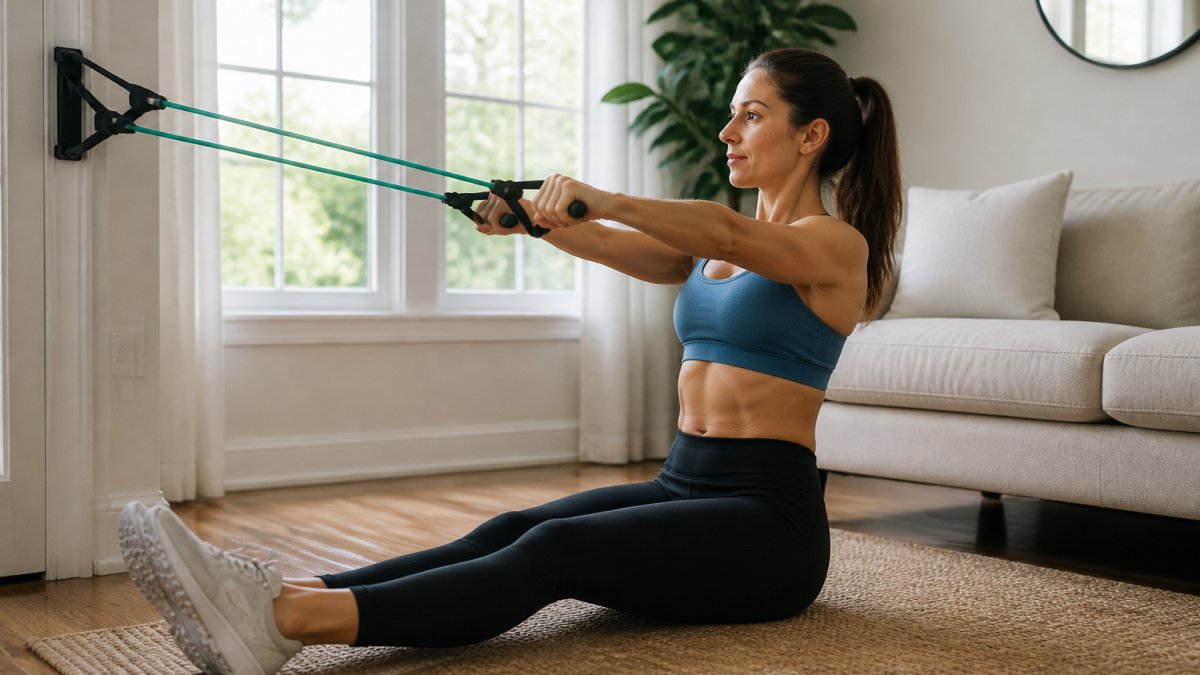
Start with these foundational movements:
- Chest press: Anchor the band at chest height, step forward to create tension, then press forward with both hands
- Rows: Anchor the band in front of you, grip both ends, and pull toward your torso
- Bicep curls: Stand on the band's center, hold the ends, and curl upward
- Shoulder press: Stand on the band, press the ends overhead
- Lateral walks: Place a band around your legs just above the knees, maintain a slight squat, and step sideways
Perform each exercise for 8-12 repetitions. Rest 60 seconds between sets. Complete 2-3 sets per movement.
Form matters more than speed or load. Move slowly through each repetition and avoid jerky movements, slow, controlled reps build better neuromuscular control and reduce injury risk.
20-Minute Resistance Band Workout for Busy Professionals
Time is the biggest barrier to consistency. This 20-minute resistance band workout delivers full-body stimulus without requiring hours at a gym.
Warm-up (2 minutes):
- Arm circles: 30 seconds
- Bodyweight squats: 30 seconds
- Band pull-aparts: 30 seconds
- Glute bridges: 30 seconds
Main circuit (16 minutes): Perform each exercise for 40 seconds of work, 20 seconds of rest. Complete 2 rounds.
Round 1:
exercises with elastic bands →
- Band chest press
- Band rows
- Band bicep curls
- Band shoulder press
Round 2:
- Lateral band walks
- Glute bridges with band
- Band wood chops
- Band pull-aparts
Cool-down (2 minutes):
- Gentle stretching for chest, back, and shoulders
This format keeps your heart rate elevated while building strength. Short rest periods create metabolic demand, so you burn calories during and after the workout, and busy professionals see real results because intensity compensates for the shorter duration.
Best Resistance Bands for Full-Body Workouts: Progressive Overload Strategies
Most guides tell you to "use a thicker band" and stop there. That advice stalls after a few months because you can't just add 5 pounds to the bar. Progressive overload with bands requires manipulating four variables, the difference between a six-week novelty and a multi-year practice.
The four overload levers for elastic resistance
-
Band tension (resistance level). Bands are color-coded by tension, and the jump between levels is not linear. A light band might offer roughly 10-25 pounds of tension at full stretch, a medium 25-40, and a heavy 40-65 or more, depending on manufacturer and band length. Because the rating is measured at a specific elongation, the same band feels very different depending on anchor distance. Before you "level up," mark the anchor point and your standing position so you can reproduce the same starting tension week to week.
-
Stretch length (pre-tension). Stepping further from the anchor increases the band's starting tension, raising the load at every point in the range of motion. A 12-inch increase in anchor distance can add meaningful resistance without changing bands. Use this free, infinitely adjustable lever before buying heavier bands.
-
Volume and density. Add reps, add sets, or reduce rest. Density work (same work in less time) is especially effective with bands because the reduced rest keeps metabolic stress high while the elastic load keeps joint stress low.
-
Tempo and time under tension. A 3-second lowering phase and a 1-second pause at peak contraction can make a light band feel like a heavy one. This is the single most underused progression tool in band training and the safest way to add stimulus without adding resistance.
A concrete 12-week progression model
- Weeks 1-2 (baseline): Light band, 2 sets of 10-12 reps per movement, 2-second lowering phase, 60 seconds rest. Record anchor distance and band color.
- Weeks 3-4 (volume): Same band, 3 sets of 12-15 reps, 45-60 seconds rest.
- Weeks 5-6 (tension): Increase anchor distance by 6-12 inches on pressing and pulling movements; keep reps at 10-12. If form breaks, revert to the previous distance.
- Weeks 7-8 (tempo): Return to baseline anchor distance, add a 3-second lowering phase and a 1-second peak pause. Reps drop to 8-10; time under tension rises.
- Weeks 9-10 (stacking): Double up bands (run a lighter band inside a heavier one) or move up one color level on your two weakest movement patterns only.
- Weeks 11-12 (deload and retest): Cut volume by roughly 40% for one week, then retest your week 1 baseline numbers. If you can complete the original sets with noticeably better control and a slower tempo, the block worked.
When to stack bands vs. buy a heavier one
Stacking a light band inside a heavy band creates a resistance curve that ramps up faster at the top of the range, useful for pressing and squatting where you're strongest near lockout. A single heavier band gives a smoother, more linear curve. If your goal is raw strength at end-range, stack; if it's smooth control through the mid-range, size up.
Equipment that supports real progression
The exercises with elastic bands foot pedal resistance band from thewellbeingshop.com is a practical choice for home workouts because the foot-pedal anchor gives you a fixed, reproducible anchor point, which is exactly what you need to measure and progress anchor distance accurately.
For shoulder-specific work, the Prehab and Performance Shoulder Bands (Set of 6) from thewellbeingshop.com provides six graduated resistance levels, which matters for overload: six levels give you finer jumps than the typical three-band set, so you can progress in smaller increments without stalling.
Recovery, Mobility, and Long-Term Results
Strength training with resistance bands is only half the equation. Recovery and mobility determine whether you build lasting results or burn out.
Active recovery days should include band work.
Mobility training with bands is underrated. Band-assisted stretching, where the band helps you deepen a stretch, improves flexibility and reduces soreness.
Sleep and nutrition support recovery. You build muscle during rest, not during the workout.
Long-term results come from consistency, not intensity.
Conclusion: Building Sustainable Strength at Home
The challenge most people face isn't knowing what to do, it's sticking with it. Resistance bands solve this because they're accessible, affordable, and effective. You can train at home, travel with them, and progress for years without outgrowing the equipment.
At thewellbeingshop.com, we recommend starting with the exercises with elastic bands foot pedal resistance band for foundational full-body work, then adding the Prehab and Performance Shoulder Bands as your training progresses.
Frequently Asked Questions
Can resistance bands build muscle as effectively as weights?
Yes. Resistance bands create variable resistance that increases tension as you stretch them, which drives muscular activation and hypertrophy similar to free weights. Many strength athletes use bands alongside weights for this reason. Your results depend on progressive overload, volume, and consistency, not the tool itself.
Is 20 minutes of resistance band training a day enough?
Twenty minutes is sufficient for maintenance and functional strength, especially for busy professionals. The advantage of bands is that they're efficient: you can work your full-body kinetic chain in a short window because setup and transitions are fast. Quality and intensity matter more than duration.
What exercises work the whole body with resistance bands?
Full-body routines combine upper-body pressing (chest press, shoulder press), pulling (rows, lat pulldowns), lower-body movements (squats, deadlifts, leg curls), and core work (wood chops, pallof presses). Bands excel at all these because they anchor easily and maintain constant tension throughout the range of motion. Beginner routines typically use 5-7 compound movements per session, hitting multiple muscle groups and improving neuromuscular control across your entire kinetic chain.
How often should you do full-body resistance band workouts?
For strength and muscle gains, 3-4 full-body sessions per week with at least one rest day between sessions allows adequate recovery. For maintenance and mobility work, 2-3 sessions weekly is effective. Recovery is when your body adapts and builds strength, so consistency matters more than frequency. Remote workers can benefit from lighter band sessions on off days for postural alignment and joint stability without compromising recovery.
Sustainable strength training starts with equipment that meets you where you are and grows with you as you progress. Resistance bands deliver that flexibility. Combine them with intentional programming, consistent effort, and proper recovery, and you'll see real results that last.