


 Link label

Yoga Equipment for Non-Flexible People
Table of Contents
- Why Yoga Equipment Matters for Non-Flexible Bodies
- Essential Yoga Props for Beginners
- How to Use Yoga Props for Tight Hamstrings
- Yoga Blocks for Beginners: Step-by-Step Usage
- Modifying Poses for Comfort and Safety
- Budget-Friendly DIY Alternatives to Yoga Props
- Building Your Yoga Practice: Progress Tracking and Consistency
- Conclusion
Last Updated: August 13, 2026
Why Yoga Equipment Matters for Non-Flexible Bodies
Many people avoid yoga believing flexibility is a prerequisite. This assumption stops countless individuals from discovering one of the most accessible forms of movement available. Yoga equipment for non flexible people changes this equation entirely. Props aren't crutches, they're tools that allow your body to find proper alignment regardless of your current range of motion.
When you use blocks, straps, and bolsters correctly, you can access the same poses and benefits as flexible practitioners, just with your body's actual starting point as the foundation. A person with tight hamstrings can finally hold a forward fold without rounding their spine. Someone with limited shoulder mobility can practice downward-facing dog without pain.
This matters because consistency beats intensity in yoga. You won't stick with a practice that hurts or makes you feel inadequate. But a practice that feels achievable? That's one you'll return to, week after week, until one day you realize your range of motion has actually improved.
Essential Yoga Props for Beginners
Building a functional yoga practice starts with understanding what each prop does and why it matters for your specific body. You don't need every piece of equipment available, just the right pieces for your limitations.
Yoga Blocks: Foundation Support for Limited Range of Motion
Yoga blocks are rectangular foam or cork tools that bring the ground closer to you. Instead of reaching down to touch the floor in a forward fold, you place your hands on a block. The genius of blocks is their simplicity: they solve the gap between where your body can reach and where you need to reach to find proper alignment.
Blocks typically come in pairs and are used in standing poses, seated stretches, and restorative positions. Cork blocks offer more grip and durability; foam blocks are lighter and less expensive. For beginners, blocks are the single most useful prop to own. They let you practice full poses without compensation patterns.
Yoga Straps: Extending Your Reach Safely
A yoga strap is a long, flat belt with a buckle or loop system that extends your reach without forcing your joints beyond their current range. If you can't clasp your hands behind your back, a strap bridges that gap. If your hamstrings are too tight to hold a reclining stretch, a strap lets you apply gentle tension without yanking.
Straps prevent the most common mistake people with limited flexibility make: forcing themselves deeper into a stretch. When you use a strap, you control the intensity and can gradually progress over weeks. Most straps are 6 to 8 feet long with a buckle mechanism. The strap's real value emerges in hamstring work, where it lets you extend your leg without rounding your lower back.
Bolsters and Cushions: Comfort for Restorative Practice
Bolsters are firm, elongated pillows designed to support your body in restorative poses. Restorative yoga is where non-flexible bodies thrive. You're supported in gentle positions, allowing your nervous system to relax while your muscles gradually lengthen. A bolster under your back in a supported fish pose opens your chest and shoulders without any active effort.
Bolsters are essential for people with tight hip flexors, rounded shoulders, or lower back tension. They let you hold poses for 5-10 minutes without discomfort, which is when real relaxation happens. Firm cushions or rolled blankets can substitute for bolsters if you're starting out.
Yoga Mats with Grip: Stability and Alignment
A quality yoga mat provides stability. A slippery mat forces you to grip with your feet and hands, creating tension and preventing proper alignment. A mat with good grip lets your limbs relax into position. For people with limited flexibility, grip matters even more since you're already working with your body's constraints.
Look for mats with textured surfaces that maintain grip when wet. Thickness should be around 1/4 inch, thick enough to cushion your joints but not so thick that you lose stability in standing poses. The mat becomes your anchor point, telling your body where it is in space.
How to Use Yoga Props for Tight Hamstrings
Tight hamstrings are the most common flexibility limitation. They pull on your lower back, restrict forward folds, and make sitting uncomfortable. Yoga equipment for non flexible people with tight hamstrings specifically addresses this pattern.
Seated Forward Fold Modifications
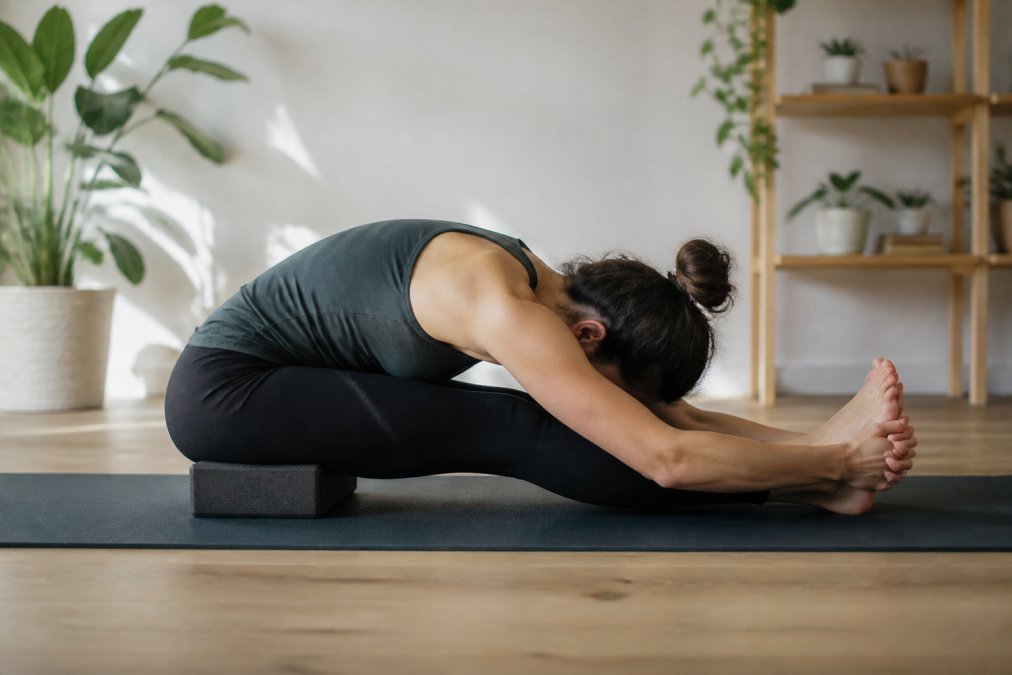
A traditional seated forward fold asks your hamstrings to lengthen while your lower back stays neutral. For tight hamstrings, this is nearly impossible without rounding your spine. The prop-supported version changes everything.
Sit with your legs extended and place a block under your sitting bones. This tilts your pelvis forward, automatically giving your hamstrings slack while your lower back stays long and neutral. Fold forward only as far as you can while keeping your spine straight. Your hands might rest on your shins, blocks, or thighs. Hold for 5-10 breaths, then release.
Repeat this version 3-5 times per week. Over several weeks, your hamstrings will gradually lengthen and you'll need less block support.
Reclining Hamstring Stretch with Props
Lying on your back, extend one leg toward the ceiling and loop your strap around the ball of your foot. Hold the strap with both hands, keeping your arms relatively straight. The strap lets you control the intensity completely, pull closer for more stretch, ease off to relax.
Keep your lower back pressed into the floor. Your extended leg doesn't have to be perfectly vertical; even a 45-degree angle works if that's where your hamstring allows. Hold this position for 60-90 seconds, breathing deeply. Your hamstring will gradually release as your nervous system relaxes. Repeat on the other side.
This single stretch, performed consistently, produces measurable flexibility gains within 4-6 weeks.
Yoga Blocks for Beginners: Step-by-Step Usage
Understanding exactly where and how to place blocks removes the guesswork from your practice.
Using Blocks in Downward-Facing Dog
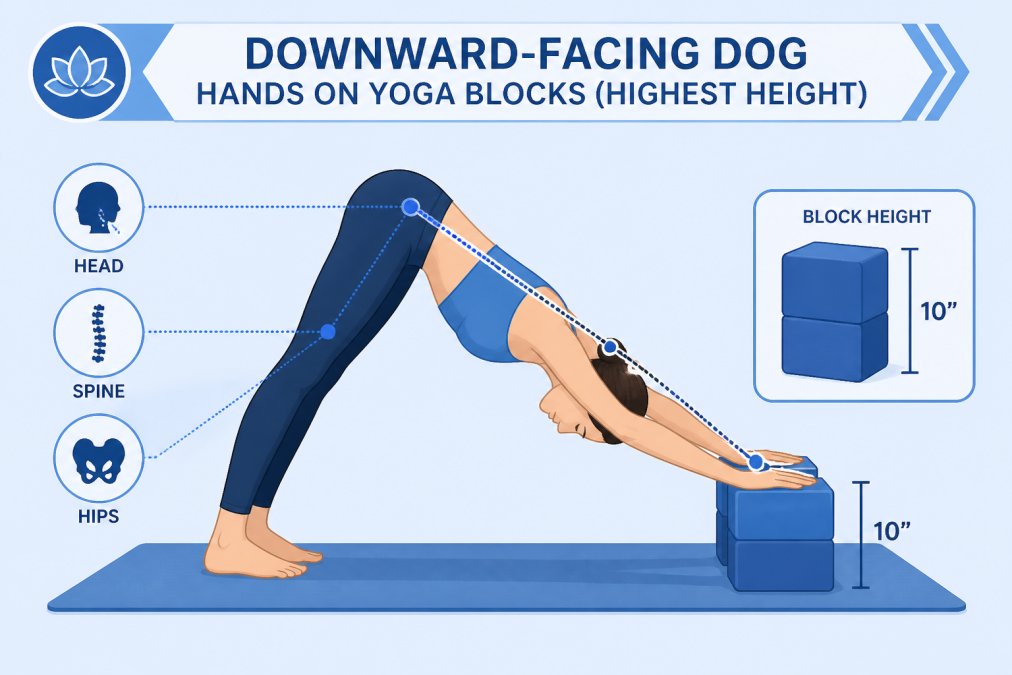
Downward-facing dog is foundational in yoga, but it's brutal for people with tight hamstrings or limited shoulder mobility. Place two blocks on the ground where your hands will land, set at their highest height. Come into downward-facing dog with your hands on the blocks instead of the floor. This instantly reduces the hamstring stretch and allows your shoulders to find proper position.
Your head should hang neutral between your hands and your spine should feel long, not compressed. Your legs can stay slightly bent if your hamstrings are very tight. Over weeks of practice, lower the blocks to medium height, then low height. Eventually, progress to hands on the floor.
Block Support in Child's Pose and Crescent Lunge
Child's pose should feel restful, not restrictive. If your hips are tight, place a block under your forehead so your neck stays neutral and your shoulders can relax. For crescent lunge, place a block under your back hand if your hamstrings prevent you from getting your front knee over your ankle. Both modifications let you hold poses longer, which deepens the benefit.
Modifying Poses for Comfort and Safety
The biggest mistake people make is viewing modifications as temporary failures. They're actually the intelligent way to practice. A modification is how you access a pose safely, given your body's current state.
Every pose has multiple versions. Your job is finding the version that challenges you appropriately without creating pain. A stretch should feel like tension, not sharp pain. If you feel pain in your joints, back off immediately. If you feel pressure in your muscles, that's usually appropriate.
Modifications also prevent injury. A rounded-spine forward fold stresses your lower back, while the same fold with a block under your hips, keeping your spine neutral, is both safer and more effective long-term. Start every pose in its modified version and only progress when the modified version feels easy.
Budget-Friendly DIY Alternatives to Yoga Props
Professional yoga equipment is useful, but it's not mandatory. Stacked books or a sturdy box can replace yoga blocks. A belt, scarf, or towel can function as a yoga strap. Rolled blankets or firm pillows substitute for bolsters in restorative poses.
The advantage of DIY alternatives is that you can start practicing immediately without investment. The disadvantage is that they're less durable and less convenient. A proper yoga block is engineered to support your full body weight without compressing.
Many people start with DIY alternatives, then upgrade to real equipment once they're committed to regular practice. If you do invest in equipment, buy blocks first, they're the most versatile prop and solve the most common limitation. Add a strap next.
Building Your Yoga Practice: Progress Tracking and Consistency
The real transformation happens through consistency, not intensity. A 15-minute practice three times per week, performed for 12 weeks, produces measurable flexibility gains. A 90-minute session once a month produces almost nothing.
Track your progress in specific, observable ways. Can you fold forward farther than last month? Can you hold crescent lunge longer without your back leg trembling? Can you sit cross-legged without your knees being five inches off the ground? These concrete measurements show real change.
Set a specific practice schedule and stick to it for at least 8 weeks before evaluating results. Three 20-minute sessions per week is more effective than sporadic longer sessions. Your nervous system adapts to regular input. Use the same props in the same poses each session to create a baseline for measuring progress.
Yoga equipment for non flexible people isn't about achieving Instagram-perfect poses. It's about creating a sustainable practice that actually improves your flexibility, mobility, and how you feel in your body. The right props remove the barriers that stop most people from starting.
At thewellbeingshop.com, we understand that your body's current state is your starting point, not your limitation. Our curated selection of yoga equipment is designed specifically for practitioners building flexibility from where they are now. Whether you're choosing your first block or completing your home practice setup, we're here to support your journey toward greater ease and strength in your body. Start with what you need today, build consistency, and watch your practice transform over the coming months.
Frequently Asked Questions
Can you do yoga with limited mobility and tight hamstrings?
Yes. Yoga equipment like blocks, straps, and bolsters allows you to modify poses to fit your body's current range of motion. Props reduce strain on tight hamstrings and other areas, letting you build flexibility safely over time. Start with gentle stretching and restorative poses, gradually working toward deeper stretches as your body adapts.
Do I need special equipment to start yoga if I'm not flexible?
Props are highly recommended for non-flexible practitioners. Yoga blocks provide stability in standing poses, straps extend your reach in stretches, and bolsters support restorative poses. These tools prevent injury, improve alignment, and make poses accessible immediately. You can also use household items like books or rolled towels as budget-friendly alternatives while building your practice.
How do yoga blocks help with flexibility?
Blocks reduce the distance you need to reach in poses, allowing proper alignment without forcing your body beyond its current range. This means less compensatory strain on joints and muscles. By practicing with blocks consistently, you build strength and awareness in tight areas like hamstrings and hips, creating the foundation for deeper stretches over weeks and months.
What yoga poses work best for someone who is extremely inflexible?
Child's pose, cat-cow stretches, and gentle forward folds are ideal starting points. Use props to modify: place a bolster under your hips in child's pose, use a strap in forward folds, and keep knees bent in stretches. Restorative yoga with bolsters and blankets is also excellent because it focuses on relaxation and gentle tension release rather than deep stretching, making it beginner-friendly and psychologically less intimidating.
This article was written using GrandRanker