


 Link label

Best Yoga Style for Beginners at Home: A 2026 Guide
Table of Contents
- How to Choose the Best Yoga Style for Beginners at Home
- Hatha Yoga for Beginners: The Foundational Starting Point
- Gentle Yoga for Beginners: Low-Impact Movement for Stiff Bodies
- Vinyasa, Yin, and Restorative: How Yoga Styles Differ in Pace
- 20-Minute Yoga for Beginners: A Structured First-Week Plan
- Yoga Equipment for Beginners: What You Actually Need at Home
- Home Practice Safety and Pose Modifications for Beginners
- Evaluating Online Yoga Classes for Beginners
- Frequently Asked Questions
Last Updated: October 15, 2026
How to Choose the Best Yoga Style for Beginners at Home
The best yoga style for beginners at home depends on three things: your goal, your mobility, and the pace you enjoy. Hatha suits most people starting out because it moves slowly and teaches foundational poses one at a time.
Most beginners quit because they picked a style that did not match their body or schedule, not because yoga is hard.
Match Your Goal to the Right Practice
Your goal should pick the style, not the other way around. Someone who wants to touch their toes has a different path than someone who wants strength.
- Want to relax and unwind? Try Yin or restorative yoga.
- Want to build strength and balance? Vinyasa flow fits best.
- Want to learn the basics properly? Start with Hatha.
A common mistake is jumping into a fast flow class on day one. That is how people pull muscles and never come back.
Assess Your Mobility and Preferred Pace
Mobility testing takes two minutes and saves months of frustration. Sit with your legs straight and reach for your toes, then try a deep squat.
If both feel difficult, choose a slow style. If both feel easy, you can handle more movement.
Pace matters just as much. Ask yourself: do I want to hold poses or flow between them? Holders do well with Hatha, Yin, and restorative; movers do well with Vinyasa.
Hatha Yoga for Beginners: The Foundational Starting Point
Hatha yoga is the best starting point for most beginners because it slows everything down.
It covers the foundational poses: forward fold, downward dog, warrior, and seated twists.
A typical Hatha session runs 45 to 60 minutes, but short 20-minute versions work well at home.
The National Center for Complementary and Integrative Health overview of yoga notes that yoga is generally safe for healthy people when practiced appropriately.
Where Hatha falls short: it can feel slow if you want a sweat. If that is you, read the Vinyasa section next.
Gentle Yoga for Beginners: Low-Impact Movement for Stiff Bodies
Gentle yoga for beginners is slow, low-impact movement with extra support.
It suits anyone with stiff hips, tight shoulders, or too many years at a desk, plus older practitioners and anyone returning after time away.
What most guides miss is that gentle does not mean easy.
Equipment helps here. A block under each hand changes a pose from painful to doable. That is not cheating.
Vinyasa, Yin, and Restorative: How Yoga Styles Differ in Pace
Yoga styles differ mainly in pace, hold time, and intensity, not difficulty. The same pose can appear in all three, held for two breaths or five minutes; what changes is how long you stay, how much heat you build, and how hard your breath works.
Here is how the main styles compare:
| Style | Pace | Hold Time | Breath Cue | Best For | Session Length |
|---|---|---|---|---|---|
| Hatha | Slow | 5-10 breaths | Steady, audible | Learning basics | 45-60 min |
| Gentle | Very slow | 5-10 breaths | Easy, unforced | Stiff bodies | 30-45 min |
| Vinyasa | Fast | 1-2 breaths | One breath, one movement | Strength and sweat | 45-75 min |
| Yin | Very slow | 3-5 minutes | Slow and quiet | Deep tension | 45-60 min |
| Restorative | Still | 5-20 minutes | Natural, relaxed | Stress relief | 60-75 min |
Vinyasa Flow for Building Strength and Momentum
Vinyasa links poses so one flows into the next. You move with your breath, and the sequence rarely stops.
This builds strength, balance, and stamina, and raises your heart rate more than slower styles, which is why it feels like a workout.
The catch: Vinyasa assumes you know basic alignment, and beginners who start here often copy movements without understanding them.
Yin and Restorative Yoga for Deep Tension Relief
Yin yoga holds poses for three to five minutes to reach deep tissue like fascia and connective tissue. Restorative yoga uses props to support the body completely so muscles release without effort.
Both target tension relief and stress relief rather than strength. Both work well as evening practices.
Yin can feel intense in the hips and hamstrings because you stay long enough for the stretch to deepen; restorative rarely feels intense at all.
A Simple Decision Guide for Choosing at Home
Most guides list styles and leave you to guess. Use these three questions instead, in order:
- What is your goal? Relaxation points to Yin or restorative. Strength and sweat point to Vinyasa. Learning the basics points to Hatha.
- How does your body feel today? Stiff, sore, or recovering points to gentle or restorative. Mobile and energetic points to Hatha or Vinyasa.
- What pace will you actually repeat? If you dread fast movement, a slow style you do three times a week beats a flow class you skip.
Answer all three and you have your style. If two answers conflict, default to the slower option for your first month, then reassess.
How the Styles Feel in the First Ten Minutes
Pace is abstract until you feel it. Here is what each style typically feels like when you start:
- Hatha: You stand still, hear the alignment cue, then move. Your breath stays even.
- Gentle: You may not stand at all for the first five minutes. Props do most of the work.
- Vinyasa: You are moving within the first minute. Your breath sets the tempo.
If the first ten minutes feel wrong, that is useful information: the pace does not match your body that day, not that you failed.
20-Minute Yoga for Beginners: A Structured First-Week Plan
Twenty minutes a day beats ninety minutes once a week. Consistency builds the habit; intensity just builds soreness.
Here is a first-week plan you can follow at home:
- Day 1: Gentle yoga, 20 minutes. Focus on breathing and body awareness.
- Day 2: Hatha basics, 20 minutes. Learn five foundational poses.
- Day 3: Rest. Walk or stretch lightly.
- Day 4: Gentle yoga, 20 minutes. Add a seated twist sequence.
- Day 5: Hatha basics, 20 minutes. Repeat day two's poses.
- Day 6: Try one slow Vinyasa flow, 20 minutes.
- Day 7: Restorative yoga, 20 minutes. Hold each pose for two minutes.
By day seven, you will know which style felt best. That is your answer.
Yoga Equipment for Beginners: What You Actually Need at Home
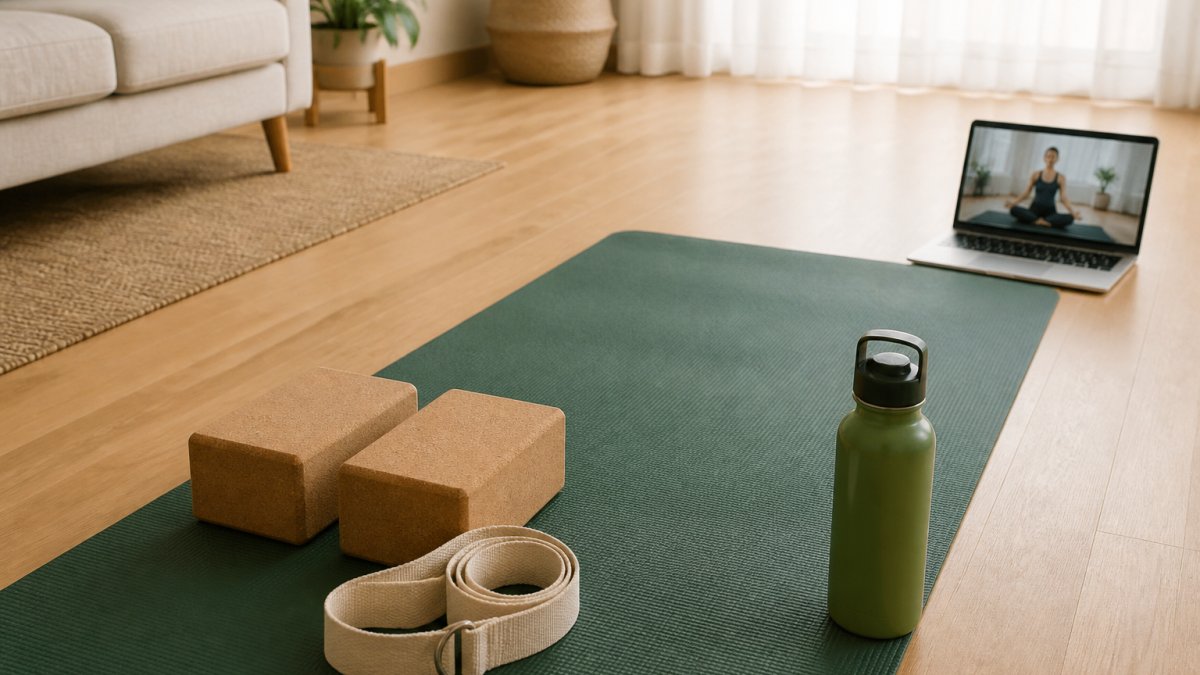
You need three things to start: a mat, two blocks, and a strap. Everything else is optional until you know you will stick with it.
What Each Piece Actually Does
A mat gives you grip and cushioning. Standard mats run about 68 inches long and 24 inches wide; a longer mat helps if you are tall.
Blocks bring the floor closer when your hands will not reach.
A strap extends your reach in poses like seated forward fold. A cotton strap with a buckle is simplest, and a rolled towel works in a pinch.
Setting Up a Small Space
You do not need a dedicated room, just a rectangle roughly the length of your mat plus a foot on each end, about seven feet by four feet. Clear that footprint and you are set.
- Floor surface: Carpet is fine; a mat on carpet can slide, so check grip before you flow. Hardwood and tile need the mat for cushioning.
- Wall space: One clear wall helps for balance poses and for legs-up-the-wall, a common restorative shape.
- Ceiling and overhead: Avoid practicing under low fixtures or ceiling fans during standing poses.
Cheap Alternatives Before You Buy
If you are not ready to spend, these substitutions work for a first month:
- Mat alternative: A dense blanket or a non-slip rug over carpet. Test grip before relying on it.
- Block alternative: A thick hardcover book or a sturdy box. Stack two if you need more height.
- Strap alternative: A belt, a bathrobe tie, or a rolled towel.
Screen and Sound Setup
Most beginners at home follow a video, so the setup matters as much as the mat.
- Screen position: Place your laptop or tablet at eye level when standing, or angle it so you can see it from the floor. A stack of books under the device is enough.
- Distance: About six to eight feet back lets the camera see your full body if you ever record yourself, and keeps the screen readable.
- Sound: Built-in speakers are usually fine. If cues get lost, a small Bluetooth speaker near your mat helps more than turning the volume up.
Skip the expensive extras at first. Bolsters, blankets, and wheels help later, once you know your practice.
At thewellbeingshop.com, we provide a curated selection of fitness equipment and mind-body training tools designed to help you enhance your daily movement and strengthen your home wellness practice.
Home Practice Safety and Pose Modifications for Beginners
Safety at home comes down to three habits: warm up, modify, and stop when something pinches.
Warm up for five minutes before any flow.
Modify poses to fit your body:
- Tight hamstrings? Bend your knees in forward fold.
- Sore wrists? Do poses on fists or forearms.
- Stiff hips? Sit on a folded blanket for seated poses.
Sharp pain means stop. Dull stretch means continue. Learn that difference early and you will avoid most injuries.
The American Council on Exercise guidance on safe stretching recommends avoiding bouncing in stretches and holding steady instead.
Evaluating Online Yoga Classes for Beginners
A good online class tells you what to do, why it matters, and how to adjust when it does not work. Anything less is a video, not instruction.
Use these criteria before you commit:
- Does the teacher offer modifications? Look for blocks, straps, and chair options.
- Is the pace labeled? "Beginner" means nothing without a speed.
- Can you see the full body? Camera angles matter more than production quality.
The Centers for Disease Control and Prevention physical activity guidelines recommend adults get regular movement each week. Short home sessions count toward that total.
Frequently Asked Questions
What type of yoga should a beginner start with?
Hatha yoga is the most common starting point for yoga for beginners. It moves at a slower pace, holds poses for several breaths, and emphasizes alignment and breath awareness. This gives you time to learn foundational poses like forward fold, seated poses, and basic standing postures without rushing. Gentle yoga is a good alternative if you have stiff hips, tight shoulders, or low mobility. Both styles work well for home practice because you can pause a video, repeat a pose, and modify without feeling behind the class.
Will 20 minutes of yoga a day make a difference?
Yes, a consistent 20-minute yoga for beginners routine can improve flexibility, mobility, and stress relief over time. The key is regularity, not session length. Practicing five to six days a week for 20 minutes builds more body awareness than one 90-minute class. A short session can include a warm-up, four to six foundational poses, and a brief relaxation. If you only have 15 minutes on busy days, that still counts. Small, repeated habits are what make a home practice stick.
Is Vinyasa yoga suitable for beginners at home?
Vinyasa can work for beginners, but it moves faster than Hatha or gentle yoga. The continuous flow between poses builds strength and cardiovascular endurance, but it can be hard to follow if you are still learning alignment. If you want to try Vinyasa at home, look for beginner-labeled classes that break down the sun salutation sequence. Start with two Vinyasa sessions a week and keep Hatha or gentle yoga on other days. That mix lets you build stamina without losing form.
What do you need to start doing yoga at home?
You need very little to start. A yoga mat with enough grip is the main piece of yoga equipment for beginners. Two blocks help you modify poses when your hamstrings or shoulders are tight, and a strap extends your reach in seated poses and forward folds. Wear comfortable clothing you can move in. A quiet corner with enough floor space for a mat is enough. You do not need special shoes, weights, or a dedicated room. Start simple and add props only when a specific pose calls for them.
Building a home yoga habit is less about finding the perfect style and more about starting with one that fits your body today. At thewellbeingshop.com, we help you build that routine with curated fitness equipment, mind-body training tools, and nutritional support designed for home practice. Our gear supports daily movement, recovery, and the small habits that add up to lasting change. Get started with thewellbeingshop.com and build a home practice you will still keep next year.