


 Link label

Effective Yoga Poses for Chronic Back Pain at Home
Table of Contents
- Why Yoga Works for Chronic Back Pain
- Before You Start: Safety and When to Seek Help
- Yoga for Lower Back Pain: Essential Poses and Techniques
- Gentle Yoga for Back Pain: Restorative Poses You Can Hold
- Restorative Yoga for Back Pain: Slow, Supported Practice
- Yoga Modifications for Back Pain: Tailoring Poses to Your Needs
- Your 20-Minute At-Home Yoga Sequence for Back Pain
- Making Yoga a Habit: Progression and Realistic Expectations
- Frequently Asked Questions
Last Updated: October 14, 2026
Why Yoga Works for Chronic Back Pain
Chronic back pain affects millions of people, especially those who spend hours sitting at desks or in cars. Effective yoga poses for chronic back pain at home can help reduce tension, strengthen weak muscles, and improve flexibility without expensive equipment or gym memberships.
Yoga addresses back pain in three key ways. First, it stretches tight muscles that pull on your spine. Second, it strengthens your core and back muscles to support your spine better. Third, it teaches you to move with better posture and alignment throughout your day.
Consistent home yoga practice can transform how people manage pain. The best part? You don't need to be flexible or experienced. You just need a mat and 20 minutes.
Before You Start: Safety and When to Seek Help
Before beginning any yoga routine for back pain, understand what's safe and what's not. Not all back pain is the same, and not all poses work for every type of pain.
Stop practicing and contact a doctor if you experience sharp, shooting pain, numbness, tingling in your legs, or pain that worsens despite rest. These can signal nerve involvement that needs medical attention.
Gentle movement helps most cases of chronic back pain. But if your pain started after an injury, accident, or fall, get cleared by a healthcare provider before starting yoga.
Work within your range of motion. Your body will tell you what it needs. Listen to it. Pain is information, not weakness.
Yoga for Lower Back Pain: Essential Poses and Techniques
Lower back pain responds well to poses that mobilize your spine and strengthen your core. These foundational poses build the strength and flexibility you need to move without pain.
Cat-Cow Pose for Spinal Mobility
Cat-Cow Pose gently moves your entire spine through its full range of motion. This pose warms up your back and teaches your body healthy spinal movement.
Start on your hands and knees on a yoga mat. Your wrists should be under your shoulders and your knees under your hips.
For the Cow part: Drop your belly toward the mat, lift your gaze, and let your tailbone reach toward the ceiling.
For the Cat part: Round your spine, tuck your chin, and draw your belly button toward your spine. Breathe out as you move into this position.
Move slowly between these two positions. Spend 5-10 breaths moving back and forth. Let your breath guide your movement, not your speed.
Child's Pose for Gentle Relief
Child's Pose is one of the gentlest yoga poses for back pain. It stretches your lower back, hips, and shoulders while calming your nervous system.
Start on your hands and knees. Bring your big toes together and let your knees fall apart. Sink your hips back toward your heels and rest your forehead on the mat.
Let your arms extend forward or rest alongside your body. Breathe deeply for 1-2 minutes. This pose feels restorative because it actually is.
Child's Pose works well as a rest pose between more active movements. Return to it whenever you need a break.
Sphinx Pose for Core Strength
Sphinx Pose strengthens your core and back muscles while gently extending your spine. It builds the strength you need to support your lower back throughout the day.
Lie on your belly with your forearms on the mat. Your elbows should be under your shoulders. Press your forearms and hands into the mat to lift your chest slightly off the ground.
Keep your shoulders relaxed away from your ears. Your gaze should stay neutral, not craning your neck up. Hold for 30-60 seconds and repeat 2-3 times.
This pose strengthens without aggressive extension. It's perfect for building endurance in your back muscles.
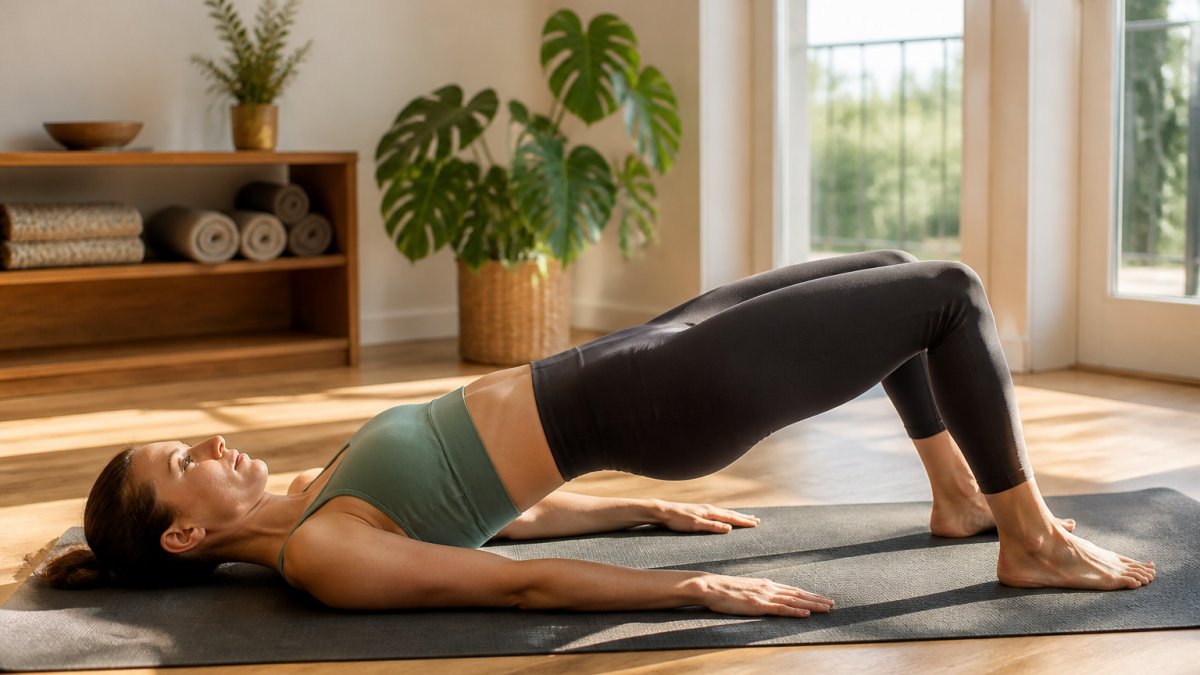
Bridge Pose for Back and Glute Activation
Bridge Pose activates your glutes and strengthens your entire posterior chain. Strong glutes take pressure off your lower back and improve your posture.
Lie on your back with your knees bent and feet flat on the floor. Your feet should be hip-width apart and parallel to each other.
Press through your feet to lift your hips toward the ceiling. Squeeze your glutes as you rise. Your shoulders should stay on the mat.
Bridge Pose is one of the most effective poses for back pain because it targets the exact muscles that support your spine.
Gentle Yoga for Back Pain: Restorative Poses You Can Hold
Restorative yoga for back pain emphasizes holding poses longer and using props to support your body. This approach reduces strain and allows deep relaxation.
Downward-Facing Dog with Modifications
Downward-Facing Dog is famous in yoga, but the standard version can strain your back if done wrong. The modified version gives you all the benefits without the risk.
Start on your hands and knees. Press your hands firmly into the mat and lift your hips high. Your body should form an inverted V shape.
For a gentler version, bend your knees slightly. This reduces strain on your lower back and hamstrings. You can also lower your forearms to the ground instead of keeping your hands down.
Hold for 30-60 seconds. Breathe deeply. If your head feels heavy, rest it on a block or the mat.
Knee-to-Chest Stretch for Spinal Release
Knee-to-Chest Stretch releases tension in your lower back and glutes. It's simple but incredibly effective for spinal mobility.
Lie on your back with both knees bent. Pull one knee toward your chest and hold it with both hands. Keep your other foot on the floor or extend it if that feels better.
Hold for 30-60 seconds on each side. Breathe slowly and let your muscles relax. Repeat 2-3 times on each leg.
This stretch targets the exact muscles that tighten when you sit all day. Use it whenever your back feels tight.
Restorative Yoga for Back Pain: Slow, Supported Practice
Restorative yoga for back pain uses props like pillows, blankets, and blocks to support your body in passive poses. You hold poses longer, sometimes 5-10 minutes, while your muscles relax completely.
The goal is not to stretch deeper or go further. The goal is to let gravity and time do the work.
Supported Child's Pose works well for this. Place a pillow under your belly and forehead. Rest here for 5-10 minutes and let your back relax completely.
Supported Reclined Twist is another restorative option. Lie on your back with a pillow under your head.
Restorative poses feel passive, but they're powerful. They teach your body that rest and relaxation are part of healing.
Yoga Modifications for Back Pain: Tailoring Poses to Your Needs
Not every pose works for every person. Your pain pattern, mobility level, and past injuries all affect which poses help and which ones hurt.
Modifications for Different Pain Patterns
Lower back pain often comes from tight hip flexors and weak glutes. If this describes your pain, focus on hip openers and glute activation poses like Bridge Pose.
Mid-back pain often comes from poor posture and tight chest muscles. Cat-Cow Pose and gentle spinal twists work better for this type of pain.
Upper back and neck pain often comes from tension and forward posture. Child's Pose and shoulder rolls address this pattern.
Pain on one side of your back suggests muscle imbalance. Do extra stretches and strengthening on the opposite side to rebalance your body.
Props and Setup for Home Practice
You don't need expensive equipment. A yoga mat, two pillows, and a blanket create everything you need for a complete home practice.
Use pillows under your head, hips, or belly for support in restorative poses. Use a blanket rolled under your lower back for extra support in Bridge Pose. A sturdy chair works as a prop for many modifications.
Investing in a quality yoga mat and a few basic props can enhance your home practice. Your home practice space should feel comfortable and inviting. You're more likely to practice consistently when your setup feels good.
Your 20-Minute At-Home Yoga Sequence for Back Pain
This sequence combines warm-up, strengthening, stretching, and relaxation. Do it 3-4 times per week for best results. You can progress to daily practice once your body adapts.
Warm-Up (3 minutes)
Start with 5-10 rounds of Cat-Cow Pose. Move slowly and let your breath guide your movement. This warms up your spine and prepares your body for deeper work.
Follow with 10 arm circles in each direction. Roll your shoulders backward 10 times. These movements prepare your upper back and shoulders.
Main Sequence (14 minutes)
- Bridge Pose: 3 sets of 60 seconds with 30 seconds rest between
- Sphinx Pose: 2 sets of 60 seconds with 30 seconds rest
- Downward-Facing Dog (modified): 3 rounds of 45 seconds
- Child's Pose: 2 minutes of rest
- Knee-to-Chest Stretch: 1 minute each leg
- Reclined Spinal Twist: 2 minutes each side
Move through this sequence at a steady pace. Rest when you need to. This isn't a race.
Cool-Down and Breathing (3 minutes)
End with 2 minutes in Supported Child's Pose. Place a pillow under your belly and rest your forehead on it. Breathe deeply and let your body relax.
Finish with 1 minute of deep breathing. Lie on your back, place one hand on your belly, and breathe slowly through your nose. Count to 4 as you breathe in, hold for 4, and breathe out for 4.
Making Yoga a Habit: Progression and Realistic Expectations
Consistency matters more than intensity. A 20-minute practice three times per week beats a 90-minute practice once per month.
Most people notice improvement within 2-3 weeks of consistent practice.
After 6-8 weeks, you'll notice real changes. You'll move differently. Your posture will improve. Your pain will decrease.
Progress by holding poses longer or adding more challenging variations. Once Bridge Pose feels easy, try single-leg Bridge Pose.
Track your progress in simple ways. Notice how far you can bend forward. Notice how long you can hold poses.
The real power of effective yoga poses for chronic back pain at home comes from showing up consistently.
Set a specific time for your practice. Morning practice energizes you for the day.
Chronic back pain doesn't have to control your life. Add supportive tools like quality yoga mats, props, and ergonomic home setup equipment to deepen your practice.
Frequently Asked Questions
Should I do yoga if my back hurts?
Gentle, modified yoga can help chronic back pain by improving spine mobility, strengthening core muscles, and reducing muscle tension. However, acute pain or sharp sensations require medical evaluation first. Start with restorative poses and listen to your body. If pain worsens during practice, stop and consult a healthcare provider.
Which yoga poses should I avoid with back pain?
Avoid deep forward bends, intense spinal twists, and backbends that strain the lower back, especially if you have chronic pain. Poses like full Downward-Facing Dog, Locust Pose, and unsupported backbends can aggravate symptoms. Modifications exist for most poses, Child's Pose and Bridge Pose are safer alternatives that build strength without excessive strain.
How often should I do yoga for back pain?
Consistency matters more than intensity. Practice 3-5 times per week for best results, with sessions lasting 15-30 minutes. Daily gentle stretching and breathing work can complement longer sessions. Allow rest days to prevent overuse, and track how your back responds to find your ideal frequency.
Can beginners do yoga for chronic back pain at home?
Yes. Beginners can safely practice yoga at home for chronic back pain by starting with gentle, restorative poses and using modifications. Focus on alignment and breath rather than depth. Props like pillows and blankets make poses more accessible. If you're unsure about form, follow instructional videos or consult a yoga instructor before starting.