
How to Start a Low Impact Strength Training Routine
Table of Contents
- What Low Impact Strength Training Actually Is
- Why Low Impact Beats High Impact for Most Beginners
- Low Impact Workout Equipment for Home
- Your Beginner Home Strength Training Plan
- Strength Training Frequency for Beginners
- Getting Past the Mental Hurdles
- Recovery, Progress Tracking, and Staying Consistent
- Frequently Asked Questions
Last Updated: September 19, 2026
What Low Impact Strength Training Actually Is
Low impact strength training builds muscle and bone strength without jumping, running, or heavy joint pounding. Movements stay controlled, and at least one foot usually stays on the floor.
That definition clears up a common mix-up.
- Low impact describes the force on your joints, not the effort you feel.
- Low intensity describes how hard you work. The two are not the same thing.
- A goblet squat with a heavy kettlebell is low impact and high effort at the same time.
Why Low Impact Beats High Impact for Most Beginners
The biggest mistake new lifters make is copying a high-impact plan built for athletes, skipping the base they need first. People who start too hard often quit within weeks as sore joints and exhaustion stack up. Low impact training flips that script.
Here is why it wins for beginners:
- Joint health comes first. Controlled movement protects knees, hips, and shoulders.
- Recovery is faster. Less pounding means less downtime between sessions.
- Form is easier to learn. Slow tempo training lets you feel each rep.
- Consistency is higher. A routine you can repeat beats one that wrecks you.
Low Impact Workout Equipment for Home
You do not need a full gym to start low impact strength training. The most common reason beginners stall is buying gear before they have a habit. So this section covers two paths: a zero-equipment setup for small spaces, and a minimal kit for when you are ready to add load.
The Zero-Equipment Path (Start Here)
Your body is the first piece of equipment. A chair, a wall, and a towel cover almost every movement pattern a beginner needs.
- A sturdy chair for sit-to-stands, incline push-ups, and step-ups.
- A clear wall for wall sits, wall push-ups, and shoulder blade slides.
- A rolled towel or folded blanket for knee padding during floor work.
- A backpack you already own, loaded with books or water bottles, as a stand-in for dumbbells.
The Minimal Kit (When You Are Ready)
Once bodyweight movements feel controlled, add tools in this priority order:
- Resistance bands first. They are the cheapest way to add pulling work and are joint-friendly because tension builds gradually through the range of motion.
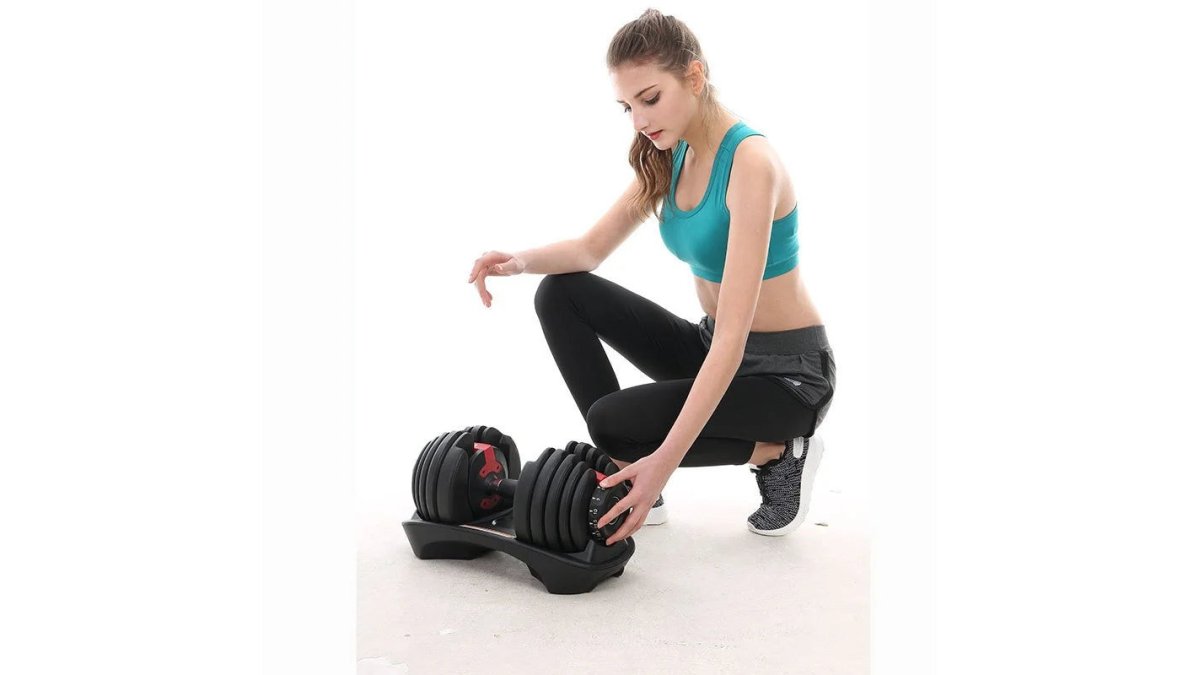
- Adjustable dumbbells second. One set replaces a rack of fixed weights and lets you progress in small increments.
- A kettlebell third, for goblet squats and carries.
- An ab wheel last, once your core can hold a neutral spine under load.
| Equipment | Best For | Why It Works |
|---|---|---|
| Bodyweight + chair | First 2-4 weeks | Teaches form with no load to manage |
| Loaded backpack | Early progressive overload | Free, adjustable, and already in your home |
| Resistance bands | Pulling and warm-ups | Gradual tension, joint-friendly |
| Adjustable dumbbells | Progressive overload | One set covers many weights |
| Neoprene dumbbells | Light, fixed work | Comfortable, non-slip grip |
| Kettlebell | Squats and carries | Textured grip, single-cast build |
| Ab wheel | Core and stability | Deep core engagement |
Small-Space Setup Rules
Training in a bedroom or living room corner? A few rules keep the routine workable:
- Keep one clear floor area roughly the size of a yoga mat. That is enough for every movement above.
- Store bands and small weights in a single bin you can slide under a bed or into a closet.
- Do presses and rows seated or standing rather than lying down if ceiling height or furniture is tight.
- Use a wall or doorframe for anchoring bands instead of buying a rack.
Your Beginner Home Strength Training Plan
A beginner home strength training plan should fit into 20 to 30 minutes, three days a week, enough to build the habit before the load.
Here is a simple full-body template:
- Warm-up: 5 minutes of arm circles, leg swings, and bodyweight squats.
- Goblet squat: 2 sets of 8 to 10 reps.
- Incline push-up: 2 sets of 6 to 10 reps.
- Glute bridge: 2 sets of 10 to 12 reps.
- Dumbbell row: 2 sets of 8 to 10 reps per side.
- Lateral raises: 2 sets of 10 to 12 reps.
- Cool-down: 5 minutes of easy stretching.
Week 1-2: Building the Habit
The first two weeks are about showing up, not pushing hard. Use light weights or just your bodyweight.
Week 3-4: Adding Load and Volume
Once the routine feels easy, add a little, progressive overload in its simplest form.
- Add one set to each exercise, or
- Add a small amount of weight, or
- Slow your tempo to make each rep harder.
Strength Training Frequency for Beginners
The right strength training frequency for beginners is two to three sessions per week, with at least one rest day between them. Muscles rebuild during recovery, not during the workout. Training the same muscles daily blocks recovery and stalls progress. Establishing this consistent rhythm provides a stable foundation for long-term health, especially when transitioning toward strength training for maintenance.
A simple weekly setup looks like this:
- Monday: Full-body session
- Tuesday: Rest or a walk
- Wednesday: Full-body session
- Thursday: Rest
- Friday: Full-body session
- Weekend: Rest or light movement
Getting Past the Mental Hurdles
The hardest part of starting is rarely physical. It is the voice that says you are not ready.
A few mental shifts that help:
- Lower the bar for day one. Ten minutes counts.
- Pick a fixed time. Same hour, same days, less decision-making.
- Track wins beyond the mirror. Energy, sleep, and mood count.
- Expect a slow start. Progress is quiet at first.
Recovery, Progress Tracking, and Staying Consistent
Recovery is where your muscles actually get stronger, and skipping it stalls your routine. For beginners, here is what matters most in the first few months.
A Beginner Recovery Protocol
Build these into every week:
- Sleep 7 to 9 hours when you can. This is the single biggest lever. Growth hormone release and tissue repair happen mostly during deep sleep.
- Eat protein at each meal. A common guideline is roughly 0.7 to 1 gram of protein per pound of bodyweight per day for people doing strength work. You do not need to track it perfectly; just anchor each meal with a palm-sized portion.
- Drink water through the day. Dehydration shows up as sluggish sessions long before it shows up as thirst.
- Take at least one full rest day per week. Two is fine if you feel run down.
- Walk on off days. Ten to twenty minutes of easy movement improves blood flow to sore muscles without adding training stress.
Warm-Up and Cool-Down Structure
Most guides mention warm-ups and cool-downs but never say what to do. Here is a simple structure for a 20 to 30 minute session.
Warm-up (5 minutes):
- One minute of marching in place or easy walking.
- Arm circles, 10 forward and 10 back.
- Leg swings, 10 per side.
- Bodyweight squats, 10 reps at a slow tempo.
- Shoulder blade slides against a wall, 10 reps.
Cool-down (5 minutes):
- Easy walking or marching for one minute to bring your heart rate down.
- Hold a gentle stretch for each major area you trained: quads, hamstrings, glutes, chest, and lats. Hold each for 20 to 30 seconds.
- Two or three slow diaphragmatic breaths to shift out of the workout state.
Tracking Progress Beyond the Scale
The scale is a poor scoreboard for strength training. Muscle weighs more than fat, so the number can stall while you get stronger. For low-impact training specifically, the most useful metrics are about movement quality, not body weight.
Track these instead:
- Reps and sets you can complete with good form at the same weight.
- Range of motion. Can you squat deeper than last month? Can you reach your arms further overhead? A phone video from the side is enough to compare.
- Stability. How much do you wobble during a single-leg balance or a split squat? Less wobble is real progress.
- Weight you can lift with good form. Add load only when the current weight feels controlled for all prescribed reps.
- How your clothes fit. A looser waistband with a stable scale number usually means body composition is shifting.
- Energy and posture through the day. Better posture and less afternoon fatigue are common early wins.
- How quickly you recover between sessions. Shorter soreness windows mean your body is adapting.
Staying Consistent When Motivation Drops
Consistency is a skill you practice, not a trait you either have or do not. A few habits make it easier:
- Set a minimum session. On bad days, do the warm-up and one exercise. That still counts and keeps the streak alive.
- Miss a day, return at the next session. Do not wait for Monday to "start over." The restart rule is the single biggest cause of lost momentum.
- Schedule sessions like appointments. Same days, same time, on your calendar.
- Review your log every two weeks. Seeing concrete progress is more motivating than any pep talk.
Frequently Asked Questions
Is low impact strength training effective for building muscle?
Yes. Muscle growth depends on progressive overload, not on jumping or pounding your joints. Moves like goblet squats, glute bridges, incline push-ups, and lateral raises load the muscles through a full range of motion. Add reps, sets, or weight every week or two, and you can build muscle hypertrophy and strength without any high-impact movement. Many lifters train this way for years.
How many days a week should a beginner do strength training?
Two to three sessions per week is the sweet spot for beginners. That gives each muscle group 48 hours to recover while still building the habit. Start with two full-body sessions, then add a third once the routine feels easy. Strength training frequency for beginners matters less than consistency, so pick days you can actually keep.
What equipment do I need for a low impact home workout?
You can start with bodyweight exercises alone. As you progress, an adjustable dumbbell set, a kettlebell, resistance bands, and a fitness equipment abdominal wheel cover most low impact strength training needs. A mat helps for floor work. The Adjustable Dumbbell Set from The Well Being Shop ($185.36) lets you add load gradually without a rack of separate weights.
How can I modify high-impact exercises to be low-impact?
Swap jumping jacks for step-outs, burpees for incline push-ups, and jump squats for goblet squats. Slow the tempo, shorten the range of motion, or add a chair for support. The goal is controlled movement that keeps tension on the muscle without pounding your joints. Form correction and intensity modification matter more than the exercise name.