


 Link label

How to Use a Pilates Ring for Core Strength at Home
Table of Contents
- What Is a Pilates Ring and Why It Works for Core Strength
- How to Use a Pilates Ring: Setup, Posture, and Breathing
- Pilates Ring Exercises for Beginners
- 10-Minute Pilates Ring Workout for Core Activation
- Pilates Ring Form Tips: Common Mistakes and Corrections
- Safety, Contraindications, and When to Stop
- Selecting and Caring for Your Pilates Ring
- Frequently Asked Questions
Last Updated: October 18, 2026
What Is a Pilates Ring and Why It Works for Core Strength
A Pilates ring, also called a magic circle, is a flexible metal circle with padded handles or pads on opposite sides. When you squeeze it, the ring creates resistance that engages your muscles.
The ring works by forcing your muscles to work harder against its spring tension. This type of resistance training activates your core, inner thighs, glutes, and hip muscles all at once.
Core strength matters. A strong core improves your posture, reduces back pain, and makes everyday movements easier. Many people sit at desks all day and develop weak cores.
The beauty of the Pilates ring is simplicity. You don't need a gym membership or expensive equipment. You just need a mat, the ring, and 10 minutes. That's enough to see real progress in core engagement and stability.
How to Use a Pilates Ring: Setup, Posture, and Breathing
Before you start any exercise, get your setup right. Proper form prevents injury and makes the ring work better.
Ring Placement for Different Exercises
Ring placement changes based on what you're targeting. Here are the main positions:
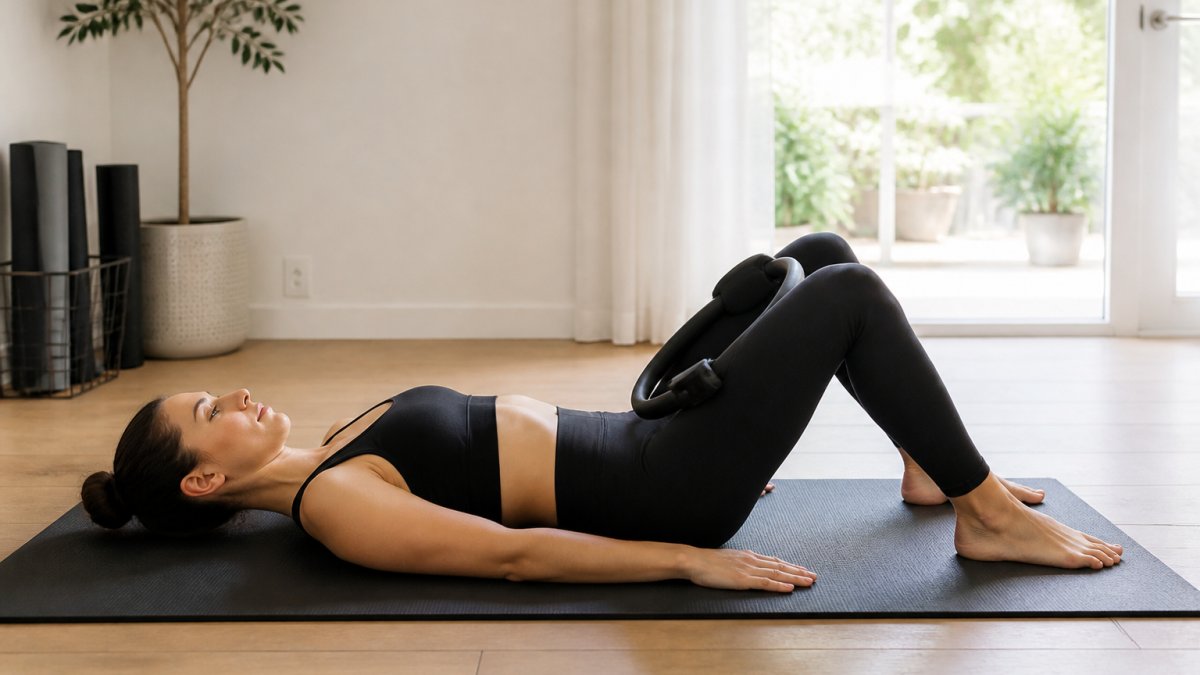
- Between the knees: Best for inner thigh and core work. Lie on your back with knees bent and place the ring between your knees.
- Between the thighs: Targets the inner thighs and glutes. Stand or lie down with the ring higher up between your thighs.
- Under your feet: Works your arms and chest. Place the ring flat on the ground and stand on it while holding the handles.
- Behind your head: Engages your chest and arms. Hold the ring behind your head and squeeze it forward.
- In your hands: Targets arms, chest, and shoulders. Hold the handles and squeeze the ring in front of your body.
Start with the between-the-knees position if you're new to Pilates rings. It's the easiest and safest way to learn proper form.
Proper Breathing and Core Engagement
Breathing matters more than most people think. Bad breathing breaks your core engagement and wastes the work you're doing.
Here's the right way to breathe during Pilates ring exercises:
- Inhale before you start the movement. Take a full breath through your nose.
- Exhale as you squeeze the ring or perform the main movement. This is when your core engages most.
- Inhale as you release or return to starting position.
Never hold your breath. Holding breath increases pressure in your chest and reduces core activation. Steady breathing keeps your muscles working and your mind focused.
Core engagement means tightening your deep abdominal muscles. Before each exercise, pull your belly button toward your spine slightly. Don't suck in your stomach hard, just engage it. This creates a stable foundation for the ring work.
Neutral spine is critical. Your spine should be in a straight line from your head to your tailbone. If you're lying down, don't let your lower back arch off the mat. If you're standing, don't lean forward or backward.
Pilates Ring Exercises for Beginners
These exercises build core strength, activate your glutes, and strengthen your inner thighs. Start with 2-3 sets of 10-15 repetitions for each exercise.
Inner Thigh Squeeze
This is the most basic Pilates ring exercise. It's perfect for beginners because it teaches you how to use the ring safely.
Starting position: Lie on your back on a mat. Bend your knees and place your feet flat on the floor about hip-width apart. Place the ring between your knees.
The movement: Squeeze the ring by pressing your knees together. Squeeze hard for 2 seconds, then release. Repeat 12-15 times.
What you should feel: Pressure in your inner thighs and a slight tightening in your lower abs.
Common mistake: Squeezing too fast. Slow, controlled squeezes work better than quick ones. Speed doesn't add resistance, tension does.
Glute and Hip Activation
This exercise targets your glutes and hip muscles. Strong glutes improve your posture and reduce lower back pain.
Starting position: Lie on your back. Bend your knees and place your feet flat. Position the ring between your upper thighs, closer to your hips.
The movement: Squeeze the ring while pressing your hips up slightly off the mat. Hold for 1 second, then lower back down. Repeat 10-12 times.
What you should feel: Your glutes working and your core tightening.
Pro tip: This exercise works better when you squeeze the ring AND press your hips up at the same time. The two movements together create more glute activation.
Beginner Progressions and Regressions
Not every body is the same. If an exercise feels too hard, make it easier. If it feels too easy, make it harder.
Easier version (regression): Do the same exercise but squeeze the ring less hard. Use only 50% of your strength. This lets you focus on form before adding intensity.
Harder version (progression): After you master the basic squeeze, add a small pulse. Squeeze the ring, then add 5-10 tiny pulses without releasing. This keeps your muscles under tension longer.
Another progression: Combine two exercises. Do 10 inner thigh squeezes, then immediately do 10 glute presses. No rest between. This builds endurance and burns more energy.
10-Minute Pilates Ring Workout for Core Activation
This complete workout takes 10 minutes and hits your entire core. Do it 3-4 times per week for best results.
| Exercise | Duration | Reps | Rest |
|---|---|---|---|
| Inner thigh squeeze | 2 minutes | 15 reps x 2 sets | 30 seconds |
| Glute and hip press | 2 minutes | 12 reps x 2 sets | 30 seconds |
| Ring pulses (between knees) | 2 minutes | 20 pulses x 2 sets | 30 seconds |
| Standing ring squeeze | 2 minutes | 15 reps x 2 sets | 30 seconds |
| Cool-down stretch | 2 minutes | Hold each 30 seconds | , |
How to do this workout: Start with inner thigh squeezes. Lie down, place the ring between your knees, and squeeze 15 times. Rest 30 seconds. Repeat one more time. Move to the next exercise without long breaks.
Timing matters. Don't rest more than 30 seconds between sets. Keeping your heart rate up makes the workout more effective.
Track your progress. Count your reps each time you do this workout. After 2 weeks, you should be able to do more reps or squeeze harder. This is how you know you're getting stronger.
exercises with elastic bands →
Pilates Ring Form Tips: Common Mistakes and Corrections
Most beginners make the same mistakes. Knowing what to avoid saves you time and prevents injury.
Mistake 1: Squeezing too hard too fast
Many people think harder is better.
Fix this: Start with 60% effort. Focus on steady, controlled squeezes.
Mistake 2: Not engaging your core before squeezing
Your core should be engaged before the ring even touches your body.
Fix this: Before every set, pull your belly button toward your spine. Tighten your abs slightly.
Mistake 3: Letting your lower back arch
When you're lying down and squeezing the ring, your lower back might lift off the mat.
Fix this: Press your lower back gently into the mat. Keep it there the whole time.
Mistake 4: Breathing incorrectly
Holding your breath is the biggest mistake.
Fix this: Exhale as you squeeze. Inhale as you release. Keep breathing steady the whole time.
Mistake 5: Rushing through reps
Speed doesn't equal results. Fast, sloppy reps waste your time and don't build strength.
Fix this: Take 2 seconds to squeeze and 2 seconds to release.
Safety, Contraindications, and When to Stop
The Pilates ring is safe for most people, but certain conditions require caution or modification.
Stop exercising immediately if you feel:
- Sharp pain in your back or joints. Sharp pain means something is wrong. Stop and rest.
- Dizziness or lightheadedness. This means you're overexerting yourself or breathing wrong.
- Pain in your lower abdomen. This could indicate a hernia or other issue.
- Numbness or tingling in your legs. This suggests nerve compression.
Modifications for specific situations:
- Pregnancy: Talk to your doctor before using a Pilates ring. Some positions may not be safe.
- Lower back pain: Skip exercises that arch your back. Focus on core engagement and glute work instead.
- Knee issues: Place the ring higher on your thighs instead of between your knees.
- Recent surgery: Wait at least 6 weeks before starting Pilates ring work. Get your doctor's approval first.
When to take a break:
If you feel sore 2-3 days after your workout, that's normal. Delayed onset muscle soreness (DOMS) means your muscles are adapting. But if soreness lasts more than 4 days or gets worse, rest for a few days.
Never push through sharp pain. Soreness is okay. Pain is not.
Selecting and Caring for Your Pilates Ring
Not all Pilates rings are the same. Choosing the right one makes a big difference in your results and comfort.
What to look for:
- Spring tension: The ring should require real effort to squeeze but not be impossible. Medium resistance is best for beginners.
- Padded handles: Padding protects your hands during long workouts. Unpadded rings can create blisters.
- Diameter: Most rings are 12-14 inches. Smaller rings work for hand exercises. Larger rings work better for leg exercises.
- Durability: Look for steel construction with thick padding. Cheap rings bend easily and lose tension.
Care and maintenance:
- Store it flat: Don't leave the ring squeezed. Store it in its natural open position.
- Keep it dry: Wipe it down after sweaty workouts. Moisture can rust the metal.
- Check for damage: Before each use, look for cracks or bends. A damaged ring doesn't provide even resistance.
- Avoid extreme heat: Don't leave it in a hot car or direct sunlight. Heat can damage the padding and weaken the metal.
A quality Pilates ring lasts for years. Investing in a good one saves money in the long run.
Building core strength at home doesn't require expensive gym equipment or long training sessions. The Pilates ring delivers real results in 10 minutes a day. At thewellbeingshop.com, we've helped thousands of people strengthen their cores and improve their posture using simple, effective tools. Start with the beginner exercises, focus on proper form, and progress slowly. Get started with thewellbeingshop.com's curated fitness equipment and build the core strength that keeps you moving all day long.
Frequently Asked Questions
How do you use a Pilates ring for core strength?
A Pilates ring creates resistance through squeezing, which activates your core and stabilizer muscles. Place the ring between your knees, thighs, or hands depending on the exercise. Squeeze the ring with controlled force while maintaining proper breathing and spinal alignment. This resistance forces your abdominal muscles, obliques, and deep core stabilizers to work harder, building strength without heavy weights. Aim for 10-15 repetitions per exercise, focusing on quality over speed.
What are the best Pilates ring exercises for beginners?
Start with the inner thigh squeeze (ring between knees), glute bridges with the ring, and lying leg lifts. These exercises target your core, glutes, and inner thighs while teaching proper form. Progress to standing squeezes with the ring at chest height and pillow squeezes lying on your side. Beginners should perform 2-3 sets of 12-15 repetitions, resting 30-60 seconds between sets. These foundational movements build stability and body awareness before advancing to more complex variations.
How often should you use a Pilates ring for core training?
Use your Pilates ring 3-5 times per week for optimal core strength development. Beginners can start with 2-3 sessions weekly while their body adapts to the resistance. Each session can range from 10-30 minutes depending on your fitness level and available time. Allow at least one rest day between intense sessions to allow muscle recovery. Consistency matters more than duration, so a 10-minute routine performed regularly will produce better results than occasional longer workouts.
Can beginners use a Pilates ring at home without prior experience?
Yes, beginners can absolutely use a Pilates ring at home. The ring is low-impact and adjustable to your strength level by controlling squeeze intensity. Start with basic exercises like the inner thigh squeeze and glute bridges, performing fewer repetitions until you build familiarity with the movement. Focus on proper form and breathing rather than speed or intensity. If you have back pain, joint issues, or are recovering from injury, consult your healthcare provider before starting any new exercise routine.