


 Link label

Mind Body Training for Busy Professionals
Table of Contents
- Why Mind Body Training Matters for Desk-Bound Professionals
- 15 Minute Mind-Body Workouts: High-Impact Sessions for Time-Constrained Schedules
- Integrating Movement Into Your Sedentary Workday
- Mindfulness Techniques for Workplace Stress and Anxiety Management
- Best Yoga Equipment for Non-Flexible People Starting Their Practice
- Strength Training for Desk-Bound Professionals: Full-Body Sessions at Home
- Designing a Flexible Training Schedule That Sticks
- Building Your Mind-Body Practice for Long-Term Results
Last Updated: August 17, 2026
Why Mind Body Training Matters for Desk-Bound Professionals
A sedentary workday takes a real toll: back aches, shoulder tension, and mental fog by mid-afternoon. Mind body training bridges the gap between what your body needs and what your daily routine demands. Unlike traditional fitness that separates strength from mental recovery, mind body training integrates physical movement with intentional breathing and cognitive focus.
At thewellbeingshop.com, we provide a curated selection of fitness equipment, mind-body training tools, and nutritional support designed to help you push your limits and achieve lasting life shifts. The key: consistency and strategic movement placement, not gym intensity or marathon sessions. Research shows that sedentary professionals who add structured movement experience stabilized energy, decreased back pain, and improved focus, but only when the approach matches their actual schedule and lifestyle.
15 Minute Mind-Body Workouts: High-Impact Sessions for Time-Constrained Schedules
When you have 15 minutes, every repetition and breath needs purpose. The minimum effective dose approach reframes exercise as "what's the least I need to do to create adaptation?" For desk-bound professionals, that threshold is surprisingly low when the work is intentional.
The Minimum Effective Dose Approach
The minimum effective dose is the smallest stimulus that produces a desired adaptation. In mind body training, this means selecting movements that address sitting constraints: tight hip flexors, rounded shoulders, and mental fatigue. A 15-minute session doesn't need cardio intervals or exhausting circuits. Instead, prioritize full-body engagement with emphasis on postural correction through three rounds of five core movements targeting mobility, stability, and breath awareness.
Completing a focused 15-minute session builds the habit loop faster than sporadic longer workouts. Consistency beats intensity for sustainable routines.
Sample 15-Minute Protocol for Home Practice
This protocol requires no equipment:
Warm-up (2 minutes): Five cat-cow cycles, five arm circles each direction, five gentle torso twists. Coordinate breath with movement.
Mobility block (4 minutes): Ninety-second holds in downward dog (release shoulders and hamstrings), low lunge (open hip flexors), and seated forward fold (lengthen posterior chain). Breathe deeply into each position.
Stability and strength (6 minutes): Two rounds of plank holds (30 seconds), single-leg glute bridges (10 each leg), and bird dogs (10 each side). Rest 20 seconds between rounds.
Integration and recovery (3 minutes): Child's pose (one minute), supine twist (one minute each side).
Repeat 4-5 times weekly. Most professionals report improved posture and reduced afternoon fatigue within two weeks.
Integrating Movement Into Your Sedentary Workday
The real transformation happens when you stop treating exercise as separate from work. Integrate movement directly into your workflow through "exercise snacking", preventing energy crashes from sitting for four straight hours. Desk-bound professionals who add movement breaks every 60-90 minutes report better focus, fewer headaches, and more stable energy.
Micro-Workout Protocols Between Tasks
A micro-workout is a 2-5 minute burst of intentional movement between work tasks.
After email blocks (2 minutes): Stand, reach overhead with a slight backbend, then fold forward. Hold for 30 seconds, breathing deeply.
Between meetings (3 minutes): Ten bodyweight squats, ten push-ups against a desk, ten glute bridges.
Mid-afternoon slump (4 minutes): Walk stairs slowly while focusing on breath, inhale for four steps, exhale for four steps.
Interrupt sitting every 60-90 minutes with 2-5 minutes of intentional motion.
Habit Stacking for Consistency
Habit stacking attaches new behavior to existing routines. Don't create new time slots, anchor movement to existing anchors in your day.
Stack morning movement to your coffee routine: Before your first cup, do your 15-minute protocol.
Stack midday movement to lunch: Before eating, take a 10-minute walk or mobility sequence.
Stack evening movement to dinner prep: While water heats, do 5 minutes of stretching or breathing work.
Consistency emerges when movement integrates into existing patterns rather than requiring new willpower.
Mindfulness Techniques for Workplace Stress and Anxiety Management
Desk work generates unique stress patterns where physical tension from sitting combines with mental pressure from email and deadlines. Mindfulness techniques address both dimensions simultaneously. For desk workers, mindfulness means noticing tension as it builds and releasing it before it becomes chronic.
Breathing Practices for Desk-Bound Workers
Your breath bridges your nervous system and conscious control. By controlling your breath, you can calm your nervous system during high-pressure moments.
The 4-4-4 technique (one minute): Inhale through your nose for four counts, hold for four counts, exhale through your mouth for four counts. Repeat five times. This activates your parasympathetic nervous system and reduces cortisol.
Extended exhale breathing (three minutes): Inhale for four counts, exhale for six counts. The longer exhale signals safety to your nervous system and reduces shoulder tension and jaw clenching.
These aren't placebo effects, they're documented physiological responses to controlled breathing patterns.
Cognitive Performance and Mental Clarity
The mental fog around 2pm results from sustained focus without nervous system regulation. When you layer breathing work and movement into your day, cognitive performance stabilizes. Professionals who practice mind body training report improved focus, fewer afternoon decision-making errors, and better creative problem-solving. Five minutes of breathing work plus 15 minutes of movement creates noticeable improvements in mental clarity within one week.
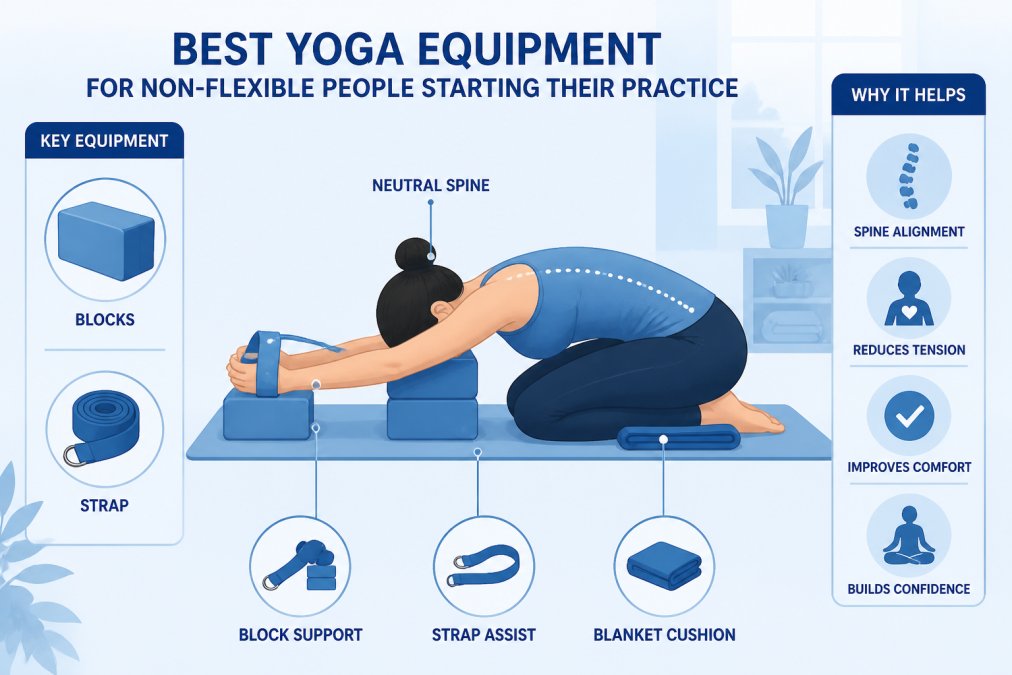
Best Yoga Equipment for Non-Flexible People Starting Their Practice
The biggest myth about yoga is that you need flexibility to start. Props exist specifically for people with limited flexibility, they're not modifications, they're essential tools that make practice accessible from day one.
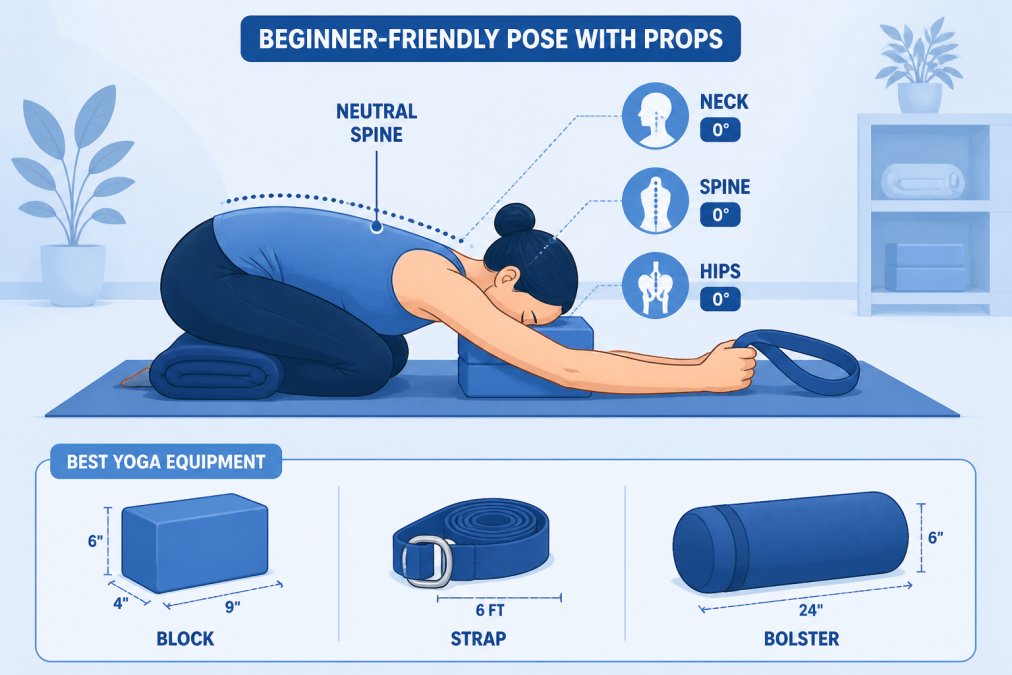
Props That Support Functional Movement
Yoga blocks bring the ground closer to you, allowing proper alignment in forward folds, side stretches, and standing poses. Without a block, tight people either compromise alignment or don't access the pose. With a block, you get full benefit.
Yoga straps extend your reach in seated forward folds or shoulder stretches, allowing proper spinal alignment while gradually increasing the stretch. Over weeks, you'll need the strap less as flexibility improves.
Bolsters support your body in restorative poses. For desk-bound professionals with tight chests and rounded shoulders, supported backbends reverse postural patterns without demanding active flexibility.
Quality props from thewellbeingshop.com give you stable, reliable support that makes practice safer and more effective.
Building Flexibility and Mobility Over Time
Flexibility is a skill you build through consistent practice. Expect noticeable improvements within 2-3 weeks of daily practice, significant changes within 8-12 weeks, and substantial transformation within 6 months. Ten minutes daily beats 90 minutes once weekly. Your nervous system needs regular signals that this range of motion is safe. As your range improves, you'll naturally need less support.
Strength Training for Desk-Bound Professionals: Full-Body Sessions at Home
Desk work weakens specific muscle groups: glutes, core stabilizers, and posterior chain muscles, while front-side muscles become chronically tight. Full-body sessions work better than split routines for busy professionals, you hit every major muscle group in one session, requiring only 2-3 sessions weekly.
Equipment-Free Travel Workouts
Travel destroys consistency, but equipment-free workouts maintain your strength anywhere.
Bodyweight progressions scale to your current strength. Can't do a full push-up? Do wall push-ups or incline push-ups with hands on a desk. As strength builds, lower your incline.
Single-leg work increases demand without equipment: single-leg glute bridges, single-leg squats (assisted with a door frame), and single-leg deadlifts.
Isometric holds require nothing but time: wall sits, plank holds, and hollow body holds build strength through sustained tension.
Most professionals maintain strength and flexibility during travel by doing a 15-minute bodyweight routine daily in their hotel room.
Designing a Flexible Training Schedule That Sticks
The best training program is the one you actually follow. Flexible scheduling means your practice adapts to your reality. Some weeks you have 30 minutes daily; other weeks you have 10 minutes. Both are valuable when structured intelligently.
Overcoming Consistency Barriers
The consistency barrier isn't motivation, it's friction.
Reduce decision friction: Decide your practice time once, then execute daily. "I practice at 6am" requires zero willpower.
Anchor to existing habits: Habit stacking eliminates the need to create new time slots.
Build in flexibility for real life: Have a "full version" (30 minutes) and a "minimum version" (15 minutes). On busy days, do the minimum. A 15-minute practice is infinitely better than zero.
Track completion, not perfection: A simple checkmark on a calendar creates psychological reinforcement.
Recovery and Sustainable Routines
Recovery isn't passive. Active recovery days, light movement, gentle stretching, slow walks, or restorative yoga, maintain the habit without creating fatigue. Two intense days plus one active recovery day per week is sustainable long-term. Mind body training works best when paired with adequate sleep, which improves recovery and creates a virtuous cycle.
Building Your Mind-Body Practice for Long-Term Results
The transformation from "I should exercise" to "I practice daily" happens gradually through shifting identity. Mind body training creates this shift because it's not about performance metrics, you're building awareness, consistency, and the felt experience of your body operating optimally.
Most professionals report that after three months of consistent practice, the question becomes "Why would I skip this?" The practice becomes as essential as coffee. The mental clarity, physical freedom, and stress relief are too valuable to abandon.
Quality equipment from thewellbeingshop.com removes friction and accelerates this shift. Start with the minimum: 15 minutes daily, one simple protocol, and basic props if needed. Build from there. The professionals who transform their lives don't start with perfect routines, they start with consistency.
The gap between knowing you should move and actually moving daily is where most professionals get stuck. The solution isn't more willpower, it's removing friction and anchoring practice to existing routines. At thewellbeingshop.com, we've designed our equipment and resources specifically for this challenge: helping desk-bound professionals build sustainable mind body training practices that fit real schedules and deliver measurable results in focus, energy, and physical well-being. Get started with a simple 15-minute protocol and quality props that support your practice from day one.
Frequently Asked Questions
Can short mind-body sessions actually improve my productivity and focus at work?
Yes. Even 15-minute mind-body sessions reduce stress, improve mental clarity, and boost energy levels throughout the workday. Professionals report better focus and reduced anxiety after consistent practice. The key is regularity, three short sessions per week outperform sporadic longer workouts. Mindfulness and movement activate the parasympathetic nervous system, enhancing cognitive performance and work-life balance.
What is the minimum effective dose for mind-body training if I only have 20-30 minutes daily?
The minimum effective dose combines 15 minutes of movement with 5-10 minutes of mindfulness. This time-efficient approach delivers measurable results for busy professionals. Focus on full-body functional movement and breathing practices rather than complex routines. Consistency matters more than duration, a sustainable 20-minute daily practice outperforms sporadic 60-minute sessions. Habit stacking helps integrate this into your existing schedule without adding burden.
I'm not flexible at all, can I still benefit from yoga and mind-body training?
Absolutely. Flexibility is not a prerequisite; it's a byproduct of consistent practice. Yoga equipment like blocks, straps, and bolsters supports non-flexible people by allowing proper alignment without forcing range of motion. Start with gentle, functional movement and mobility work. Over time, consistency builds flexibility naturally. Many desk-bound professionals begin inflexible due to sedentary lifestyle, but see significant improvements within 4-6 weeks of regular practice.
How do I maintain consistency when my schedule is unpredictable?
Use habit stacking, attach mind-body practice to existing routines like morning coffee or lunch break. Design flexible training schedules with backup options: a 15-minute home session if you're busy, a 30-minute session when time allows. Equipment-free travel workouts ensure you can practice anywhere. Track consistency by marking completed sessions rather than perfection. Building intentional habits through small, repeatable actions creates sustainable routines that survive schedule changes.
This article was written using GrandRanker