


 Link label

Low-Impact Workouts for Mental Focus: A How-To Guide
Table of Contents
- How Low-Impact Workouts Improve Mental Focus
- The Science Behind Movement and Cognitive Function
- Best Low-Impact Activities for Mental Clarity
- Yoga Equipment for Non-Flexible People
- Duration of Exercise for Mental Focus
- Building Your Home Routine: Step-by-Step
- Common Mistakes to Avoid When Starting
- Conclusion
Last Updated: August 19, 2026
How Low-Impact Workouts Improve Mental Focus
Low-impact workouts sharpen focus by activating your parasympathetic nervous system, the part responsible for calm alertness, rather than triggering fight-or-flight stress. Unlike high-intensity exercise, gentle rhythmic movement leaves you present and clear, not exhausted. This matters especially for remote workers and knowledge professionals whose productivity depends on sustained mental output. A 20-minute walk or yoga session isn't a break from work; it's an investment in your ability to work better.
The Science Behind Movement and Cognitive Function
Movement influences cognition through multiple biological pathways. Rhythmic, sustained movement increases production of brain-derived neurotrophic factor, a protein that supports neuron growth and maintenance, directly improving your ability to form new connections and focus. Low-impact activities also regulate cortisol, the primary stress hormone. Elevated cortisol impairs concentration and creates mental fog, while sustainable movement lowers cortisol without the recovery fatigue that intense workouts trigger.
Repetitive, predictable movement quiets the default mode network, the part of your brain responsible for mind-wandering. This is why walking often produces unexpected insights and why yoga practitioners report improved focus. Low-impact exercise delivers endorphins and mood-enhancing neurochemicals without the inflammatory response that intense training can trigger, making it sustainable for daily practice where real cognitive gains accumulate.
Best Low-Impact Activities for Mental Clarity
Walking and Rhythmic Movement
Walking is the most underrated cognitive tool available. The rhythmic, bilateral movement synchronizes both brain hemispheres while your breathing naturally settles into a steady pattern. A 15-minute walk at conversational pace delivers more cognitive benefit than a 45-minute power walk that leaves you breathless, your goal is effortless movement where your mind can wander productively.
Walking also removes you from your desk and resets your attention. When you return to work, your focus capacity has been partially restored. Rhythmic movement beyond walking, like tai chi or qigong, operates on the same principle: slow, deliberate transitions demand present-moment attention while remaining low-stress.

Yoga and Tai Chi
Yoga and tai chi merge movement with intentional breathing and mindfulness, anchoring your attention to the present moment. Each pose or transition demands proprioceptive awareness, a sense of where your body is in space, which occupies the parts of your brain that usually generate distraction and worry. You can't be anxious about an email while holding a challenging balance pose.
Tai chi operates at a slower pace, making it accessible for almost anyone. The flowing transitions create a moving meditation where your mind settles into rhythm. Both practices build somatic awareness, a connection between your physical sensations and mental state, helping you recognize when stress is building before focus deteriorates.
Swimming and Water-Based Exercise
Water-based exercise offers unique cognitive benefits. The resistance of water engages muscles without impact stress while the sensory input of immersion creates a meditative state. Swimming requires rhythmic breathing coordination and bilateral movement, activating the same focus-enhancing pathways as walking but with added resistance.
Water's sensory properties, temperature, pressure, resistance, create a full-body proprioceptive experience that quiets mental chatter. Many swimmers report entering a flow state: complete absorption in the activity with no awareness of time passing. This is peak focus, accessible through simple, sustainable movement.
Yoga Equipment for Non-Flexible People
The biggest barrier to starting yoga is the assumption that inflexibility disqualifies you. Yoga is not about touching your toes; it's about moving your body with attention and breathing with intention. Equipment transforms yoga from intimidating to accessible. Blocks, straps, and bolsters allow you to access pose benefits without forcing your body beyond its current range. A block under your hand in a forward fold removes pressure to reach the floor. A strap around your foot lets you experience lengthening without aggressive strain.
The Well Being Shop offers curated yoga equipment designed for this purpose. Starting with foundational tools, a quality mat, blocks, and a strap, gives you everything needed to practice safely. Having proper equipment signals that this practice matters, building the mental commitment that translates into consistency.
Duration of Exercise for Mental Focus
The ideal duration for low-impact workouts is 20-30 minutes, delivering measurable cognitive benefits without requiring the time commitment that discourages consistency. Research shows diminishing returns beyond 45 minutes for cognitive outcomes. A 20-minute walk done daily outperforms a 60-minute session done once a week because consistency amplifies the cognitive effect.
For busy professionals, this is liberating: you don't need an hour. A quick morning walk, midday yoga session, or evening swim, done consistently, will shift your baseline mental clarity. What matters most is choosing a duration you can sustain without it becoming a burden. A 15-minute practice six days a week beats a 60-minute practice once a month.
Building Your Home Routine: Step-by-Step
Creating a sustainable home routine requires three essential steps: establishing your space, starting small, and tracking your progress.
Step 1: Set Your Space and Gather Tools
Designate a corner of your bedroom, living room, or office where you'll move. This becomes your practice space. The psychological effect of having a dedicated area is significant, your brain recognizes it as a space for this activity, increasing consistency.
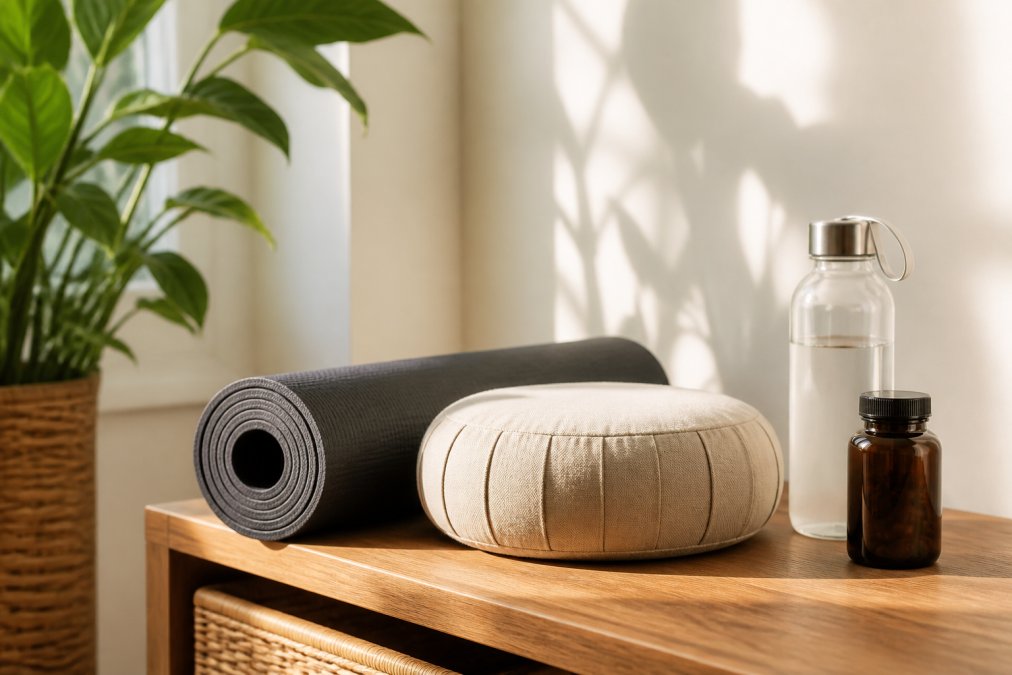
Gather minimal equipment to start. A yoga mat provides cushioning and defines your space. A water bottle keeps you hydrated. If you're doing yoga, grab a block and a strap. The point is to remove friction. Consider adding a focus supplement to support your cognitive performance during and after movement. The Well Being Shop's Focus Supplement for Mental Clarity and Concentration is designed to combat distractions and support sustained attention, complementing the cognitive benefits of your low-impact workouts.
Step 2: Start With Micro-Workouts
A micro-workout is a 10-15 minute focused session. Commit to 15 minutes, five days a week. This is achievable and sustainable. Choose one activity: walking, yoga, or swimming. Focus on consistency, not intensity. By week three, you'll notice your focus sharpens. By week six, you'll feel the difference in your baseline mental clarity.
As the habit solidifies (usually by week 4-6), extend your sessions to 20-25 minutes. You're building a practice you can maintain for life, not a heroic effort you'll abandon in two months.
Step 3: Track Your Mental Clarity Progress
Keep a simple log. After each session, note your focus level on a scale of 1-10. Over two weeks, you'll see a pattern showing higher focus scores following workouts. You can also track secondary indicators: hours worked without distraction, task completion ease, or afternoon energy stability.
The Well Being Shop's Memory Supplement for Brain Support pairs well with this tracking approach. Used consistently alongside your movement routine, it supports mental clarity over time.
Common Mistakes to Avoid When Starting
Mistake 1: Choosing intensity over consistency. Start with a 20-minute walk, not a 60-minute exhausting session you can't sustain. Sustainability beats intensity every time.
Mistake 2: Waiting until you're "ready." Start where you are. Inflexibility and lack of fitness are reasons to start, not barriers.
Mistake 3: Expecting immediate results. Mental clarity benefits compound over weeks, not days. This gradual change builds sustainable practice.
Mistake 4: Treating low-impact as "less than." Low-impact workouts are optimized for cognitive clarity and sustainable practice. They're not easier, they're different.
Mistake 5: Neglecting recovery and supplementation. Sleep, hydration, and nutrition matter. The Well Being Shop's curated supplements provide the nutritional foundation that allows cognitive benefits to compound.
Mistake 6: Skipping the warm-up or cool-down. A 5-minute warm-up prepares your nervous system. A 5-minute cool-down consolidates mental clarity benefits and transitions your mind back to work.
Building a sustainable practice of low-impact workouts for mental focus is one of the highest-return investments you can make in your cognitive performance. Consistency beats intensity. A 20-minute practice you maintain for a year outperforms a 60-minute effort you abandon in two months.
Start this week. Choose one activity. Commit to 15 minutes, five times. Notice how your focus shifts. As your practice deepens, support it with proper equipment and supplementation from thewellbeingshop.com. Our curated selection of fitness equipment, mind-body training tools, and cognitive supplements, including our Focus Supplement for Mental Clarity and Concentration, helps you elevate your mind-body harmony and push your cognitive limits daily.
| Activity | Duration | Best For | Cognitive Focus |
|---|---|---|---|
| Walking | 15-30 min | Daily consistency | Sustained, meditative |
| Yoga | 20-45 min | Flexibility + focus | Active, intentional |
| Tai Chi | 20-30 min | Balance + calm | Flowing, rhythmic |
| Swimming | 20-40 min | Full-body engagement | Immersive, sustained |
| Micro-workouts | 10-15 min | Habit building | Quick mental reset |
Frequently Asked Questions
How long should a low-impact workout be to improve mental focus?
Even 15-20 minutes of consistent low-impact movement can improve concentration and mental clarity. Research shows that shorter, regular sessions are more sustainable than lengthy workouts. Start with 15-minute sessions and gradually extend to 30 minutes as your routine becomes habitual. The key is consistency, daily or near-daily practice produces better cognitive benefits than occasional longer sessions.
Can I do low-impact workouts for mental focus if I'm not flexible?
Absolutely. Flexibility is not a requirement, it develops over time with regular practice. Props like yoga blocks, straps, and cushions help you access poses safely at your current range. Focus on gentle stretching and breathing rather than depth. Many practitioners find that starting with walking, tai chi, or supported yoga poses is ideal for building confidence and flexibility simultaneously without intimidation.
What equipment do I need to start low-impact workouts at home?
You can start with minimal equipment: a yoga mat, comfortable clothing, and a water bottle. To deepen your practice, consider adding meditation tools like The Ouroboros sensory meditation maze ($95) for mindfulness breaks, or props like yoga blocks and straps. Pairing movement with focus supplements like SensIQ™ Focus ($79) can further enhance mental clarity during and after your workouts.
How does low-impact exercise reduce anxiety and improve focus?
Low-impact movement activates the parasympathetic nervous system, which calms your body and reduces cortisol levels. This physiological response improves emotional regulation and allows your brain to concentrate better. Activities like walking, yoga, and tai chi also promote rhythmic, mindful breathing, which enhances blood flow to the brain and supports cognitive function. Over time, consistent practice strengthens the mind-body connection and builds mental resilience.
This article was written using GrandRanker