
Mind-Body Training for Beginners: A 2026 Guide
Table of Contents
- What Is Mind-Body Training and Why It Matters for Beginners
- Benefits of Daily Yoga Practice at Home
- Essential Tools for Mind-Body Training
- Your Beginner Mind-Body Workout Routine
- Frequency, Recovery, and Progressive Overload
- Common Beginner Mistakes and How to Avoid Them
- Building Habit Consistency Through Mindfulness
- Accessibility Modifications for Limited Mobility
Last Updated: August 29, 2026
What Is Mind-Body Training and Why It Matters for Beginners
Mind-body training integrates physical movement with mental awareness, treating your body and mind as interconnected systems that improve together. This approach matters for remote workers, busy professionals, and anyone building sustainable wellness routines.
Benefits of Daily Yoga Practice at Home
Consistent home practice improves posture alignment through automatic body awareness. Remote workers sitting at desks may experience relief in lower back tension and shoulder tightness as the neuromuscular connection strengthens.
Mental clarity emerges as controlled breathing, body awareness, and focused movement activate your parasympathetic nervous system, the part responsible for calm and recovery (peer-reviewed research). This can translate into better focus during work and improved sleep quality.
Core stability improves through functional movement patterns. Your deep abdominal muscles strengthen to stabilize your spine and support posture, making daily activities like carrying groceries feel easier.
When you practice in the same space at the same time daily, your brain creates an environmental trigger. Stepping onto your yoga mat becomes a signal that activates the calm, focused state you've practiced there hundreds of times.
Essential Tools for Mind-Body Training
A quality meditation cushion eliminates discomfort that causes beginners to quit early. The Premium Buckwheat Meditation Cushion from thewellbeingshop.com ($37.90) provides ergonomic support that promotes proper spinal alignment with a removable organic cotton cover.
A yoga mat creates a dedicated practice space and signals to your brain that this is where focused movement happens. Aromatherapy enhances the mind-body connection by engaging your olfactory system, the sense most directly linked to emotion and memory. The Leleshwa Meditative Essence ($15.05) from thewellbeingshop.com provides a calming fragrance that becomes associated with your practice space.
The Ouroboros Sensory Meditation Maze ($95.00) from thewellbeingshop.com serves dual purposes: it deepens mindfulness practice and provides a physical anchor for restless hands. Candles create ambient atmosphere and serve as a focal point for meditation. The Forest State of Mind Candle ($29.99) from thewellbeingshop.com combines woodsy aromatics with the visual anchor of a flame.
Meditations from the Mat: Daily Reflections on the Path of Yoga ($22.00) from thewellbeingshop.com provides 365 daily insights that connect yoga philosophy to everyday life, helping beginners understand the "why" behind the practice.
Start with a meditation cushion and mat. Add aromatics and a meditation tool after two weeks. Let your practice develop before expanding your toolkit.
Your Beginner Mind-Body Workout Routine
A complete beginner routine balances warm-up, functional movement, and cool-down within 20-30 minutes, realistic for busy professionals.
Warm-Up and Mobility Sequence
Begin with five minutes of gentle movement to prepare your nervous system and increase blood flow. Start standing with feet hip-width apart and perform slow arm circles in both directions, 10 circles each way.
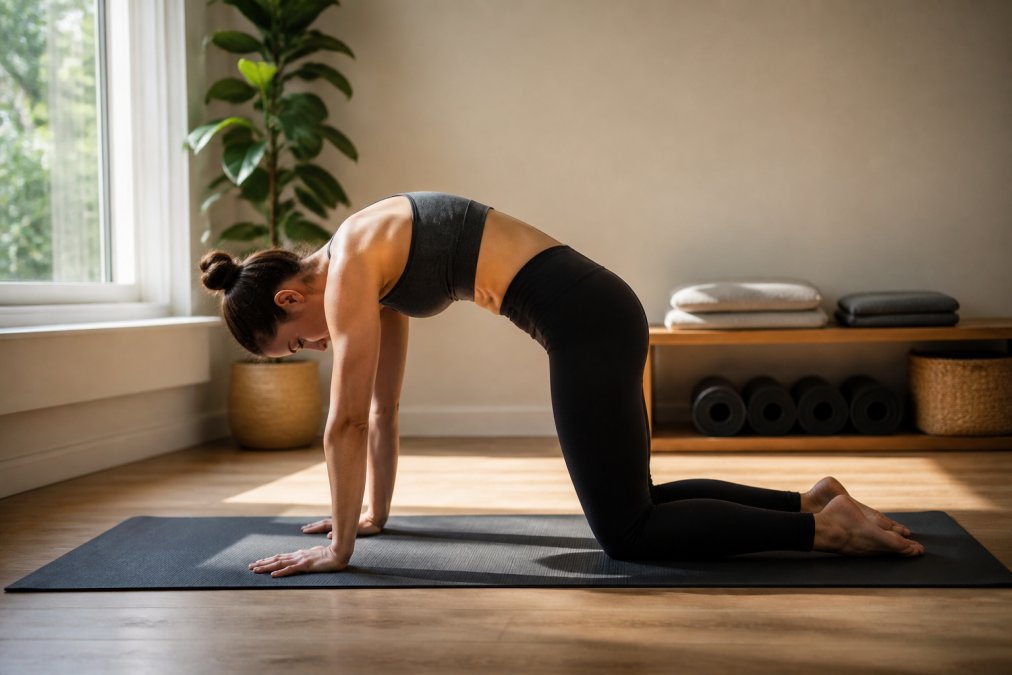
Move into cat-cow stretches: on hands and knees, arch your back and lift your gaze on the inhale, then round your spine and tuck your chin on the exhale. Perform eight slow repetitions, synchronizing breath with movement.
Follow with a forward fold: standing, hinge at your hips and let your arms hang toward the ground. Hold for 30 seconds while focusing on your breath. Finish with gentle spinal twists: standing, cross your right arm over your chest and slowly rotate your torso to the left. Hold for 20 seconds, then repeat on the other side.
Core Strength and Stability Movements
Plank holds build core stability. Begin in a push-up position with forearms on the ground, elbows directly under shoulders. Hold for 20-30 seconds while maintaining steady breathing. Rest 15 seconds, then repeat three times.
Bird dogs develop contralateral strength. On hands and knees, extend your right arm forward while simultaneously extending your left leg backward. Hold for two seconds, return to start, then repeat on the opposite side. Perform 10 repetitions per side, focusing on keeping your hips level.
Glute bridges activate your posterior chain and counteract desk work posture. Lie on your back with knees bent and feet flat. Press through your heels to lift your hips toward the ceiling, squeezing your glutes at the top. Hold for two seconds, then lower. Perform 12-15 repetitions.
Modified push-ups build upper body strength. Begin on your knees rather than your toes. Lower your body until your chest nearly touches the floor, maintaining a straight line from knees to head. Press back up. Perform 8-10 repetitions with controlled movement.
Rest 60 seconds between each movement.
Cool-Down and Mindfulness Integration
Begin with gentle stretching: seated forward fold, holding for 30 seconds while breathing deeply. Then a supine spinal twist, lying on your back with one knee crossed over your body, holding for 20 seconds per side.
Finish with five minutes of seated meditation. Sit upright on your meditation cushion, spine naturally aligned. Close your eyes and focus on your breath, observing the natural rhythm of inhalation and exhalation. When your mind wanders, gently return attention to the breath without judgment. This practice trains your nervous system to access calm on command.
Frequency, Recovery, and Progressive Overload
Consistency matters more than intensity for beginners. Three sessions per week provides enough frequency to create neurological adaptation while allowing adequate recovery (peer-reviewed research). Your nervous system needs 48 hours between intense sessions to consolidate learning (peer-reviewed research).
Light movement on non-workout days maintains neural patterns while allowing muscles to repair. Progressive overload means increasing challenge gradually: after two weeks, hold plank positions for 35 seconds instead of 30. After four weeks, add five additional repetitions. After six weeks, move from modified push-ups to full push-ups.
Track your progress in a simple journal: date, movements performed, duration of holds, repetitions completed, and how you felt. This creates accountability and makes progress visible.
Common Beginner Mistakes and How to Avoid Them
The most common mistake is prioritizing range of motion over alignment. A shallow stretch performed with perfect spinal alignment builds strength and safety; a deep stretch with compromised form creates injury risk.
Another frequent error is inconsistent breathing. Exhale during exertion, inhale during relaxation. If you can't maintain steady breathing during a movement, the movement is too challenging.
Skipping the warm-up or cool-down undermines results. The warm-up prepares your nervous system to focus; the cool-down consolidates the neural patterns you've created.
Many beginners abandon their routine after missing a single session. Missing one session out of twelve is still 92% consistency, more than enough to maintain habit formation.
Building Habit Consistency Through Mindfulness
Habit formation requires understanding the neurological loop: cue, routine, reward. The cue is your scheduled practice time and designated space. The routine is the workout itself. The reward is the calm, focused mental state you experience after practice.
Build environmental triggers that make the habit automatic. Lay out your yoga mat the night before. Set a recurring calendar reminder 15 minutes before your practice time. Light your candle or diffuse your essence as the session begins.
Document your practice with a calendar where you mark each completed session with a checkmark. Visual progress reinforces the habit loop and makes consistency visible.
The first three weeks are hardest because the reward isn't yet automatic. Push through with environmental support, scheduled time, dedicated space, and prepared equipment. By week four, the practice begins to feel natural.

Mindfulness, paying attention to present-moment experience without judgment, is the mechanism that builds consistency. When you practice with full attention, your brain registers the experience as significant, triggering neuroplasticity that makes neural patterns stick.
Accessibility Modifications for Limited Mobility
Modify movements to match your current capacity. For limited hip mobility, reduce forward fold depth and use props. Sit on a meditation cushion during seated stretches to elevate your hips, which automatically reduces hamstring demand.
For lower back issues, avoid deep spinal extensions and focus on gentle mobilization. Cat-cow stretches move your spine through its natural range without forcing depth. Planks can be performed on your knees, reducing load while building core stability.
For shoulder limitations, perform push-ups against a wall rather than on the ground. For knee issues, perform glute bridges instead of deep knee bending.
Every movement has a spectrum of difficulty. Find the point where you feel challenged but safe. This point changes as your capacity improves, so progression happens naturally.
Accessibility also means pacing. If you're new to movement, perform the routine once per week for two weeks before adding a second session.
Mind-body training for beginners isn't about achieving perfect form or impressive flexibility. It's about establishing a practice where you move with intention, breathe with awareness, and gradually build the neural patterns that make calm focus and physical strength sustainable habits. The tools from thewellbeingshop.com remove friction and deepen your practice, but the real work happens in the consistency you build week after week. Start with three sessions per week, focus on proper form over depth, and let your body adapt at its own pace. Within eight weeks, you'll notice that the calm, focused state you cultivate on the mat begins showing up in your work and daily life.
Frequently Asked Questions
Q: What are some examples of mind-body exercises for beginners?
A: Beginner-friendly mind-body exercises include cat-cow stretches, child's pose, body scans, and standing balance poses like tree pose. Gentle flowing movements such as tai chi and Pilates fundamentals are also excellent starting points. These compound movements improve range of motion and neuromuscular connection without requiring advanced flexibility or strength. Start with 5-10 repetitions of each exercise and focus on form correction over speed.
Q: How long should a beginner mind-body session last?
A: Most beginners benefit from 20-30 minute sessions, 3-4 times per week. This timeframe allows adequate warm-up, core work, and cool-down while fitting into a busy schedule. As your habit consistency improves, you can extend sessions to 45-60 minutes. Even brief 15-minute sessions provide mental clarity and physical wellness benefits when done regularly with proper form and intentional breathing.
Q: What equipment do I need to start mind-body training at home?
A: Essential tools for mind-body training at home include a quality meditation cushion for proper spinal alignment during seated practice, a yoga mat for ground work, and comfortable clothing. The Premium Buckwheat Meditation Cushion ($37.90) provides ergonomic support while adapting to your body. Additional items like resistance bands, foam rollers, and mindfulness tools such as The Ouroboros Meditation Maze ($95.00) enhance your practice, but you can begin with just a cushion and mat.
Q: How does mind-body training improve mental focus and physical flexibility?
A: Mind-body training combines functional movement with breath awareness, which activates the parasympathetic nervous system and reduces stress. Regular practice improves range of motion through progressive overload of stretching and mobility training, while mindfulness techniques strengthen the neuromuscular connection between your brain and muscles. This integration enhances posture alignment, reduces mental fog, and builds stamina. Daily practice creates neuroplasticity changes that support both physical wellness and sustained mental clarity.
Q: Can I do mind-body training if I'm not flexible or athletic?
A: Yes. Mind-body training is beginner-friendly and meets you where you are. Flexibility improves through consistent practice over weeks and months, not overnight. Focus on proper form and controlled movement rather than depth of stretch. Modifications and accessibility adjustments allow people with limited mobility to participate fully. Start with gentle bodyweight exercises, use props like cushions for support, and listen to your body's signals. Progress happens through habit consistency and intentional practice, not natural ability.
Q: What makes mind-body training different from traditional gym workouts?
A: Mind-body training integrates physical movement with breath awareness and mental focus, creating a holistic approach to fitness. Rather than isolating muscles through heavy resistance training, it emphasizes compound movements, functional mobility, and the mind-muscle connection. This approach reduces injury risk, improves posture alignment, and builds sustainable habits. It's particularly effective for remote workers addressing back pain and professionals seeking low-impact, time-efficient routines that boost both physical wellness and mental clarity.
Q: How do I stay consistent with a mind-body routine if I've struggled with fitness habits before?
A: Consistency builds through neuroplasticity and habit formation when you anchor practice to existing routines (morning coffee, lunch break, evening wind-down). Start small with 15-20 minute sessions to reduce psychological barriers to entry. Create a dedicated space with supportive tools like a meditation cushion and calming elements such as the Forest State of Mind Candle ($29.99) to signal to your brain that this is your wellness time. Track completion, not perfection, and celebrate small wins to reinforce the behavior loop.
This article was written using GrandRanker