
Best Lumbar Support Pillows for Home Office
Table of Contents
- Why Lumbar Support Matters for Home Office Workers
- What to Look for in a Lumbar Support Pillow
- Lumbar Support Pillow Benefits for Posture and Pain Relief
- How to Sit Properly at a Desk With Lumbar Support
- Memory Foam vs. Gel Lumbar Cushions: Which Is Right for You
- Choosing the Right Lumbar Pillow for Your Chair Type
- Conclusion
Last Updated: August 28, 2026
Why Lumbar Support Matters for Home Office Workers
Sitting for eight hours without proper support fundamentally changes how your spine aligns. When you settle into a chair without lumbar support, your lower back rounds forward, placing stress on the vertebrae and discs. Over weeks and months, this becomes chronic pain that doesn't disappear when you leave your desk.
A quality lumbar support pillow addresses the core problem: it maintains the natural curve of your spine during prolonged sitting. Your lumbar spine (the lower five vertebrae) bears the majority of your upper body weight when sitting (peer-reviewed research). Without proper support, those vertebrae compress unevenly, and the discs between them experience unbalanced pressure.
Workers who use lumbar support pillows report reduced afternoon fatigue, better focus during the workday, and fewer days when back pain prevents them from working effectively. More importantly, they're preventing the long-term damage that makes chronic pain management necessary later.
What to Look for in a Lumbar Support Pillow
Not every lumbar support pillow works the same way. The difference between one that delivers real relief and one that collects dust comes down to three specific factors: how it's designed, what it's made from, and whether it fits your body and chair.
Ergonomic Design and Spinal Alignment
The best lumbar support pillows have a contoured curve that mirrors the natural inward curve of your lower spine. This three-dimensional form supports the lumbar region while allowing your pelvis to sit back against the chair.
Look for pillows with adjustable straps. A pillow that slides around defeats its purpose. Straps that attach securely to your chair keep the pillow positioned exactly where your spine needs support. Height matters too, your pillow should fill the gap between your lower back and the chair, typically between three and five inches of depth. Too thin and it won't provide meaningful support; too thick and it will push you forward and create awkward posture.
When your lumbar support pillow is positioned correctly, your pelvis tilts slightly forward, which naturally aligns your thoracic spine and reduces strain on your lower back.
Material Quality and Durability
Memory foam conforms to your body's shape, providing personalized support. High-density foam maintains consistent firmness and doesn't compress over time. Memory foam typically lasts 2-3 years before losing effectiveness; high-density foam can last 4-5 years or longer (peer-reviewed research).
Breathability matters if you spend eight hours in your chair. Mesh covers allow air circulation, preventing heat buildup. Check that the cover is removable and washable, dust and sweat accumulate on any cushion used daily. A cover you can throw in the wash extends the pillow's life and keeps it hygienic.
Lumbar Support Pillow Benefits for Posture and Pain Relief
The primary benefit of lumbar support pillows is reducing lower back pain by maintaining proper spinal alignment. When your spine is properly aligned, your entire musculoskeletal system works more efficiently.
In the first week of using a lumbar support pillow, you'll notice reduced afternoon fatigue. Your back muscles don't have to work as hard to compensate for poor positioning. Over months, workers who maintain proper sitting posture see improvements in focus and productivity. When your body isn't sending pain signals to your brain, you have more mental capacity for actual work.
The preventive aspect is critical. Many remote workers don't experience significant back pain until they've spent years in poor posture. By that point, the damage is structural. A lumbar support pillow used from the beginning of your remote work journey prevents this trajectory entirely.
How to Sit Properly at a Desk With Lumbar Support
Start by positioning your chair so your feet rest flat on the floor with your knees at a 90-degree angle (osha.gov). Your hips should be slightly higher than your knees, which tilts your pelvis forward naturally and reduces strain on your lower back.
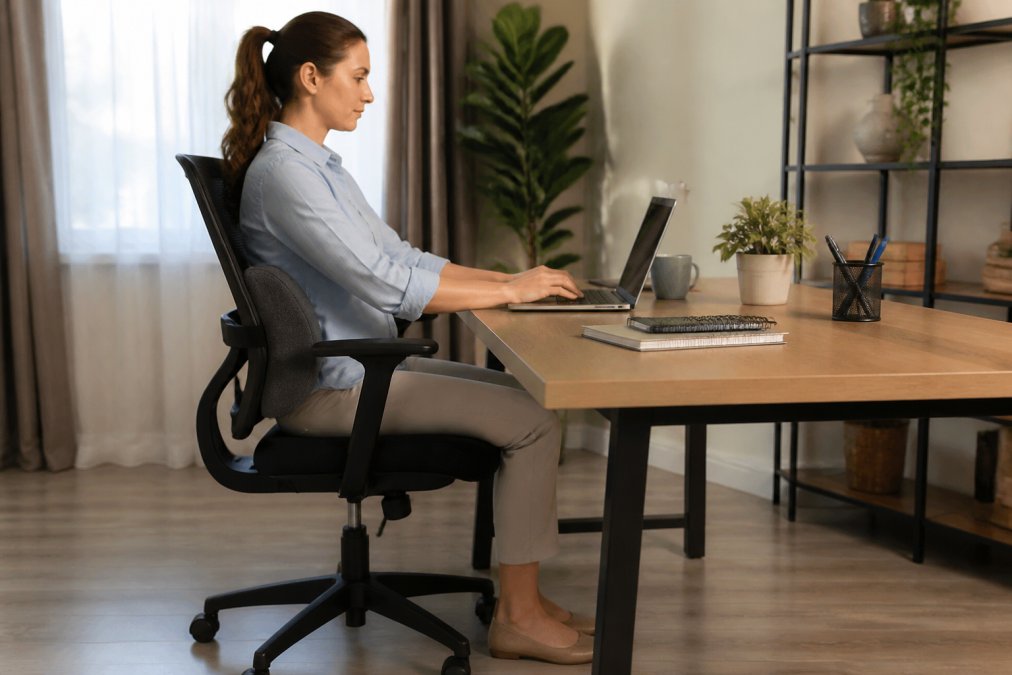
Position your lumbar support pillow so it fills the curve of your lower back at approximately belt-line level. Secure the straps firmly enough that the pillow won't shift, but not so tight that you feel restricted. Your screen should be at eye level when sitting upright with good posture. Position your keyboard and mouse so your elbows rest at 90 degrees and your wrists stay neutral.
Your shoulders should be relaxed and back, not hunched forward. Set a timer to check your posture every 30 minutes. Every 45-60 minutes, stand up, walk around, and do gentle stretches. Your lumbar support pillow maintains proper alignment during sitting, but it doesn't replace the benefits of regular movement.
Memory Foam vs. Gel Lumbar Cushions: Which Is Right for You
Memory foam conforms closely to your body, providing customized support that adapts to your unique spinal curve. Gel cushions maintain firmer, more consistent support while offering enhanced cooling properties.
Memory foam excels if you have a unique spinal curve or significant pain requiring personalized support. However, it compresses over time and loses responsiveness after 2-3 years of daily use. Gel cushions are better if you sit in a warm environment or tend to feel hot during extended sitting. Gel maintains firmness longer and doesn't absorb body heat the way memory foam does. The trade-off is that gel cushions don't conform quite as closely to your body initially.
If you're new to lumbar support pillows, start with memory foam to understand what proper support should feel like. If you find yourself overheating or your pillow compresses noticeably after a year, consider switching to gel for your next purchase.
| Feature | Memory Foam | Gel Cushions |
|---|---|---|
| Customization | High (conforms to body) | Moderate (firmer shape) |
| Durability | 2-3 years | 4-5 years |
| Heat retention | Higher (can feel warm) | Lower (cooling effect) |
| Initial comfort | Often immediate | Builds over time |
| Cost | Generally lower | Generally higher |
| Best for | Pain relief, custom support | Long-term durability, heat sensitivity |
Whichever you choose, commit to using it daily for at least three weeks to accurately assess whether the pillow is working for you.
Choosing the Right Lumbar Pillow for Your Chair Type
Not every lumbar support pillow works with every chair. Office chairs, gaming chairs, dining chairs, and car seats all have different depths, angles, and back support structures.
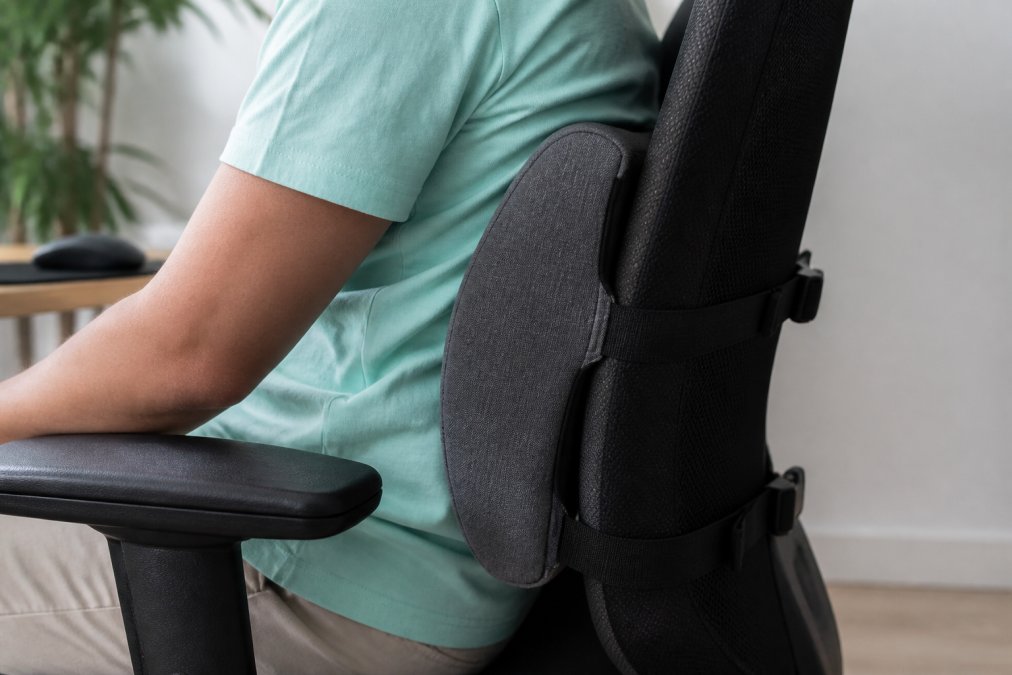
Office chairs typically have deeper seats and more upright back support. For these, you want a pillow with firm straps that attach securely to the chair's frame. Gaming chairs have different geometry and are often more reclined. A lumbar pillow for a gaming chair needs to fit within that narrower space and shouldn't interfere with the chair's existing lumbar support.
Dining chairs and other non-ergonomic seating present a different challenge. These chairs often have minimal back support and more vertical angles. A lumbar pillow for a dining chair needs to be thinner and more flexible. Car seats require smaller, car-specific pillows designed to fit contoured vehicle seat backs.
Before purchasing, measure your chair's depth, the angle of the backrest, and the width of the gap between your lower back and the chair when sitting properly. Compare these measurements to the pillow's specifications. A pillow that's too wide won't fit properly; one that's too thin won't provide adequate support.
Many remote workers benefit from having multiple pillows, one for their home office chair, one for their car, and perhaps one for their dining table. This ensures you're maintaining proper support regardless of where you're sitting.
Conclusion
The best lumbar support pillows for home office work address a specific problem: maintaining neutral spine alignment during the hours you spend seated at your desk. The right pillow prevents lower back pain that develops from poor posture, improves afternoon focus by reducing fatigue, and protects your long-term spinal health.
When evaluating options, prioritize fit over brand name. Measure your chair, understand the material differences between memory foam and gel, and choose based on how the pillow will integrate into your daily routine. Consistency matters more than perfection, a lumbar support pillow you use every day beats an expensive option you use occasionally.
At thewellbeingshop.com, we understand that remote work wellness is about building routines that support your body and mind over the long term. Our curated selection of ergonomic tools and recovery products is designed to help you maintain proper posture, reduce pain, and create the physical foundation for sustained productivity and well-being. Explore our range of lumbar support pillows and complementary ergonomic solutions to transform how you sit, work, and feel at the end of each day.
Frequently Asked Questions
Do lumbar support pillows actually work for lower back pain?
Yes, when positioned correctly, lumbar support pillows help maintain neutral spine alignment and reduce pressure on the lower back during extended sitting. They work by supporting the natural curve of your spine and preventing slouching, which is a primary cause of sitting fatigue and chronic pain. Results depend on proper placement and consistent use throughout your workday.
What are the main benefits of using a lumbar support pillow?
Lumbar support pillow benefits include improved posture correction, reduced lower back pain, better spinal alignment, and decreased sitting fatigue. They distribute weight more evenly across your vertebrae, reduce strain on the musculoskeletal system, and help prevent the muscle fatigue that builds up during long office hours. Many users report increased comfort and focus within the first week of use.
How should I position my lumbar pillow for maximum support?
Place the lumbar pillow at the curve of your lower back, approximately at waist level. The pillow should fill the gap between your spine and the chair, supporting your lumbar region without pushing you forward. Your feet should rest flat on the floor, hips at a 90-degree angle, and the pillow should keep your shoulders relaxed. Adjust straps snugly but not so tight that they restrict movement.
What's the difference between memory foam and gel lumbar cushions?
Memory foam molds to your spine's unique shape and provides consistent, firm pressure relief, making it ideal for those who prefer customized support. Gel cushions offer better heat dissipation and breathability, staying cooler during long sitting sessions, and work well if you tend to feel warm. Memory foam provides longer-lasting support over time, while gel maintains its shape better but may compress faster with heavy use.
This article was written using GrandRanker