


 Link label

How to Start a Daily Meditation Practice for Beginners
Table of Contents
- Why a Daily Meditation Practice Beats Meditating When You Feel Like It
- How Long Should a Beginner Meditate Each Day?
- Step-by-Step: Your First 10-Minute Meditation Session
- Best Meditation Tools for Home Practice (and What You Don't Need)
- How to Build a Meditation Habit That Survives Week Three
- Troubleshooting: Physical Discomfort, Restless Minds, and Off Days
- How to Tell Your Daily Meditation Practice Is Working
- Conclusion: Start Smaller Than You Think
- Frequently Asked Questions
Last Updated: October 3, 2026
Why a Daily Meditation Practice Beats Meditating When You Feel Like It
A daily meditation practice is a scheduled, repeatable period of quiet attention you return to every day, regardless of mood, rather than a session you squeeze in when stress peaks.
This guide from thewellbeingshop.com is built for people who have tried meditation once or twice, felt calmer for an afternoon, and then let it slide.
A common mistake is treating meditation like a workout you do when motivated. Motivation is a terrible training partner.
How Long Should a Beginner Meditate Each Day?
The best starting length for a beginner is five minutes daily. That is short enough to survive a busy morning and long enough to establish the habit loop.
How long should a beginner meditate before extending sessions? Most teachers suggest adding a minute or two per week rather than jumping straight to twenty. Discomfort, restlessness, and the urge to check your phone all shrink when the session ends before your patience does.
Week-by-Week Starting Timeline (2 to 20 Minutes)
| Week | Daily Length | Focus | What Success Looks Like |
|---|---|---|---|
| 1 | 2-3 minutes | Showing up at the same time | You sat down four days out of seven |
| 2 | 5 minutes | Breath awareness only | You noticed your mind wander and returned |
| 3 | 8 minutes | Body scan, seated position | You finished without watching the clock |
| 4 | 10 minutes | Full session with anchor point | Practice feels like part of the routine |
| 6-8 | 15-20 minutes | Extended sits, guided or silent | You miss it on the days you skip |
Step-by-Step: Your First 10-Minute Meditation Session
Here is the full sequence we recommend for a first proper sit. Read it once, then run it without the screen.
- Pick your time. Morning works best for most people because the day has not started competing for attention.
- Choose a seat. A cushion, a folded blanket, or the front edge of a chair all work. Knees below hips is the goal.
- Set a timer. Ten minutes, silent alarm. This removes clock-checking entirely.
- Close your eyes or soften your gaze. Either is fine. Closed eyes suit indoor practice.
- Anchor on the breath. Follow the sensation at the nostrils or the rise of the belly.
- Count breaths to ten, then restart. This gives the wandering mind a job.
- When you notice drifting, return. Noticing is the practice, not a failure.
- End gently. Open your eyes, sit for ten seconds, then stand.
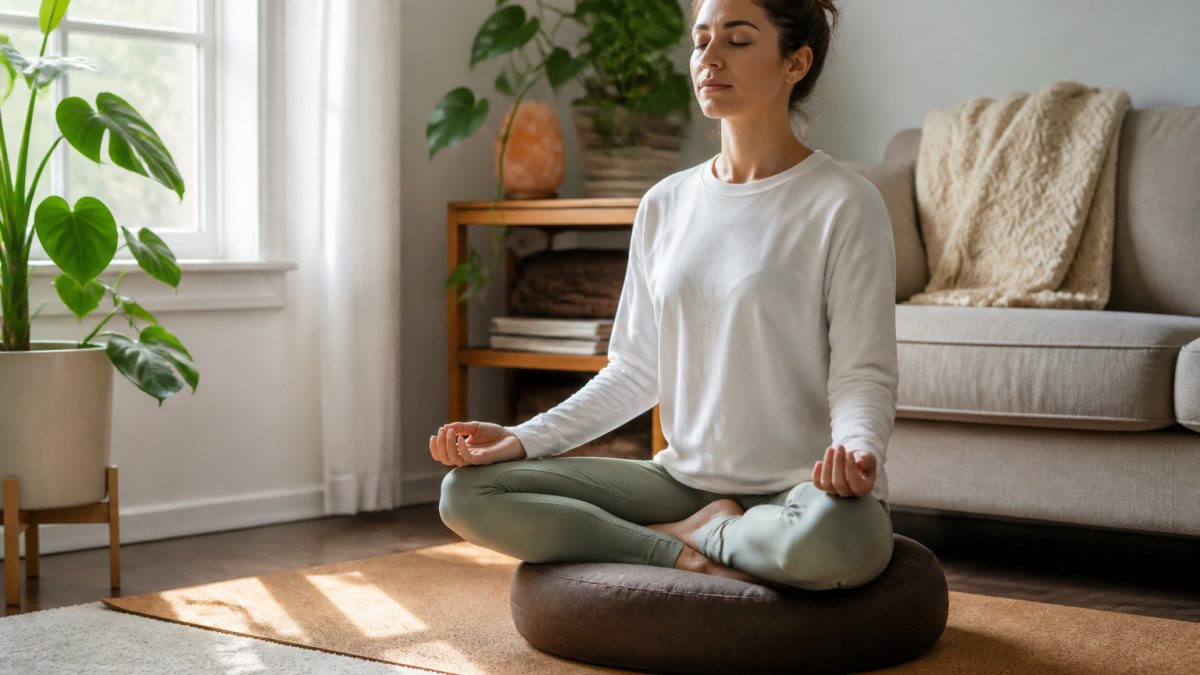
Set Up Your Seat: Posture, Cushions, and Comfort
Posture decides whether you last three minutes or fifteen. Sit tall with a natural curve in the lower back, shoulders relaxed, chin slightly tucked.
A firm, ergonomic meditation cushion raises the hips above the knees, which tilts the pelvis forward and takes strain off the lower back. Our Premium Buckwheat Meditation Cushion uses buckwheat filling that adapts to your body and promotes spinal alignment, with a removable organic cotton cover that washes clean.
For hard floors, a non-slip surface underneath changes everything. The Cork & Natural Rubber Meditation Mat pairs a warm cork top with a natural rubber base that stays put, and it is thin enough to sit stable under a zafu or bench.
Anchor on the Breath and Handle a Wandering Mind
The wandering mind is not the enemy of meditation. It is the raw material.
Every time you notice you have drifted and return to the breath, you complete one repetition. Ten minutes of that is ten minutes of training attention, even if it felt like ten minutes of thinking about your inbox.
Two techniques help when the drift is constant:
- Counting: inhale, exhale, one. Up to ten, then start again.
- Labeling: silently note "thinking," "planning," or "worrying," then return.
Best Meditation Tools for Home Practice (and What You Don't Need)
The best meditation tools for home practice are a supportive seat, a stable surface, and a timer. Everything else is optional.
What you do not need: an app subscription, a dedicated room, a specific cushion brand, or perfect silence. A corner of a bedroom works. Street noise works.
That said, a few additions genuinely help people stay with it. The Scent of Nirvana Meditation Candle uses a proprietary agarwood blend designed to accompany grounding and relaxation.
For anyone who finds stillness harder than movement, a tactile focus object can be the difference between quitting and continuing. The Ouroboros Sensory Meditation Maze is a wooden tile maze you arrange and trace, with no wrong configuration, which makes it a gentle entry point for restless hands.
| Tool | What It Solves | Skip If |
|---|---|---|
| Firm cushion | Hip and lower back strain | You already sit comfortably on a chair |
| Non-slip mat | Slipping on hard floors | You practice on carpet |
| Timer | Clock-watching | Your phone timer is out of reach |
| Scent cue | Difficulty switching into practice mode | Fragrance bothers you |
| Tactile focus object | Restless hands, racing thoughts | Breath counting already works |
How to Build a Meditation Habit That Survives Week Three
Week three is where most routines collapse. Novelty has worn off, results feel invisible, and the calendar fills up.
The fix is structural, not motivational. Attach the practice to something you already do without thinking, keep the session short enough to be non-negotiable, and track only whether you showed up, not how well it went.
Habit Stacking: Attach Practice to an Existing Routine
Habit stacking means pairing the new behavior with an existing one so the cue is automatic. The formula: after [current habit], I will [new habit].
Premium Buckwheat Meditation Cushion →
- After I pour my morning coffee, I will sit for five minutes.
- After I brush my teeth at night, I will do a three-minute body scan.
- After I close my laptop for the day, I will sit on the mat before leaving the room.
One rule matters more than the rest: never miss twice. A single skipped day is noise. Two in a row starts a new habit, and it is the wrong one.
Troubleshooting: Physical Discomfort, Restless Minds, and Off Days
Physical discomfort is the most common reason beginners quit, and it is almost always a setup problem rather than a personal failing.
- Back pain: raise your seat height. Hips above knees.
- Knee pressure: switch to a chair or use a kneeling bench.
- Numb feet: sit cross-legged less tightly, or alternate positions mid-session.
For a restless mind, shorten the session rather than forcing a longer one. A completed three-minute sit builds more habit strength than an abandoned fifteen-minute one.
If you are neurodivergent, standard silent sitting may simply not fit. That is not a failure of discipline.
How to Tell Your Daily Meditation Practice Is Working
Progress in meditation is quiet, which is exactly why people quit before they notice it. The problem with most advice on this topic is that it asks you to trust a feeling.
A better approach is to track two things separately: whether you showed up, and whether anything shifted. The first is objective. The second is subjective but can still be made consistent with a simple rating scale.
Track Two Numbers, Once a Week
Once a week, same day, same time, write down two numbers.
- Days sat. How many days out of seven did you actually sit, even for two minutes? This is your consistency score. It is the only number that predicts whether the habit survives.
- Perceived stress, 1 to 10. Rate how stressed you felt on average over the past week, where 1 is calm and 10 is overwhelmed. Do not try to be precise. A rough number is enough.
That is the whole system. Two numbers, once a week, in a notes app or on the back of an envelope. After four weeks you have a trend line instead of a memory.
What you are looking for is not a dramatic drop in stress. It is a slow drift.
Behavioral Signals That Beat 'Feeling Calm'
Subjective calm is the least reliable indicator of progress, because it fluctuates with sleep, caffeine, and life. Watch for behavioral changes instead, they are harder to fake and easier to notice in hindsight.
- The pause before reaction. A frustrating email or a sharp comment from a family member produces a half-second gap before you respond. That gap is the practice showing up off the cushion.
- Earlier detection of tension. You notice your shoulders are up around your ears during the workday and drop them without being told to.
- Faster return from rumination. You catch a worry spiral at loop two instead of loop twenty.
None of these are dramatic. That is the point. If you wait for a dramatic transformation, you will quit in week three.
What Does Not Count as Progress
A few things beginners mistake for failure:
- A session full of thoughts. A wandering mind is not a broken session. Noticing the wandering and returning is the repetition. Ten returns in ten minutes is a strong session, not a weak one.
- Missing a day. One skipped day is noise. Two in a row is the start of a new habit, and it is the wrong one.
- Not feeling different afterward. Immediate calm is a side effect, not the goal. The goal is a nervous system that responds differently over months, not minutes.
When to Adjust the Plan
If after four weeks your consistency score is below three days a week, the session is too long or the cue is unreliable. Cut the length in half and re-anchor it to a habit you never skip. If your consistency is strong but your stress rating has not moved at all after six to eight weeks, try a different technique, body scan instead of breath counting, or guided audio instead of silence, before concluding the practice does not work for you.
Conclusion: Start Smaller Than You Think
The hardest part of learning how to start a daily meditation practice for beginners is accepting that two minutes counts. Most people quit because they aimed at twenty and landed at zero.
Build the routine first, then let it grow. A firm seat, a stable surface, and a fixed time do more for consistency than any app or technique. That is the whole method.
At thewellbeingshop.com, we curate the tools that make a home practice easier to keep: an ergonomic buckwheat cushion for proper spinal alignment, a non-slip cork and natural rubber mat for hard floors, and sensory pieces that give restless minds something to anchor to.
Frequently Asked Questions
How long should a beginner meditate each day?
Start with 2 to 5 minutes daily and add one minute per week. Research on habit formation suggests consistency matters more than duration, so a short daily meditation practice you actually repeat beats a 20-minute session you skip. By week four, most beginners comfortably sit for 10 minutes. If you feel restless at minute three, stop there and return tomorrow. The goal in month one is showing up, not logging long sessions.
Do I need special equipment to start meditating at home?
No. A chair with a firm seat and both feet flat on the floor works fine. That said, a supportive cushion helps if you want to sit cross-legged without your hips aching. A buckwheat meditation cushion, like the one sold at thewellbeingshop.com for $37.90, adapts to your body and supports spinal alignment so you can sit longer without strain. A non-slip cork mat underneath keeps everything stable on hard floors.
What is the best time of day to practice meditation?
The best time is whenever you will actually do it consistently. Many beginners anchor practice to an existing routine, like right after pouring morning coffee or immediately after brushing teeth at night. Morning sessions tend to stick because the day hasn't filled up yet, but evening practice works well for winding down. Pick one slot and keep it fixed for at least two weeks before adjusting.
What are the common obstacles when starting a meditation practice?
The three biggest obstacles are physical discomfort from sitting without support, frustration with a wandering mind, and skipping sessions after missing one day. Fix discomfort with a proper cushion or a chair. Treat a wandering mind as normal, not failure; noticing it is the practice. For missed days, use a two-minute rule: sit for two minutes the next day instead of quitting. Small returns rebuild momentum faster than waiting for motivation.