


 Link label

Wellness Activities at Home: 7 Best Mind-Body Picks
Table of Contents
- Wellness Activities at Home: Start Small, Stay Consistent
- How to Fix Posture Working From Home (Without Fancy Gear)
- Best Home Fitness Equipment for Small Spaces
- Simple Mindfulness Exercises for Beginners
- Zero-Cost Wellness Activities That Actually Work
- Neurodivergent-Friendly Wellness: Adapting Activities to Your Brain
- How to Build a Home Wellness Routine You Won't Quit
- Conclusion: Your Next Step Starts Today
- Frequently Asked Questions
Last Updated: October 2, 2026
Wellness Activities at Home: Start Small, Stay Consistent
The case for staying home is stronger than most people assume. Home workouts aren't a downgrade from the gym, the real advantage is friction.
Here's what most guides get wrong: they hand you a 40-item list and no system. That's overwhelming, especially if you're neurodivergent, short on time, or on a tight budget.
Why Home Wellness Beats the Gym for Busy People
Home wellness wins for busy people because it removes the two biggest barriers to exercise: travel time and scheduling pressure. A workout that starts in your living room takes zero minutes to reach.
The CDC's physical activity guidance recommends adults get at least 150 minutes of moderate activity per week, and those minutes count whether they happen in a gym or beside your couch. Ten minutes here, fifteen there, it adds up.
The gym isn't just a place, it's a ritual with overhead: packing a bag, driving, finding parking, waiting for a rack.
How to Fix Posture Working From Home (Without Fancy Gear)
Fixing posture while working from home comes down to three things: screen height, chair support, and movement breaks. You don't need an expensive ergonomic setup.
Start with your screen: the top of your monitor should sit at roughly eye level so your neck stays neutral instead of craning down.
Next, check your chair.
The 20-Minute Desk Reset
The 20-minute desk reset is a simple sequence you run once or twice a day to undo the damage of sitting. Set a timer, stand up, and move through these in order:
- Neck rolls, slow and controlled, 1 minute
- Shoulder rolls and shoulder blade squeezes, 2 minutes
- Standing chest opener against a doorway, 1 minute
- Seated spinal twist, 1 minute per side
- Hip flexor stretch in a half-kneeling position, 1 minute per side
- Standing forward fold, 1 minute
- Wall angels for upper back strength, 2 minutes
- A short walk around your space, 5 minutes
That's roughly 20 minutes, and it targets every area that stiffens during desk work. The OSHA guidance on computer workstations notes that alternating postures and taking breaks reduces strain, which is exactly what this reset does.
When to Add Support Tools
Support tools make sense once you've built the habit and hit a ceiling. If your back aches after ten minutes of meditation, a proper cushion solves that; if your wrists hurt during floor work, a mat helps.
This is where a curated shop earns its place. Random gear from a big-box shelf often sits unused because it doesn't match how you actually practice. A buckwheat cushion that adapts to your body, for example, keeps you sitting longer than a flat pillow. The Premium Buckwheat Meditation Cushion is designed to provide comfort, support, and eco-friendly durability, with premium buckwheat filling that adapts to your body, promoting proper spinal alignment.
Best Home Fitness Equipment for Small Spaces
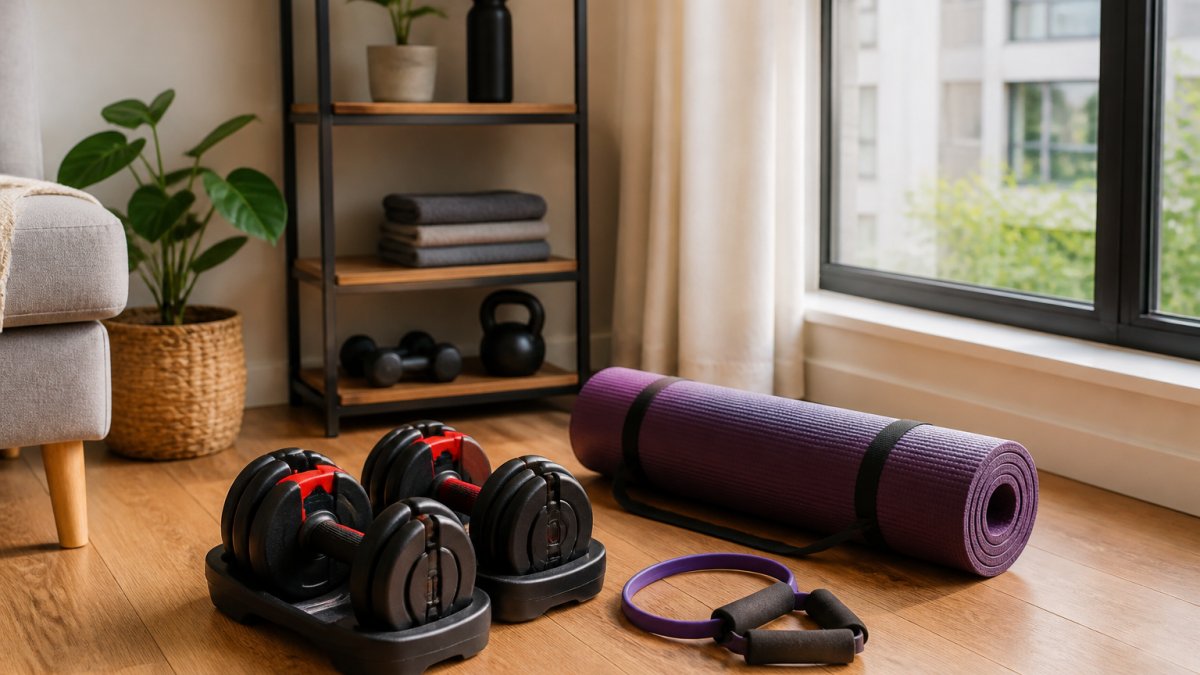
The best home fitness equipment for small spaces stores flat, adjusts to multiple exercises, and doesn't demand a dedicated room. Think adjustable weights and resistance tools over bulky machines.
What to Look For in Compact Gear
Look for four things when space is tight: footprint when stored, range of resistance, setup time, and durability. A tool that takes five minutes to assemble won't get used on a busy morning.
Here's how the main categories compare for apartment living:
| Equipment | Storage Footprint | Best For | Starting Price |
|---|---|---|---|
| Adjustable Dumbbell Set | Small, replaces a full rack | Progressive strength training | $185.36 |
| Six-Tube Pedal Tension Rope | Fits under a couch | Full-body resistance work | $10.00 |
| Abdominal Wheel | Drawer-sized | Core and stability | $29.99 |
| Cork & Rubber Meditation Mat | Rolls up | Floor practice and stretching | $34.95 |
| Balsa Wood Yoga Block | Shelf-sized | Support in poses and stretching | $60.00 |
The Adjustable Dumbbell Set is the workhorse: it replaces a whole rack of fixed weights, so you start light and progress without buying anything new.
Simple Mindfulness Exercises for Beginners
Simple mindfulness exercises for beginners are short, low-pressure practices that anchor your attention to your breath, body, or senses. Five minutes is enough to start, and the goal is not to empty your mind but to notice when attention drifts and bring it back.
A common mistake is treating a wandering mind as failure. It is not. Each time you notice the drift and return, you are doing the rep.
Three Exercises You Can Do in Five Minutes
Try these when you have a spare five minutes. Each gives your attention a single anchor so you are not holding everything at once.
- Box breathing. Inhale for four counts, hold for four, exhale for four, hold for four. Repeat for five minutes. The equal counts regulate your nervous system and give your mind a predictable rhythm to follow. If four counts feels short, extend to five or six, but keep all four phases equal.
- Five senses scan. Name five things you can see, four you can hear, three you can touch, two you can smell, one you can taste. This works well when your thoughts are racing because it forces your attention outward and into the present environment.
- Finger tracing. Trace the outline of one hand with the index finger of the other, breathing slowly as you go. The physical sensation gives your mind something concrete to track, which makes it easier to stay with the breath.
What to Do When Your Mind Wanders
When you notice your attention has drifted, label it without judgment, a simple mental note like "thinking" or "planning" is enough, then return to your anchor. The labeling interrupts the automatic loop and turns a lost moment into a deliberate one.
If you're wandering every few seconds, shorten the session rather than pushing through, two focused minutes beat ten distracted ones.
Making It Stick
Attach the practice to something you already do: meditate right after you pour your morning coffee, or do a five senses scan when you sit down at your desk.
If sitting still is hard, a sensory tool can give your hands something to do while your mind settles. The Ouroboros Sensory Meditation Maze is built for exactly that: arrange wooden hexagon tiles into looping pathways and guide a marble by tilting the board, or trace the path with a finger.
For a seated practice, the Premium Buckwheat Meditation Cushion promotes spinal alignment so you can sit longer without strain, and the Cork & Natural Rubber Meditation Mat gives you a stable, non-slip surface underneath.
The Ouroboros: A Sensory Meditation Maze →
NIH's overview of meditation and mindfulness research outlines how these practices fit into broader stress-reduction approaches.
Zero-Cost Wellness Activities That Actually Work
Zero-cost wellness activities work because they remove the excuse that you need to buy something first. Movement, breath, and connection are free.
A few that hold up over time:
- A daily walk, ideally outdoors
- Bodyweight circuits: squats, push-ups, lunges, planks
- Journaling for ten minutes before bed
- A digital detox hour with your phone in another room
- Calling a friend instead of scrolling
- Stretching while your coffee brews
None require equipment, just a trigger, a time, and a low bar. Aim for two minutes on your worst days so the streak survives.
Neurodivergent-Friendly Wellness: Adapting Activities to Your Brain
Neurodivergent-friendly wellness means adapting the activity to your brain instead of forcing your brain to fit the activity.
The core shift is to stop treating friction as a personal failing and start treating it as design feedback. If an activity is hard to start, the problem is usually the activity's shape, not your discipline.
Adjust the Unit, Not the Goal
Instead of a 30-minute workout, do three 10-minute blocks. Task initiation is easier when the commitment is small, and the same total minutes still count.
A useful rule: halve the activity until it feels almost too easy, then keep it there for a week before adding time. A streak you can protect beats a session you can only do on good days.
Use Sensory Input as a Tool, Not a Distraction
Music, a fidget tool, or a textured mat can make a practice easier to start and stay with.
Match the sensory input to the task: a fidget tool works during a phone call or walk but competes with attention during breath work. Experiment with one variable at a time so you can tell what helps.
Drop the All-or-Nothing Rule
A two-minute session still counts. A single stretch still counts. The identity of "someone who does this daily" is built from small, imperfect repetitions, not perfect weeks. When you miss a day, return the next day rather than restarting the program.
Build in Recovery and Transition Time
Neurodivergent nervous systems often need more transition time. Going straight from a meeting to a workout can feel impossible, so build in a five-minute buffer: change clothes, make a drink, put on one song. The buffer is the on-ramp, not wasted time.
Tools That Support Structure
The Meditations from the Mat paperback offers 365 daily reflections, which suits anyone who prefers a defined prompt over an open-ended "just meditate" instruction. A daily prompt removes the decision of what to do, often the hardest part.
For movement, the Six-Tube Pedal Tension Rope stores under a couch and requires no setup, lowering the barrier to starting. The Balsa Wood Yoga Block gives you a stable prop for poses.
How to Build a Home Wellness Routine You Won't Quit
A home wellness routine survives when it's small, scheduled, and forgiving. Most people quit because they set the bar too high in week one.
Use this simple framework:
| Phase | Duration | Focus | Example |
|---|---|---|---|
| Anchor | Weeks 1-2 | One habit, same time daily | 5-minute stretch after coffee |
| Stack | Weeks 3-4 | Add a second habit | 20-minute desk reset at lunch |
| Build | Weeks 5-8 | Add resistance or mindfulness | Dumbbell circuit three days a week |
| Sustain | Week 9+ | Protect the streak | Two-minute minimum on bad days |
Track it somewhere visible, a wall calendar with a checkmark beats an app you forget to open. Plan for the missed day before it happens, so one skip doesn't become a month.
Conclusion: Your Next Step Starts Today
The hard part isn't knowing what to do, it's starting before you feel ready and continuing after motivation fades. Pick one activity from this guide, set a two-minute minimum, and let the habit grow. When you're ready to add real tools, thewellbeingshop.com curates fitness equipment, mind-body training tools, and nutritional support built for exactly this kind of intentional routine, from the Premium Buckwheat Meditation Cushion for longer sits to the Adjustable Dumbbell Set for progressive strength at home.
Frequently Asked Questions
What are the 7 daily wellness activities?
A balanced daily routine can include physical movement, mindfulness or meditation, stress management, a creative hobby, a short digital detox, sleep hygiene practices, and social connection. You do not need all seven every day. A practical starting point is three: one movement activity, one mindfulness exercise, and one connection or creative activity. Rotate them based on your energy and schedule.
How can I start a wellness routine at home?
Start with a single activity you can do in under 10 minutes, such as a short stretch, a breathing exercise, or a brief walk. Attach it to an existing habit like your morning coffee or lunch break. Once that feels automatic, add a second activity. Consistency matters more than intensity, and small daily habits build the foundation for a lasting home wellness routine.
What are low-cost wellness activities for beginners?
Many effective wellness activities cost nothing: walking, bodyweight stretching, deep breathing, journaling, and guided meditations available free online. If you want to invest in equipment, start with versatile, compact tools. A six-tube pedal tension rope at $10.00 or a cork and natural rubber meditation mat at $34.95 can support a full range of movement and mindfulness practices without taking up much space.
How do I maintain consistency with home wellness habits?
Link new habits to existing routines, keep sessions short, and track your progress visually. If you miss a day, resume the next day without guilt. Pairing activities with physical cues, like placing a meditation cushion where you will see it, reduces the effort of starting. Over time, these cues make the habit feel automatic rather than forced.
What is the 5-3-1 rule for wellness?
The 5-3-1 rule is a simple framework: five servings of vegetables or fruits, three moments of intentional movement, and one act of self-reflection or gratitude each day. It is not a strict medical guideline, but it gives you a lightweight structure for covering nutrition, physical activity, and mental clarity without overhauling your entire routine.