


 Link label

How to Start Pilates at Home for Seniors: A Beginner's Guide
Table of Contents
- Why Pilates Is a Smart Choice for Seniors Starting at Home
- Safety First: Screening and When to Consult a Clinician
- Setting Up Your Home Space for Safe Pilates Practice
- Beginner Pilates Exercises for Seniors: A Step-by-Step Sequence
- Your 15-Minute Beginner Pilates Workout at Home
- Standing Pilates for Seniors: Balance and Stability Without a Mat
- Pilates Equipment for Beginners at Home: What You Actually Need
- Common Mistakes to Avoid and How to Progress Safely
- Frequently Asked Questions
Last Updated: October 21, 2026
Why Pilates Is a Smart Choice for Seniors Starting at Home
Learning how to start pilates at home for seniors comes down to one idea: controlled, low-impact movement that builds strength without punishing your joints. Pilates is a mind-body exercise method that uses slow, precise movements and steady breathing to build core strength, flexibility, and balance. Pilates is one of the most joint-friendly ways to stay strong after 60.
Here is what makes it different from most home workouts:
- Low impact: No jumping, no heavy weights, no pounding on the floor.
- Core-focused: Every move trains your abs, back, and hips to work together.
- Scalable: You can do it on a mat, in a chair, or standing.
- Short sessions work: A focused 15 minutes beats a long, sloppy hour.
The CDC's physical activity guidance for older adults recommends regular muscle-strengthening and balance work for adults 65 and up. Pilates checks all three boxes in one routine.
One honest caveat: Pilates rewards control, not speed. If you rush it, you get nothing. If you slow down, it changes how you move all day.
Safety First: Screening and When to Consult a Clinician
Talk to your doctor before starting Pilates if you have osteoporosis, recent surgery, joint replacements, heart conditions, uncontrolled blood pressure, or balance problems that have caused a fall. For most healthy older adults, gentle beginner Pilates is safe. But screening first is not optional.
Ask yourself these questions before your first session:
- Have I fallen in the past year?
- Do I have pain that gets worse with movement?
- Has a doctor told me to avoid certain positions?
- Am I on medication that affects balance or dizziness?
If you answer yes to any of these, get medical clearance first. A physical therapist can also flag movements to skip, like deep spinal twists or loaded forward bends.
Setting Up Your Home Space for Safe Pilates Practice
A safe home setup takes about ten minutes and prevents most beginner injuries. You need a clear, flat space roughly the size of a yoga mat, plus something sturdy within arm's reach.
Set up your space like this:
- Clear the floor: Remove rugs that slide, cords, and furniture corners.
- Use a non-slip mat: A thick mat cushions your spine and knees.
- Place a sturdy chair nearby: A dining chair against a wall works for balance support.
- Keep water within reach: Hydration matters more than most people think.
- Check the light: You want to see your body clearly, not squint.
Fall prevention starts before you exercise. Keep the floor dry, wear supportive shoes or go barefoot on a non-slip surface, and never practice near stairs or hard furniture edges.
Beginner Pilates Exercises for Seniors: A Step-by-Step Sequence
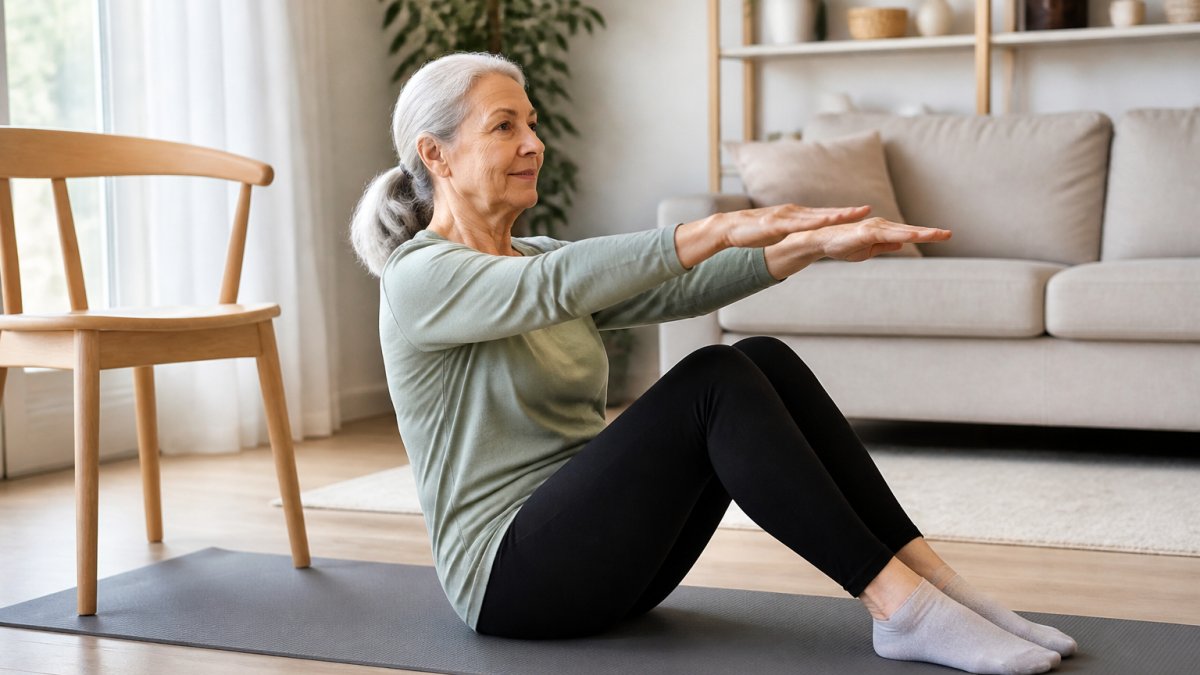
The best beginner Pilates exercises for seniors are simple, supported, and done slowly. Start with these five moves, in this order, and do 5 to 8 slow repetitions of each. For every move, a chair-supported or standing version is listed so you can adapt to your body on any given day.
-
Breathing: Lie on your back, knees bent. Breathe in through your nose, out through your mouth. Feel your ribs expand. Do 5 slow breaths.
- Chair version: Sit tall in a sturdy chair, feet flat, hands on your ribs. Breathe the same way.
- Modification: If lying flat is uncomfortable, place a small pillow under your head or do the seated version only.
-
Bridge: Lie on your back, feet flat and hip-width apart. Press through your feet and lift your hips a few inches. Hold for 2 seconds, then lower slowly. This strengthens your glutes and lower back.
- Reduced range: Lift only an inch or two, or simply press your feet into the floor and squeeze your glutes without lifting.
- Chair version: Sit at the front edge of a chair, press through your feet, and gently squeeze your glutes as you sit tall.
-
Single Leg Stretch: Lie on your back, bring one knee toward your chest, then switch legs. Keep the movement small and controlled.
- Chair version: Sit tall and march one knee up at a time, holding the chair seat for support.
- Modification: Keep both feet on the floor and slide one heel out and back instead of lifting the leg.
-
Bird Dog: On hands and knees, extend one arm and the opposite leg. Hold for 3 seconds, then switch sides. This builds core stability and balance.
- Chair version: Sit tall and extend one arm forward while lifting the opposite foot slightly off the floor.
- Standing version: Hold the chair back and extend one arm forward, then the other, keeping your hips level.
- Modification: If wrist pressure is an issue, do the standing version only.
-
Clams: Lie on your side, knees bent and stacked. Lift your top knee without rolling your hips. This targets your glutes and hip stability.
- Chair version: Sit tall with knees apart, press your hands against your outer thighs, and gently push out as you engage your hips.
- Standing version: Hold the chair back and lift one knee out to the side, keeping your torso upright.
Each move should feel steady, never strained. If one feels wrong, skip it and try a smaller range of motion or the chair version. A common pattern is to start with the seated or standing option for the first two weeks, then add floor work as confidence and comfort grow.
Your 15-Minute Beginner Pilates Workout at Home
A 15-minute beginner Pilates workout at home is enough to build real strength when you do it consistently. Here is a simple session you can repeat three times a week.
Warm-up (3 minutes): Gentle breathing, slow shoulder rolls, and ankle circles.
exercises with elastic bands →
Main sequence (10 minutes):
| Exercise | Time | Focus |
|---|---|---|
| Bridge | 2 minutes | Glutes and lower back |
| Single Leg Stretch | 2 minutes | Lower abs |
| Bird Dog | 2 minutes | Core stability and balance |
| Clams | 2 minutes | Hip strength |
| Seated leg extension | 2 minutes | Knee and thigh strength |
Cool-down (2 minutes): Slow breathing and a gentle spinal stretch.
The 15-minute format works because it removes the biggest barrier: time. Short, repeatable sessions beat long ones you dread.
Standing Pilates for Seniors: Balance and Stability Without a Mat
Standing Pilates for seniors trains balance in the position you actually use every day: on your feet. It is ideal if getting down to the floor is hard, uncomfortable, or unsafe.
Try these standing moves, holding a chair back for support:
- Standing leg lifts: Lift one leg to the side, hold, lower. Switch sides.
- Heel raises: Rise onto your toes slowly, then lower. This strengthens your calves and ankles.
- Standing knee lifts: Lift one knee toward your chest, hold, lower.
- Side bends: Reach one arm overhead and lean gently, then switch.
Keep your movements slow and your breathing steady. Standing work builds the ankle and hip stability that protects against falls. Start with 5 repetitions per side and add more as you feel stronger.
Pilates Equipment for Beginners at Home: What You Actually Need
You need very little to start. A non-slip mat and a sturdy chair cover most beginner sessions. Everything else is optional until you know you will stick with it.
Here is what helps, and when to add it:
- Mat: The one essential. Choose a thick, non-slip mat.
- Chair: Free and already in your home. Use it for balance support.
- Resistance bands: Add gentle resistance to arm and leg work once the basics feel easy. Our elastic band foot pedal trainer is a compact option that lets you add resistance to your arms, legs, shoulders, and abs without bulky weights.
- Small pillow or folded towel: Supports your head or knees during floor work.
Skip the reformer for now. A reformer workout is excellent, but it is a bigger investment. Master mat and standing work first.
Common Mistakes to Avoid and How to Progress Safely
The biggest mistake beginners make is doing too much too soon. Pilates feels easy at first, so people add reps and skip rest days. Then their back or hip complains.
Watch for these:
- Holding your breath: Breathe through every move.
- Rushing the reps: Slow is the whole point.
- Skipping the warm-up: Cold muscles strain more easily.
- Ignoring pain: Discomfort is fine; sharp pain is a stop sign.
- Doing it daily at first: Start with three sessions a week.
A four-week beginner progression:
- Week 1: Do the 15-minute session three times. Use chair or standing versions for any move that feels uncomfortable on the floor. Focus on breathing and slow, steady reps.
- Week 2: Same three sessions. Add 2 repetitions to each exercise if the last two reps felt controlled. Keep the same moves.
- Week 3: Add one new exercise from the sequence (for example, the standing version of Bird Dog) and reduce the reps of the others slightly to keep the session at 15 minutes.
- Week 4: Do the full sequence with 8 reps per move, three times. If you feel strong, add a fourth short session or extend to 20 minutes.
How to progress after week four: Add one new exercise or one extra repetition every two weeks, never both at once. Increase reps before you increase difficulty. Track your sessions in a notebook so you can see the pattern.
Consistency beats intensity. Three short sessions a week for a month will do more for your strength and balance than one long session you never repeat.
Frequently Asked Questions
Is Pilates good for people over 70?
Yes, Pilates can be very beneficial for people over 70 when adapted to individual abilities. It focuses on core strength, flexibility, and balance, which are key for daily activities and fall prevention. Many exercises can be done seated or with chair support. However, it's important to consult a clinician before starting, especially if you have joint issues, osteoporosis, or balance concerns. A qualified instructor can help modify movements to suit your needs.
How often should seniors do Pilates as beginners?
Beginners should aim for 2 to 3 sessions per week, allowing rest days in between. Start with 15-minute sessions and gradually increase to 20-30 minutes as comfort and strength improve. Consistency matters more than duration. Listen to your body and modify or stop if you feel pain or excessive fatigue. A progressive plan over several weeks helps build a sustainable habit without overdoing it.
Can seniors do Pilates standing or seated?
Absolutely. Standing Pilates for seniors is excellent for balance and functional strength, using a chair or wall for support. Seated Pilates is ideal for those with limited mobility or balance concerns. Both options allow you to work on core stability, posture, and range of motion without getting down on the floor. Many exercises like arm circles, leg extensions, and spinal twists can be done seated.
What equipment do you need to start Pilates at home?
You need very little to start. A mat or a non-slip surface is helpful, and a sturdy chair for support. Resistance bands can add variety and challenge; for example, a foot pedal resistance band trainer ($92.92) from thewellbeingshop.com offers a compact way to add resistance for arms and legs. Avoid buying bulky equipment until you know your routine. Comfortable clothing and bare feet or grip socks are sufficient.
Starting a home Pilates routine asks one thing of you: show up for 15 minutes, three times a week. That is the whole challenge. The Well Being Shop curates the tools that make it easier, from supportive mats to our elastic band foot pedal trainer for gentle resistance work. Our focus is smarter wellness routines that build mind-body harmony in small, repeatable steps. Get started with thewellbeingshop.com and turn a few quiet minutes each day into lasting home strength.