


 Link label

Is a Yoga Wheel Worth It for Home Practice?
Table of Contents
- What a Yoga Wheel Is and How It Works for Home Practice
- Real Benefits of a Yoga Wheel for Your Daily Practice
- Yoga Wheel Back Stretches: Practical Techniques
- Yoga Wheel for Beginners: Is It Accessible?
- Yoga Wheel vs Yoga Blocks and Other Alternatives
- What Actually Matters: Durability, Size, and Fit for Home Use
- The Real Verdict: Is It Worth It for You?
- Frequently Asked Questions
Last Updated: October 6, 2026
What a Yoga Wheel Is and How It Works for Home Practice
A yoga wheel is a circular prop designed to support stretching, backbends, and spinal mobility work in your home practice.
The yoga wheel worth it question comes down to one thing: does it solve a specific problem in your practice? That's what we'll explore here.
Real Benefits of a Yoga Wheel for Your Daily Practice
The yoga wheel delivers real benefits when used consistently, but they depend on what you're trying to fix.
Back and Upper Back Stretching
Your upper back takes a beating from desk work, phone scrolling, and forward-leaning postures.
The benefit is specific: relief from that pinched feeling between your shoulder blades, often felt on the first use.
Spend 2-3 minutes per session on your upper back. Consistency matters more than duration, three times a week beats one long session.
Chest Opening and Spinal Mobility
Tight chest muscles pull your shoulders forward and limit your range of motion.
The practical outcome: better posture and easier breathing. When your chest opens, your shoulders sit back naturally and you stand taller, meaningful for remote workers hunched over keyboards.
Spinal mobility improves because the wheel allows safe extension through your entire back. You're not forcing a backbend. You're supporting one.
Tension Relief and Relaxation
The yoga wheel works for tension release, similar to foam rolling but gentler. Rolling slowly over tight areas encourages muscles to relax, and the support plus gentle movement creates a calming effect.
This is where the wheel shines for stress relief. Many people use it 5-10 minutes in the evening to unwind: the repetitive motion is meditative, your nervous system downshifts, and tension releases without aggressive pressure.
Yoga Wheel Back Stretches: Practical Techniques
The real value of a yoga wheel emerges when you know how to use it. Generic rolling isn't enough. Specific techniques create specific results.
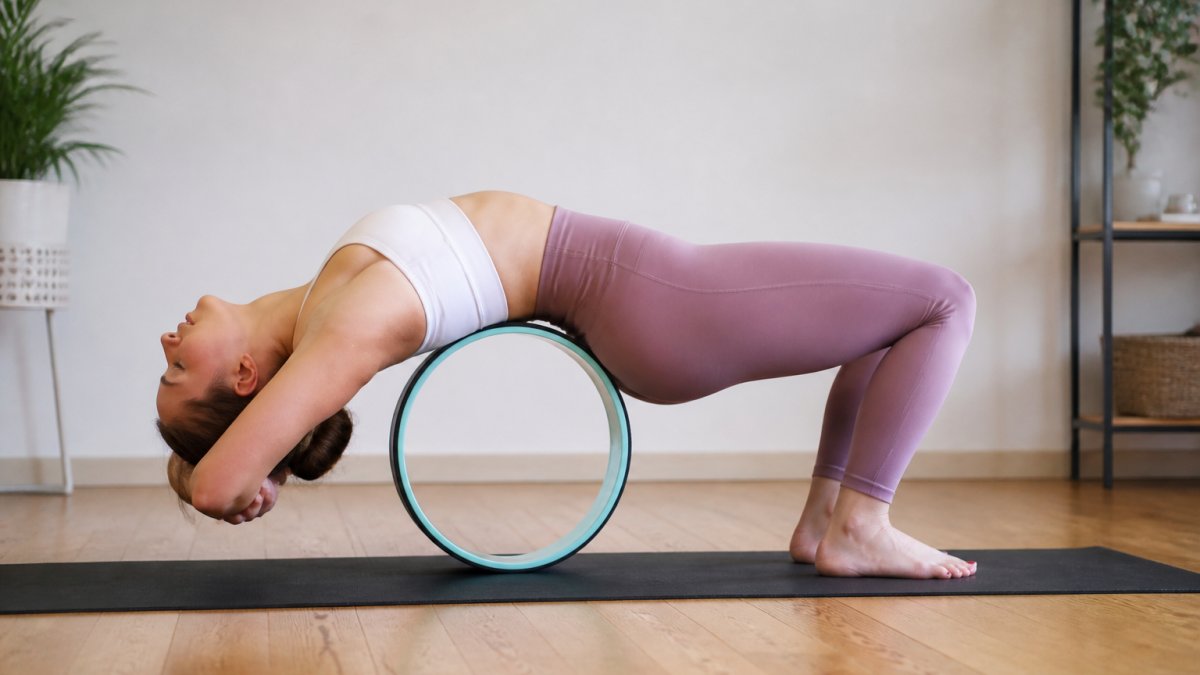
Supported Backbends and Deeper Arches
A supported backbend is the foundation of yoga wheel practice. Here's how it works:
Position the wheel under your mid-back, between your shoulder blades. Support your head with your hands or rest it on the wheel, extend your legs or bend your knees for easier entry, and breathe steadily for 30-60 seconds.
This position opens your chest and extends your spine safely. The wheel does the work. You just breathe.
For deeper arches, move the wheel lower along your spine, each position targets different areas.
The key: never force depth. Your body will tell you when you've hit your limit; forcing a deeper arch risks injury.
Safe Progressions for Controlled Movement
Beginners should start with basic supported backbends.
Advanced practitioners can try supported backbends with legs extended, or even light weight across the chest. But these progressions take time.
The principle: add complexity only when the basic version feels easy. Your home practice should feel sustainable, not risky.
Yoga Wheel for Beginners: Is It Accessible?
Beginners often worry they're "not flexible enough" for yoga props.
Start with the wheel under your mid-back. Rest there for 30 seconds.
Common concerns fade quickly. Most beginners feel comfortable within 2-3 sessions.
The main adjustment is mental, not physical: trust the wheel to hold you.
Yoga Wheel vs Yoga Blocks and Other Alternatives
Whether a yoga wheel is worth it depends heavily on what else you already own or could buy instead. Here's the decision logic.
The Core Trade-Off: Specialization vs Versatility
A yoga wheel does one job extremely well: supported spinal extension. Its curved, rigid surface holds your thoracic and lumbar spine in a gentle arch while you breathe.
Blocks, straps, bolsters, and foam rollers each solve different problems. None replicate the wheel's continuous spinal support, and the wheel doesn't replicate theirs.
Choose a Yoga Wheel If:
- Your primary complaint is mid-back stiffness or a pinched feeling between the shoulder blades from desk work or phone use
- You want to open your chest and counteract forward-rounded posture
- You want to practice supported backbends at home without a teacher spotting you
Choose Yoga Blocks If:
- You need multi-purpose support, hand placement in standing poses, a lift under your pelvis in seated stretches, stacked height for restorative work
- You're building a home practice from scratch and want the most versatile prop per dollar
- You have very limited storage space
Blocks are flat and precise, excellent for positioning, poor for spinal extension, since they offer no continuous curve to rest your back against.
Choose a Yoga Strap If:
- Your main goal is shoulder mobility or hamstring flexibility
- You want to reach deeper into poses you can already do, rather than support new ones
- You travel and need something that packs flat
A strap extends your reach. It doesn't support your spine.
Choose a Foam Roller If:
- You want self-myofascial release for calves, quads, IT bands, or general muscle tightness
- You want a firmer, more aggressive pressure than a padded wheel provides
A foam roller is a massage tool. A yoga wheel is a mobility and backbend tool. They overlap only slightly, and neither replaces the other.
Choose a Yoga Bolster If:
- You practice restorative yoga and want full-body supported relaxation
- You want a prop for savasana, supported child's pose, or gentle chest opening while lying flat
A bolster is soft and broad, supporting relaxation. A wheel is firm and narrow, supporting extension. Different jobs.
Side-by-Side Comparison
| Tool | Best For | Spinal Extension | Typical Price Range | Storage Footprint |
|---|---|---|---|---|
| Yoga Wheel | Chest opening, supported backbends, upper-back release | Excellent | $30-$70 | Moderate (roughly 12-16 in diameter) |
| Yoga Block | Multi-purpose support, hand placement, seated height | Poor | $10-$25 each | Low |
| Yoga Strap | Shoulder work, hamstring stretches, reach extension | Poor | $8-$20 | Very low |
| Foam Roller | Muscle release, tissue massage | Not designed for this | $15-$40 | Moderate |
| Yoga Bolster | Restorative poses, full-body relaxation | Mild | $40-$90 | High |
The Cost-Per-Use Reality Check
A yoga wheel is a modest one-time purchase. The real cost isn't the money, it's the space and mental overhead of a single-purpose prop.
Before buying, ask: do I already own a block and a strap, and do they fail to reach my upper back?
What the Wheel Does Not Replace
A yoga wheel is not a substitute for:
- A foam roller for muscle release
- A strap for shoulder or hamstring flexibility
- Blocks for standing-pose support
If you understand that, the wheel becomes an easy yes-or-no decision rather than a vague maybe.
What Actually Matters: Durability, Size, and Fit for Home Use
A cheap wheel that cracks after two months isn't a bargain, and the wrong diameter wastes money. Here are the specs that determine whether a wheel works for you.
Diameter: The Single Most Important Spec
Yoga wheels typically come in three diameter ranges, and the right one depends on your experience and flexibility:
- 12 inches (small): Best for beginners, tighter backs, and anyone who finds full backbends uncomfortable. The smaller curve creates a gentler arch, and it's also good for targeted upper-back work and smaller body frames.
- 13 inches (standard): The most common size, a reasonable middle ground for most home practitioners who want a moderate arch and enough surface area to feel stable.
- 14-16 inches (large): For experienced practitioners and very flexible backs. The larger curve produces a deeper arch, which is exactly what you don't want if you're new to supported backbends.
A common mistake is buying the biggest wheel because it looks more impressive. For most home practitioners, a 12- or 13-inch wheel is the better starting point. You can always size up later.
Width: Stability vs Portability
Wheel width usually ranges from about 5 to 13 inches. Wider wheels feel more stable under the spine and are easier to balance on, especially for beginners.
If you have a broader frame or want maximum stability, lean wider. If storage is tight, a narrower wheel is fine once you're comfortable with the basic position.
Padding: Firm, Not Soft
The padding protects your spine from the hard core underneath. Two things matter:
- Thickness: Thin padding lets you feel the rigid core, which is uncomfortable and can discourage use. Look for padding substantial enough to cushion your vertebrae without being so soft you sink through it.
- Firmness: The best padding is firm but forgiving, it distributes pressure across your back rather than concentrating it on one spot. Very soft padding feels nice for a second and then offers no real support.
If you can handle the wheel before buying, press your thumb into the padding. It should give slightly and spring back, not bottom out against plastic.
Grip: Non-Negotiable for Safety
The wheel's outer surface needs enough texture to keep it from rolling when you don't want it to. A slick wheel is a safety problem, not just an annoyance.
Test it if you can: place the wheel on your mat and press down. It shouldn't skate.
Weight Capacity and Construction
Most quality yoga wheels are rated to support roughly 300 to 500 pounds. If you're near or above the upper end of a wheel's rating, choose one with a higher capacity, a wheel that fails under load is dangerous, not just disappointing.
Construction matters as much as the number:
- ABS plastic core: The most common material. Durable and rigid when the plastic is thick enough. Thin, cheap cores are where failures happen.
- Wood or bamboo cores: Heavier and often pricier, but very sturdy and pleasant to grip.
- Composite or reinforced cores: Often the strongest option for heavier users.
Check reviews for any mention of cracking, flexing, or collapsing under weight. A wheel that flexes during use is a wheel you shouldn't trust.
A Quick Buying Checklist
Before you buy, confirm:
- Diameter matches your experience level (12-13 in for beginners, 14-16 in for advanced)
- Width feels stable for your frame
- Padding is firm and thick enough to protect your spine
Storage and Frequency of Use
A yoga wheel is roughly the size of a large dinner plate standing upright, about 12 to 16 inches across and 5 to 13 inches wide.
The real question is frequency.
Be honest about your habits. Do you stick with home routines, or do you buy equipment that collects dust?
The Real Verdict: Is It Worth It for You?
Do you have upper back tension from desk work?
Do you want a general fitness tool?
The wheel is specialized. It's excellent at one thing.
For home practitioners, the yoga wheel worth it calculation comes down to three factors:
- Problem specificity: Does it target your actual issue?
- Consistency: Will you use it regularly?
- Space and budget: Do you have room and can you afford it?
If all three align, a yoga wheel is worth it.
We believe in equipment that serves a real purpose in your practice.
Frequently Asked Questions
What are the main benefits of using a yoga wheel?
A yoga wheel provides targeted back and chest stretching, improves spinal mobility, and offers deeper arch support for backbends than traditional yoga props. It also helps relieve muscle tightness and tension in the upper back and shoulders. For home practitioners, the wheel combines multiple benefits into one piece of equipment, making it efficient for stretching, mobility work, and pose support in limited space.
Is a yoga wheel good for beginners?
Yes, yoga wheels are beginner-friendly when used with proper modifications and controlled movement. Start with gentler stretches and lower back placement before progressing to deeper arches. Beginners should focus on comfort and alignment rather than intensity. Many beginners find the wheel's stability and body support reassuring compared to unsupported stretching, though modifications and gradual progression are essential for safe practice.
How does a yoga wheel compare to yoga blocks?
Yoga blocks are better for precise alignment and pose support in standing or seated poses, while a yoga wheel excels at continuous rolling, chest opening, and deeper backbends. Blocks are more versatile for general yoga practice and take up less storage space. A wheel is specialized equipment that targets specific mobility goals. For home practice, blocks are more fundamental, but a wheel adds value if your routine emphasizes back stretching and spinal mobility work.
Can you use a yoga wheel if you have back pain?
A yoga wheel can help with certain types of back tension and stiffness, but it is not appropriate for acute pain or injury. If you have existing back pain, consult a healthcare provider or physical therapist before using one. Proper alignment, controlled movement, and gradual progression are critical. Start with light, gentle stretching and avoid deep arches until you understand how your spine responds to the wheel's support.
The difference between equipment that transforms your practice and equipment that becomes clutter comes down to intention. A yoga wheel is a powerful tool for spinal mobility and backbend support. It works best for people committed to consistent home practice who specifically want to open their chest and upper back. If that's you, thewellbeingshop.com can help you find a wheel that matches your needs, fits your space, and supports your practice for years to come.