


 Link label

Yoga vs Pilates for Flexibility at Home: A 2026 Guide
Table of Contents
- Yoga vs Pilates for Flexibility at Home: The Core Difference
- Yoga for Flexibility: Static Holds and Breath-Led Stretching
- Pilates for Flexibility: Controlled Movement and Active Range
- Beginner Yoga Stretches at Home: A Simple Starting Sequence
- Beginner Pilates Exercises at Home: Building Core and Spinal Mobility
- Realistic Flexibility Timelines and How Often to Practice
- Which One Should You Choose? Matching the Practice to Your Body
- Conclusion: Building a Consistent Home Practice
- Frequently Asked Questions
Last Updated: October 8, 2026
Yoga vs Pilates for Flexibility at Home: The Core Difference
The yoga vs pilates comparison comes down to one distinction: yoga builds passive flexibility through held stretches and breath, while Pilates builds active flexibility through controlled movement against resistance.
At thewellbeingshop.com, we hear this from people who work from home and want a realistic routine, not a studio membership. Below: how each practice develops range of motion, which fits your starting point, and how to build a home practice that sticks.
How Each Practice Approaches Range of Motion
Range of motion is the full movement available at a joint, and each practice develops it differently. Yoga lengthens tissue through sustained holds; Pilates trains the muscles around a joint to control that length. A person can be very flexible and still have poor joint stability, which is why some yoga practitioners struggle with controlled movement, and strong core control does not automatically produce flexibility.
| Factor | Yoga | Pilates |
|---|---|---|
| Primary focus | Static flexibility, breath | Core strength, stability |
| Typical hold | 30-60 seconds | Continuous movement |
| Best for | Tight hips, hamstrings, shoulders | Low back support, posture |
| Equipment | Mat, blocks, strap | Mat, resistance band |
| Learning curve | Gentle, self-paced | Moderate, form-sensitive |
Yoga for Flexibility: Static Holds and Breath-Led Stretching
Yoga for flexibility relies on static stretching: holding a pose long enough for the muscle to relax and lengthen. Breathing slowly in a held pose downshifts the nervous system, and the muscle releases its protective tension.
For home practice, this is the gentler entry point. According to the National Center for Complementary and Integrative Health overview of yoga, yoga is generally well tolerated for healthy adults, though people with injuries should modify poses or check with a clinician first.
Pilates for Flexibility: Controlled Movement and Active Range
Pilates for flexibility works the opposite way: instead of holding a stretch, you move a joint through its available range with the core engaged, building active flexibility, the strength to control a stretch rather than fall into it. Muscle engagement is constant, which is why sessions feel harder than they look and why the low back often feels more supported within a few weeks.
Beginner Yoga Stretches at Home: A Simple Starting Sequence
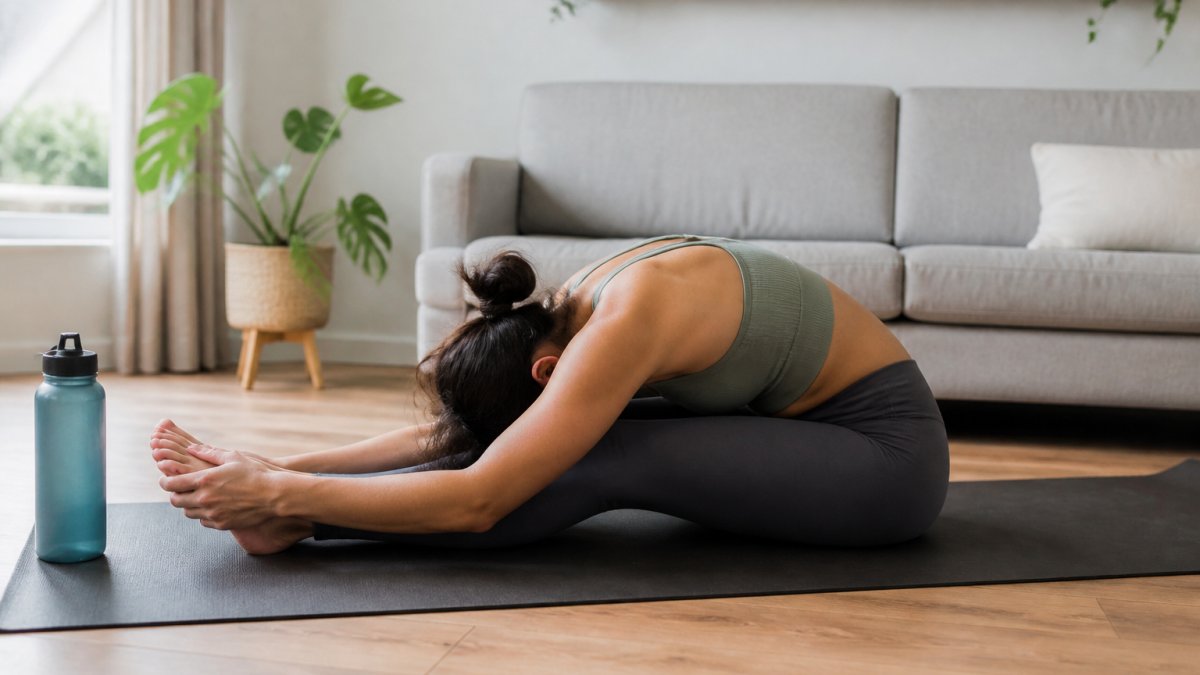
Start with five poses held 30 to 60 seconds each, breathing slowly throughout. This 10-minute sequence targets what home workers complain about most: hips, hamstrings, shoulders, and spine.
- Cat-Cow - on hands and knees, alternate arching and rounding the spine for 8 slow rounds
- Seated forward fold - legs extended, hinge from the hips, hold 30-60 seconds
- Low lunge - one knee down, other foot forward, hold 30-45 seconds per side
- Thread the needle - from hands and knees, slide one arm under the body, hold 30 seconds per side
- Child's pose - knees wide, hips back toward heels, hold 60 seconds
Form Cues for Practicing Without an Instructor
Without a teacher watching, alignment becomes your responsibility. Keep these cues in mind:
- Move into a stretch until you feel tension, never sharp pain
- Keep breathing steadily; if you hold your breath, you have gone too far
- Keep the spine long rather than forcing a deeper fold
Beginner Pilates Exercises at Home: Building Core and Spinal Mobility
Five foundational Pilates exercises build core strength and spinal mobility in about 10 minutes, mat-based and with no equipment to start.
- Pelvic tilt - lie on your back, gently flatten the low back, 10 slow reps
- Dead bug - arms and legs at 90 degrees, extend opposite arm and leg, 8 reps per side
- Bird dog - on hands and knees, extend opposite arm and leg, hold 3 seconds, 8 per side
- Spine stretch - seated, round forward and back with control, 8 reps
- Bridge - lift the hips, roll down one vertebra at a time, 10 reps
Adding Resistance for Muscle Conditioning
Once the basics feel controlled, resistance bands add muscle conditioning without the joint load of heavy weights, anchoring rowing, pressing, and lower-body movements that challenge the core through a range.
Our exercises with elastic bands foot pedal resistance band is built for exactly this: the foot pedal anchors lower-body resistance, the handles work arms, shoulders, and abdomen in the same session, and it stores flat when your living room doubles as your gym.
Realistic Flexibility Timelines and How Often to Practice
Most people notice meaningful flexibility changes in four to eight weeks of consistent practice, three to four sessions per week. But "flexibility" is not one thing, and separating the three types is the most useful thing you can do before you start.
- Passive flexibility is the range you can reach with gravity, a prop, or a partner doing the work, sinking into a seated forward fold, for example. This is what yoga develops fastest, and where beginners see the quickest gains.
- Active flexibility is the range you can hold using your own muscle contraction, no prop or gravity assist. Lifting a straight leg to hip height and holding it there is active. This is what Pilates builds, and it takes longer because you are training strength at end range, not just length.
- Mobility is the usable combination of the two, the range you can actually control and move through in daily life. Touching your toes is passive flexibility; bending over to pick up a laundry basket without your back rounding is mobility.
A person can be very flexible passively and still have poor mobility, which is why some long-time yoga practitioners cannot control the range they can reach.
How to Track Progress Without a Trainer
You do not need a goniometer. Three self-tests, done every two weeks under the same conditions, tell you whether the practice is working:
exercises with elastic bands →
- Seated forward fold, sit with legs extended, hinge forward, and note how far your hands reach (shins, ankles, toes, past toes). Measure the distance from fingertips to toes with a ruler or tape.
- Standing hamstring reach, stand with one heel on a low step, keep the knee straight, and note the angle of your torso. A phone photo from the side is more honest than memory.
- Sit-and-reach against a wall, sit with legs straight, back against a wall, and reach forward. This removes the tendency to round the spine and cheat the test.
Log the number, not the feeling, feelings fluctuate with sleep, stress, and hydration; the measurement does not. Expect a fast gain in the first two weeks as the nervous system relaxes its protective tension, then a normal plateau of several weeks while the tissue remodels.
What Actually Changes the Timeline
- Consistency beats duration. Ten to fifteen minutes daily beats one long weekly session, because flexibility adapts to repeated exposure. Three to four short sessions per week is the minimum for steady progress; daily is better.
- Warmth matters. Tissue lengthens more readily when warm. A five-minute walk, a few sun salutations, or a warm shower before stretching makes a session noticeably more productive than stretching cold.
- Age and training history. Most healthy adults can improve flexibility at any age, but tissue remodeling is slower after roughly age 40, and people who were never active tend to start with more resting tension to unwind.
Which One Should You Choose? Matching the Practice to Your Body
Most people benefit from both, and the order matters less than starting. But the right entry point depends far more on your starting point than on your goal. Here is how to decide based on where your body actually is.
If You Are Sedentary and Very Tight
Start with yoga for two to three weeks to open range before adding strength work. Static holds with slow breathing are the gentlest way to convince a guarded nervous system to release tension, and they require no coordination or core control to begin. Once you can move through a basic sequence without bracing, add two short Pilates sessions per week to hold the new range.
If You Have Low Back Pain From Sitting
Prioritize Pilates for core and spinal support, and add gentle yoga for hips and hamstrings. Prolonged sitting leaves the hip flexors short and the deep core and glutes underactive, pulling the pelvis into a position the low back must compensate for. Pelvic tilt, dead bug, and bird dog retrain that support; yoga hip openers address the tightness side. If pain radiates down a leg, is sharp, or wakes you at night, see a clinician first.
If You Are Already Flexible but Unstable
Pilates is the better fit, and more stretching is likely to make things worse. If you can touch your toes, fold deeply, or drop into splits but feel wobbly, your limiter is control, not length, passive stretching on an already-lax joint reduces the stability the surrounding muscles provide. Focus on active flexibility: hold end-range positions under your own muscle power, move slowly, and stop before the joint feels like it is hanging on ligaments rather than muscle.
If You Are Hypermobile
This group is most often failed by generic advice. Hypermobility means joints move beyond a normal range, often because connective tissue is more lax, so stretching further is not the goal and can be counterproductive. Choose Pilates or a slow, strength-focused yoga style, avoid deep end-range holds, and prioritize stability at mid-range. If a pose feels like it rests on the joint rather than the muscle, back off.
If You Have a Specific Movement Limitation
- Tight hamstrings: yoga forward folds with a strap or bent knees are the faster route; Pilates will help you control the range once you have it.
- Tight hips: yoga hip openers (low lunge, pigeon variations) address this directly; Pilates has less dedicated hip-opening work.
- Tight shoulders and upper back: both help, but yoga's thread-the-needle and chest openers tend to be more direct.
If You Are Short on Time
A 15-minute Pilates core session gives more functional return than a rushed yoga flow, because the strength supports posture and daily movement all day. If your goal is to touch your toes, a 10-minute daily yoga hold sequence gets you there faster. With one slot, alternate: yoga for mobility on stiff days, Pilates for strength on loose days.
If You Want Both
Alternate days, or pair them in one session: five to ten minutes of yoga to open range, then ten to fifteen minutes of Pilates to train control in that new range. Lengthening first and then teaching the muscles to own the length works best; strength first is also fine, but stretching fatigued muscles feels less productive.
Conclusion: Building a Consistent Home Practice
The real challenge is not choosing between yoga and Pilates. It is building a routine you return to on the days you do not feel like it, because consistency is what changes your flexibility.
At thewellbeingshop.com, we built our catalog around exactly that problem. Our resistance band trainer adds muscle conditioning to any mat routine, our mind-body tools support daily practice, and our curated selection suits small spaces and short sessions.
Frequently Asked Questions
Is yoga or Pilates better for improving flexibility at home?
It depends on the type of flexibility you want. Yoga uses longer static holds that target passive range of motion, which can make you feel looser quickly. Pilates builds active flexibility through controlled movement, so your muscles can control that new range. Many people combine both: yoga for lengthening and Pilates for strength through the range. If you only pick one, choose yoga for faster visible flexibility gains and Pilates for flexibility that holds up under movement.
Can beginners do yoga and Pilates at home without equipment?
Yes. Both practices need only a mat and enough floor space to lie down with arms extended. Beginner yoga stretches at home rely on body weight, while beginner Pilates exercises at home use small, controlled movements that need no props. As you progress, a resistance band trainer can add challenge to Pilates-style pulling and pressing movements without taking up much storage space.
How often should I do yoga or Pilates to become more flexible?
Three to four sessions per week, 20 to 30 minutes each, is a realistic target for most beginners. Consistency matters more than session length. Static stretching after a short warm-up works best for yoga-style flexibility, while Pilates-style active work fits well before or after strength training. Expect noticeable range-of-motion changes in four to six weeks if you practice regularly, though individual timelines vary.
Which is better for seniors, Pilates or yoga?
Both can work well with modifications. Yoga offers balance practice and gentle stretching, while Pilates focuses on core stability that supports posture and fall prevention. Chair-based versions of either practice reduce floor time. A physical therapist or qualified instructor can help you adapt poses and exercises to your limitations, especially if you have joint or balance concerns. Start with shorter sessions and build gradually.