


 Link label

Low-Impact HIIT for Weight Loss: Does It Actually Work?
Table of Contents
- What Is Low-Impact HIIT and How Does It Work for Weight Loss?
- Benefits of Low-Impact HIIT Beyond the Scale
- Low-Impact HIIT Workout Routine: Sample 20-Minute Session
- Effective 20-Minute Home Workout Routines Using Low-Impact HIIT
- Low-Impact HIIT vs. Steady-State Cardio: Which Burns More Fat?
- Joint Health and Injury Prevention During Low-Impact Training
- Equipment and Nutrition for Maximum Results
- Frequently Asked Questions
Last Updated: September 21, 2026
What Is Low-Impact HIIT and How Does It Work for Weight Loss?
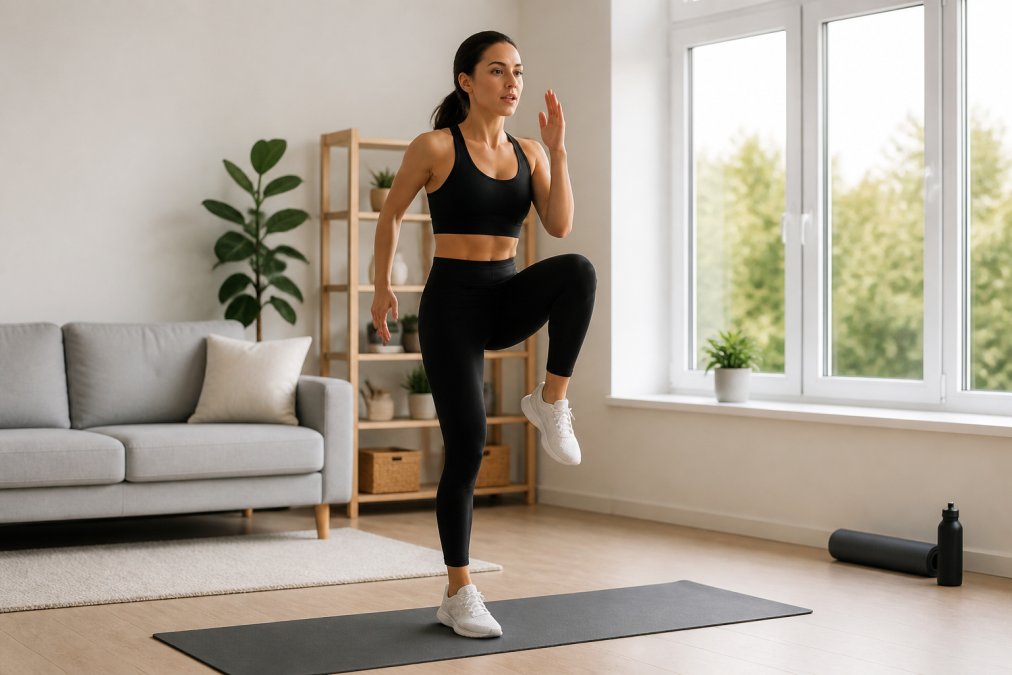
Low-impact HIIT weight loss uses high-intensity interval training performed without jumping or heavy impact on your joints. Instead of traditional HIIT moves like burpees or jump squats, you perform explosive movements in place: high knees, fast marching, lateral shuffles, and modified lunges. The intensity comes from speed and effort, not ground impact. This approach maintains the metabolic demands that make HIIT effective for weight loss while protecting your joints from repetitive stress.
Alternating 20-30 seconds of maximum effort with recovery periods elevates your heart rate to near-anaerobic threshold levels. Your body burns calories during the workout, but the real payoff happens after: post-exercise oxygen consumption (EPOC) keeps your metabolic rate elevated for hours, meaning you continue burning calories even after you've stopped moving.
Low-impact HIIT weight loss makes achieving a caloric deficit easier by increasing total energy expenditure without joint wear that might force you to stop training. For people with existing knee, ankle, or hip issues, this is the difference between a sustainable practice and one that becomes painful within weeks.
Benefits of Low-Impact HIIT Beyond the Scale
Beyond weight loss, low-impact HIIT improves cardiovascular health: resting heart rate drops, heart efficiency increases, and aerobic capacity climbs, reducing heart disease risk.
Low-impact HIIT eliminates grinding stress on cartilage and connective tissue, preventing overuse injuries. Recovery time shrinks because joints aren't inflamed or damaged.
Low-impact HIIT preserves lean muscle mass because high-intensity bursts signal your body to keep muscle tissue. You lose fat, not muscle, maintaining higher metabolism long-term.
Adherence improves when training doesn't hurt. Low-impact HIIT removes joint discomfort barriers, making 3-4 weekly sessions realistic and sustainable.
Low-Impact HIIT Workout Routine: Sample 20-Minute Session
Sustainable fat loss requires progressive overload, systematically increasing demand over weeks and months. Without progression, your body adapts and fat loss stalls.
Week 1-2: Foundation Phase
Perform each exercise at maximum effort for 30 seconds, then recover for 30 seconds. Complete the circuit twice.
Warm-up (2 minutes): March in place with increasing intensity for 60 seconds, then 8 slow bodyweight squats and 8 arm circles in each direction.
Circuit (9 minutes per round, 2 rounds total):
- High knees marching: Drive knees up to hip height, alternating legs as fast as possible
- Lateral shuffle: Side-step quickly left for 15 seconds, then right for 15 seconds
- Modified burpee: Place hands on ground, step back into plank, step forward, stand up (no jump)
- Standing oblique crunch: Lift right knee while bringing right elbow down, alternate sides rapidly
- Glute bridge march: Lie on back, lift hips, march legs while maintaining bridge position
- Speed skater: Shift weight side to side with a slight jump, landing softly on the ball of your foot
Cool-down (2 minutes): Walk slowly in place for 60 seconds, then perform gentle stretches for the legs, hips, and shoulders.
Week 3-4: Intensity Increase
Shift to 30 seconds work, 20 seconds recovery. Heart rate stays elevated longer, forcing cardiovascular adaptation. Metabolic demand increases significantly without equipment or complexity.
Week 5-6: Volume Addition
Complete three circuits instead of two (27 minutes total work vs. 18 minutes). Caloric burn increases and metabolism re-sensitizes to the training stimulus.
Week 7-8: Movement Complexity
Upgrade to more demanding variations: high knees with arm drive, lateral lunge shuffle, modified burpee with push-up, standing knee-to-elbow with rotation, single-leg glute bridge march, and speed skater with tap. These demand greater neuromuscular coordination without equipment.
Week 9-10: Resistance Introduction
Add dumbbells, resistance bands, or household items. Perform goblet holds during high knees, add weight to glute bridges, or wear a weighted vest. Adding 5-10 pounds dramatically increases muscular demand without changing movement patterns.
Week 11-12: Density Training
Perform more total repetitions in the same 30-second intervals. If you completed 40 high knees in Week 1, aim for 45-50 in Week 11. This forces continuous adaptation without longer workouts.
Progression Framework Summary
| Week | Primary Variable | Mechanism | Expected Adaptation |
|---|---|---|---|
| 1-2 | Baseline establishment | Learn movement patterns | Neuromuscular coordination |
| 3-4 | Reduced recovery | Sustained intensity | Cardiovascular capacity |
| 5-6 | Increased volume | More total work | Metabolic demand elevation |
| 7-8 | Movement complexity | Greater coordination demand | Neuromuscular challenge |
| 9-10 | External load | Increased resistance | Muscular strength and endurance |
| 11-12 | Work density | More reps in same time | Metabolic efficiency |
After 12 weeks, cycle back to Week 1 exercises with increased demands. Your baseline has shifted, preventing adaptation plateaus and ensuring continuous fat loss.
Effective 20-Minute Home Workout Routines Using Low-Impact HIIT
Twenty-minute sessions fit any schedule. Choose movements that challenge multiple muscle groups simultaneously, maximizing efficiency.
Jump Ropes With Electronic Counting →
Strength-focused routine: Pair low-impact HIIT with resistance using dumbbells or bands. Perform goblet squats, renegade rows, overhead presses, and lateral raises at high speed for 30 seconds each, recovering 30 seconds between. The Adjustable Dumbbell Set at $185.36 allows progression, while the CAP Neoprene Coated Dumbbells 10 lbs at $12.00 provide an affordable entry point.
Cardio-focused routine: Emphasize movement speed without equipment. High knees, lateral shuffles, speed skaters, and standing knee drives keep your heart rate elevated throughout. This approach maximizes fat oxidation and cardiovascular adaptation without requiring any gear.
Hybrid routine: Alternate between cardio bursts and strength moves. Perform 30 seconds of high knees, then immediately shift to 30 seconds of push-ups or dumbbell rows. This pattern prevents any single muscle group from fatiguing while keeping overall intensity high.
Three sessions per week allows adequate recovery while driving adaptation. Space them at least one day apart to prevent overtraining.
Low-Impact HIIT vs. Steady-State Cardio: Which Burns More Fat?
Steady-state cardio (running, cycling, elliptical at moderate intensity for 30-45 minutes) burns calories primarily during the activity at a sustainable aerobic intensity.
Low-impact HIIT burns fewer calories during the session but creates an oxygen debt that elevates metabolic rate for hours afterward. Over a full day or week, total energy expenditure often exceeds steady-state cardio.
People sustain steady-state cardio longer but can't maintain it consistently without joint pain or mental fatigue. Low-impact HIIT is harder in the moment but easier to sustain long-term. Consistency matters most.
Joint Health and Injury Prevention During Low-Impact Training
Running creates impact forces 2-3 times your body weight per foot strike; jumping adds more. These accumulate over months, causing inflammation and cartilage wear. Low-impact HIIT eliminates this stress while maintaining intensity.
High knees in place create no ground impact. Lateral shuffles move weight side to side without vertical loading. Modified burpees eliminate the jump that stresses knees and ankles. You maintain intensity while removing mechanical stress.
Recovery is easier when joints aren't inflamed.
Dynamic movements take joints through full range of motion repeatedly, maintaining flexibility and joint health better than static stretching alone.
Equipment and Nutrition for Maximum Results
Low-impact HIIT changes nutritional demands. Training without nutritional alignment stalls fat loss, regardless of workout consistency.
The Nutritional Shift When Switching to Low-Impact HIIT
Transitioning to low-impact HIIT increases daily energy expenditure by 300-500 calories, creating fat-loss opportunity, but only if you don't unconsciously increase food intake.
Many experience increased appetite after starting HIIT due to hunger hormones and depleted glycogen. The mistake is satisfying this with excess calories. Instead:
Prioritize protein intake. During a caloric deficit with high-intensity training, your body breaks down muscle if protein is insufficient. Aim for 0.8-1.0g per pound of body weight daily (144-180g for a 180-pound person). Protein preserves muscle mass and increases satiety.
Maintain a moderate caloric deficit. A 300-500 calorie daily deficit is sustainable and preserves muscle while losing fat.
Equipment for Low-Impact HIIT
Supplementation: What Matters vs. What Doesn't
Protein powder ($20-40/month) helps reach daily protein targets if whole foods are insufficient. A scoop provides 20-30g protein with minimal calories.
The Nutrition-Training Synergy
Frequently Asked Questions
Is low-impact HIIT effective for weight loss?
Yes. Low-impact HIIT elevates your heart rate and metabolic rate during and after exercise, creating a caloric deficit without high-impact joint stress. The interval structure forces your body to burn fat stores more efficiently than steady-state cardio. Results depend on consistency, nutrition, and training frequency, most people see measurable weight loss within 4 to 6 weeks of 3 to 4 sessions per week.
How much does low-impact HIIT improve cardiovascular endurance?
Low-impact HIIT strengthens your cardiovascular system by repeatedly pushing your heart rate into higher zones, then allowing recovery. This trains your aerobic capacity and anaerobic threshold. Over 6 to 8 weeks of regular training, most people report improved stamina, faster recovery times, and better endurance during daily activities. Your body adapts by improving oxygen delivery and energy efficiency.
Can you lose weight doing only 20 minutes of low-impact HIIT three times per week?
Yes, 20 minutes of low-impact HIIT three times weekly can support weight loss if paired with a caloric deficit and consistent nutrition. The high exercise intensity maximizes fat oxidation and metabolic rate elevation in a short timeframe. However, adding a fourth session or complementing HIIT with strength training (like kettlebell work or resistance bands) accelerates results and preserves lean muscle mass during weight loss.
What equipment do I need to start a low-impact HIIT routine at home?
You can start with no equipment, bodyweight moves like marching, step-touches, and modified burpees work well. To intensify, add tools like a jump rope with electronic counting to track your work intervals, resistance bands like the six-tube pedal tension rope for upper-body intervals, or dumbbells for strength-based intervals. The electronic jump rope ($38.00) is especially useful because it displays calories burned and helps you stay consistent with your weight loss goals.