


 Link label

7 Procrastination Traps That Stall Your Daily Wellness Routine
Last Updated: November 3, 2026
Quick Summary
Overcoming procrastination in a daily wellness routine comes down to reducing friction, not building willpower. Define a cue, a minimum viable action, a time and place, and a backup plan for each habit, then add time only after seven consecutive check marks.
- Procrastination runs in a predictable loop of intention, delay, guilt and avoidance.
- Attach each wellness habit to a cue you never skip, such as brushing your teeth or pouring coffee.
- Increase time or volume by no more than about ten percent per week.
- Track only completion, days to resume, and a one-to-five energy or mood rating.
- After a lapse, do the two-minute version today and rebuild for three days at half your old volume.
Table of Contents
- Why Your Daily Wellness Routine Keeps Stalling
- Spotting the Triggers and Avoidance Patterns That Derail You
- How to Build Consistent Wellness Habits With Small Steps
- Strategies to Stop Procrastinating on Exercise
- Wellness Routine Planning Tools That Keep You on Track
- Using Timers and Work Intervals to Start Moving
- Resetting Your Mindset and Self-Talk After a Lapse
- Building Your Home Wellness Setup With the Right Tools
- Frequently Asked Questions
Why Your Daily Wellness Routine Keeps Stalling
Overcoming procrastination in daily wellness routines rarely comes down to laziness. It comes down to friction.
That gap between intention and action is the whole problem. A daily wellness routine is the set of small, repeatable actions you take each day for your body and mind.
Below, we break down the traps that stall a routine and the fixes that get it moving again.
The Procrastination Cycle Behind Skipped Workouts
Procrastination runs in a loop, and the loop is predictable. You plan a workout. The task feels big. You delay it. You feel guilty. Guilt makes the task feel even bigger next time.
That is the vicious cycle: intention, delay, guilt, avoidance. Each pass through it makes starting harder. The fix is not more willpower. It is shrinking the task until starting feels almost silly.
Spotting the Triggers and Avoidance Patterns That Derail You
Most people miss their own triggers because they blame character instead of circumstance. Watch for these patterns:
- Time-of-day collapse: you schedule exercise for the hour you are most tired.
- All-or-nothing thinking: a 20-minute window feels pointless, so you skip it.
- Perfectionism: you wait for the "right" equipment or the perfect plan.
Name your trigger and you can design around it. That is the first real step in overcoming procrastination in daily wellness routines.
Most missed routines trace back to a handful of recognizable triggers rather than a lack of willpower.
| Trigger | What it looks like | Fix |
|---|---|---|
| Time-of-day collapse | Exercise scheduled for your most tired hour | Match exercise to when you have energy |
| All-or-nothing thinking | A 20-minute window feels pointless, so you skip | Shrink the task until starting feels silly |
| Perfectionism | Waiting for the right equipment or perfect plan | Start with the minimum viable action |
| Decision fatigue | Too many choices about what to do next | Pre-decide the time and pre-set the space |
| Emotional avoidance | Stress makes movement feel like one more demand | Name the trigger and design around it |
How to Build Consistent Wellness Habits With Small Steps
Consistent habits come from a lower bar, not a higher one. The goal is showing up, not impressing anyone. Choosing the right small action for your body and schedule takes a little more thought than simply starting small. The method below is designed for wellness routines, where energy, sleep, and stress change from day to day.
Design One Habit Around Four Decisions
Instead of picking a habit and hoping, define four things before you start:
- Cue: the existing action the habit attaches to. For wellness habits, the most reliable cues are already-built routines: brushing your teeth, pouring morning coffee, taking off your shoes after work, or getting into bed. Choose a cue you never skip.
- Minimum viable action: the smallest version that still counts. For exercise, that might be one set of squats or a five-minute walk. For hydration, one full glass of water. For sleep, lights out ten minutes earlier. For meals, one serving of vegetables on the plate. For mental well-being, three slow breaths before you open your email.
- Time and place: a specific window and location, not "sometime today." "After I pour coffee, at the kitchen counter" beats "in the morning."
- Backup plan: the version you do on a bad day. If the full routine is a 30-minute walk, the backup is a five-minute walk or ten standing calf raises. The backup is not failure; it is the habit preserved.
Write these four decisions down once. If you want a concrete way to stay accountable so small steps turn into consistent habits, learn how to find an accountability partner for wellness goals. Most people find that the act of writing the backup plan is what keeps the streak alive, because it removes the in-the-moment negotiation that feeds procrastination.
Wellness-Specific Examples You Can Copy
The same four-decision method works across every wellness domain. Here are concrete starting points:
- Exercise: cue = shoes by the door after work; minimum action = five bodyweight squats; backup = one lap of the living room.
- Sleep: cue = phone plugged in across the room; minimum action = lights out ten minutes earlier than usual; backup = same bedtime, no screens for five minutes.
- Meals: cue = opening the refrigerator for lunch; minimum action = add one handful of vegetables; backup = a piece of fruit with whatever you already planned.
Notice that each example ties the habit to something that already happens. That is the mechanism: you are not adding a new routine to your day, you are attaching a small action to an existing one.
Add Time Only After a Week of Check Marks
Track the minimum action with a simple check mark on a wall calendar or a notes app. Do not track the full routine, and do not track duration at first.
After seven consecutive check marks, add time or volume. If you miss a day, do not restart the count from zero; instead, resume the next day at the same minimum action. A common pattern is that people add too much too soon after a good week, then miss two days and quit. The fix is to increase by no more than about ten percent per week, and to keep the backup plan active even on good weeks.
Watch out: if you find yourself designing a complex tracking system with multiple metrics and color codes, you have replaced the habit with a project. Keep tracking to one check mark per day until the habit is automatic.
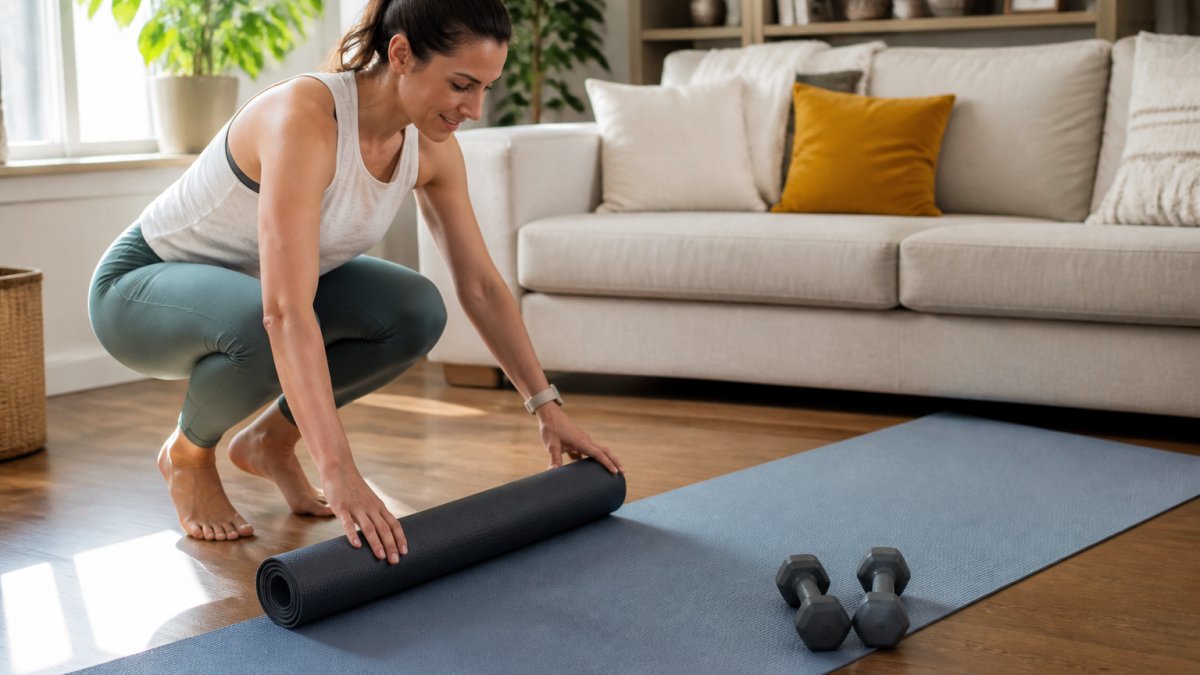
Breaking Overwhelming Wellness Tasks Into Manageable Steps
Overwhelm is a size problem. A 45-minute workout is a mountain. A five-minute warm-up is a step.
Take the task you keep avoiding and cut it in half. Then cut it in half again. "Get fit" becomes "do one set of squats." For a low-barrier starting point, try these equipment free workouts for weight loss. That smaller entry point is how task initiation actually happens.
Strategies to Stop Procrastinating on Exercise
The best strategies to stop procrastinating on exercise share one trait: they remove decisions. You do not want to negotiate with yourself at 6 p.m.
- Pre-decide the time. Put it on the calendar like a meeting.
- Pre-set the space. Mat out, weights visible, shoes by the door.
- Use a commitment device. Tell someone your plan, or schedule a walk with a friend.
Timing matters too. If mornings keep failing, try matching exercise to the part of the day when you actually have energy.
Wellness Routine Planning Tools That Keep You on Track
Planning tools work when they are simple enough to use on a bad day. A wall calendar and a pen beat a complicated app you abandon in week two. But the tool matters less than what you measure. Most wellness planners fail because they track too many things and give you no way to interpret a missed day.
Track Three Things, Not Ten
For a daily wellness routine, track only what helps you make a decision:
- Completion: did the minimum action happen today? Yes or no.
- Resumption: after a missed day, how many days did it take to start again?
- Energy or mood: a simple one-to-five rating at the end of the day.
That is enough to see patterns without turning tracking into a second job. A paper planner with a weekly spread works well, and so does a notes app with a single line per day. The format is less important than the consistency of the three measures.
Two Measures That Actually Tell You Something
- Completion rate: the number of days the minimum action happened divided by the number of days you planned it. A completion rate of five out of seven is not a failure; it is a signal that the minimum action may be slightly too large or the cue is unreliable.
- Days to resume: the number of days between a missed day and the next completed action. This measure matters more than a perfect streak, because the people who stick with routines are the ones who resume quickly, not the ones who never miss.
A common pattern is that people with a high completion rate but slow resumption are one illness or vacation away from quitting. If your days-to-resume is consistently more than two, your backup plan is too demanding. Shrink it.
A Simple Weekly Review
Once a week, spend five minutes with your planner and answer three questions:
- Which cue failed most often?
- Which day of the week had the lowest completion?
- What is one adjustment for next week?
Do not review more often than weekly. Daily review turns tracking into self-criticism, which is the emotional avoidance that feeds procrastination in the first place.
When a Paper Planner Beats an App
Apps are useful for reminders and for people who already live in their phones. Paper planners are better for people who find notifications easy to dismiss and who benefit from a physical check mark.
Look for a planner or journal that lets you log sleep, movement, and mood in one place. If you are choosing a planning tool, wellness journal reviews explain what to look for before you buy.
Watch out: if your tracking data makes you feel guilty rather than curious, stop tracking for a week and return to the minimum action only.
Using Timers and Work Intervals to Start Moving
A timer is the cheapest cure for avoidance. Set it for five minutes and give yourself permission to stop when it rings. Most days, you will keep going.
The Pomodoro technique works for movement too. Try 25 minutes of activity, then a five-minute break. Or flip it for busy days: 10 minutes of movement, 50 minutes of work. Short work intervals lower the cost of starting, and starting is the hard part.
Resetting Your Mindset and Self-Talk After a Lapse
A lapse is data, not a verdict. The people who stick with a daily wellness routine are not the ones who never miss. They are the ones who restart fast.
Watch your self-talk. "I always quit" becomes a self-fulfilling script. Swap it for "I missed two days, and I am starting again today." Self-compassion is not softness. It is what keeps you in the game long enough to build the habit.
A Realistic Restart Plan for When You Fall Off
- Skip the guilt audit. Do not replay the missed days.
- Do the two-minute version today, right now.
- Rebuild for three days at half your old volume.
- Return to your normal routine on day four.
- Adjust one thing that made the lapse likely.
That is the whole restart. No penance, no starting from zero.
Building Your Home Wellness Setup With the Right Tools
The right setup removes friction, and friction is what feeds procrastination. A mat that stays out, weights within reach, and a quiet corner all make starting easier. Mind-body tools like a foam roller or resistance band add variety without adding complexity.
If you are building a space from scratch, choose mind-body options that fit a small room. Browse thewellbeingshop.com for current product details and availability.
Frequently Asked Questions
What is the 5-4-3-2-1 rule for overcoming procrastination?
The 5-4-3-2-1 rule is a countdown technique: when you notice yourself avoiding a task, count down from five and start moving on one. Applied to a daily wellness routine, it looks like this: five seconds to stand up, four to roll out your mat, three to set a timer, two to take a breath, one to begin. The countdown interrupts the avoidance loop before excuses build. It works best on small, defined actions like putting on shoes or filling a water bottle, not on planning an entire workout.
How do I break down overwhelming wellness tasks into manageable steps?
Start with the smallest physical action that moves you toward the habit. Instead of 'work out for an hour,' write 'put on workout clothes.' Then add the next single action: 'do five minutes of stretching.' Each step should take under two minutes and require no decision-making. Once you can complete three small steps without skipping, extend the final one by five minutes. This approach reduces task initiation friction and builds follow-through before you add intensity.
How does procrastination impact long-term wellness goals?
Procrastination does more than delay a single workout. Each skipped session weakens the habit loop and makes the next start harder, which is why routines collapse after a week or two. Over months, the gap between intention and action grows, and people often abandon the goal entirely rather than restart. The bigger cost is the self-talk that follows: repeated broken promises to yourself erode confidence. Rebuilding with small, repeatable steps restores both consistency and trust in your own commitments.
How can I build a morning wellness routine that I actually stick to?
Attach the new habit to something you already do without thinking. If you make coffee every morning, stretch for five minutes while it brews. Lay out your equipment the night before so task initiation takes zero effort. Keep the first week deliberately short, under ten minutes, and track completion rather than duration. When you miss a day, restart the next morning with the same small version instead of waiting for a fresh week. Consistency comes from lowering the barrier, not from motivation.
Your routine will stall again at some point. The question is whether your setup makes restarting easy. Start with one small habit, one visible tool, and one honest check-in each day. Explore the fitness and recovery tools at thewellbeingshop.com to build a home space that makes showing up the easy choice.
