


 Link label

Balance Physical and Mental Health Daily
Table of Contents
- Why Balancing Physical and Mental Health Daily Matters
- Build Daily Habits for Mental and Physical Health
- Start a Daily Yoga Practice at Home
- Mind-Body Exercises for Beginners
- How to Manage Stress and Stay Active
- Create a Realistic Daily Routine You'll Actually Follow
- Track Progress Without Obsessing Over Numbers
- When Self-Care Habits Aren't Enough
- Frequently Asked Questions
Last Updated: October 10, 2026
Why Balancing Physical and Mental Health Daily Matters
Your body and mind are connected. Moving your body improves mood, managing stress sharpens focus, and better sleep strengthens both immunity and emotional resilience. Research shows they work best together, not separately.
The key to transformation isn't perfection, it's consistency. Small daily actions compound into real change.
This guide shows you how to balance physical and mental health daily through practical habits, routines that fit your schedule, and when to seek professional support.
Build Daily Habits for Mental and Physical Health
Daily habits form the foundation of sustainable wellness. When you balance physical and mental health through habit, you don't rely on motivation, the behavior becomes automatic.
Start small: one habit at a time. A 10-minute walk, water before coffee, or five minutes of breathing work because they're repeatable.
The best daily habits address multiple needs at once. A walk outdoors gives movement, fresh air, stress relief, and social time. Yoga combines strength, flexibility, breathing, and focus. Strength training builds confidence alongside muscle.
Track what you do for one week to spot patterns, like skipping movement on busy days or sleep when stressed. Once you see the pattern, you can interrupt it.
Start a Daily Yoga Practice at Home
Yoga is one of the most effective ways to balance physical and mental health because it trains both simultaneously: you build strength and flexibility while practicing breathing and focus.
A mat, ten minutes, and a quiet corner work. A daily yoga practice at home removes barriers: no commute, no class schedule, no intimidation.
Start with basic poses: child's pose (calms the nervous system), cat-cow (coordinates breath with movement), and downward dog (builds strength while calming your mind). Hold each for five breaths and move slowly.
The mental benefit comes from focus: your mind has one job, follow your breath and move with intention. This mental break is as valuable as the physical stretch.
Start with 10-minute beginner sessions and progress to 20 minutes as you build confidence. Consistency matters more than duration.
Mind-Body Exercises for Beginners
Mind-body exercises for beginners teach you to notice your body, control your breathing, and calm your mind. Tai chi, Pilates, and gentle yoga all qualify.
Pilates strengthens your core and improves posture, which matters if you work from home. It teaches you to engage your core, lengthen your spine, and move with control, benefits that carry into daily life.
Tai chi is a slow, flowing martial art that improves balance and coordination while reducing anxiety and improving sleep. You can learn the basics in one session and practice anywhere.
Progressive muscle relaxation teaches your body what relaxation feels like: tense each muscle group for five seconds, then release, moving from toes to head.
Resistance training qualifies as mind-body work if done intentionally: focus on the muscle working, feel the contraction, and control the movement. This transforms exercise from a chore into a practice.
The Well Being Shop offers tools like exercises with elastic bands that make mind-body training accessible at home. The foot pedal design gives you stability while you focus on form and breathing, turning simple resistance work into intentional practice.
How to Manage Stress and Stay Active
Chronic stress raises cortisol, disrupts sleep, triggers overeating, and suppresses immunity. You can't out-exercise stress, you have to manage it directly.
Movement is one of the best stress reducers. Walking, dancing, swimming, or cycling all work through daily consistency, one workout won't undo weeks of stress.
Breathing techniques interrupt the stress response instantly. Breathe in for four counts, hold for four, exhale for four for two minutes. Your nervous system calms.
Stress management requires boundaries: don't check work emails after 6pm or set time limits on draining activities. These are necessary for mental health.
Social connection reduces stress dramatically by lowering cortisol and improving mood. Schedule it like any other appointment.
| Stress Management Approach | Best For | Time Needed | Frequency |
|---|---|---|---|
| Walking or outdoor movement | Clearing your mind and moving your body | 15-30 minutes | Daily |
| Breathing exercises | Quick stress relief anywhere | 2-5 minutes | As needed |
| Social time | Reducing isolation and boosting mood | 30+ minutes | 3-4x weekly |
| Yoga or stretching | Releasing physical tension | 10-20 minutes | Daily |
| Journaling or reflection | Processing emotions and thoughts | 10-15 minutes | 3-5x weekly |
Create a Realistic Daily Routine You'll Actually Follow
The best routine is one you'll actually do. A routine that's 80% consistent beats a perfect routine you abandon after two weeks.
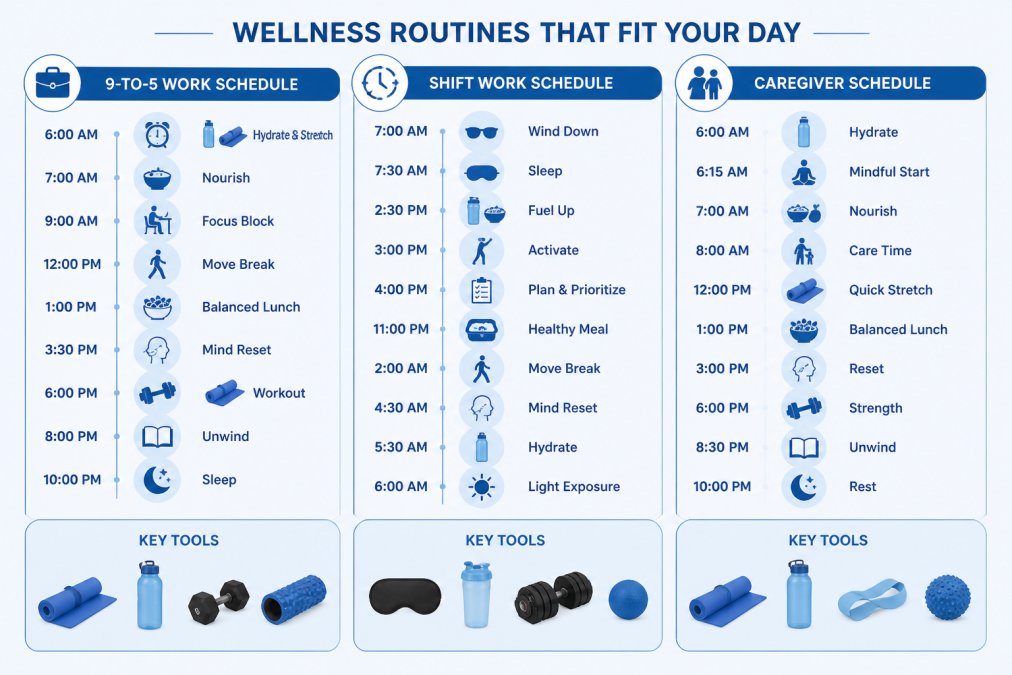
List your fixed commitments (wake time, work hours, meals, bedtime, commute, caregiving). Stack wellness into existing time blocks. The goal is integration, not addition.
For a Standard 9-to-5 Schedule:
- 6:30am: Wake, drink water, five minutes of stretching or breathing
- 7:00am: Breakfast with intention (no screens)
- 12:00pm: 15-minute walk outside or movement break
- 1:00pm: Lunch
- 5:00pm: 20-30 minutes of yoga, resistance training, or cardio
- 7:00pm: Dinner and social time (family, friends, or phone call)
- 9:00pm: No screens, prepare for bed
- 10:00pm: Sleep
This routine includes movement, stress management, sleep, nutrition, and connection in about 45 minutes.
For Shift Workers or Irregular Schedules: Your routine won't look like a 9-to-5 example, and that's fine.
If you work nights, your movement might happen in the afternoon before your shift. Your "wind-down" happens in the morning after work.
Shift workers often struggle with sleep and stress. Prioritize sleep first. A consistent sleep schedule (even if it's 8am-4pm) matters more than exercise timing.
For Caregivers (Parents, Eldercare, etc.): Your schedule is fragmented. Build micro-habits instead of blocks.
- 5-minute breathing or stretching while coffee brews
- 10-minute walk during a child's activity or while a family member rests
- Strength training in 10-minute bursts (three sets of one exercise) during lunch or after bedtime
- Social connection during existing activities (walk with a friend, call someone while doing dishes)
One caregiver might do five 10-minute movement sessions spread across the day instead of one 30-minute block. This is not inferior. It's realistic.
exercises with elastic bands →
For Beginners or People with Chronic Conditions or Disabilities: Start smaller. A realistic routine might be:
- Morning: 5 minutes of gentle movement or breathing (seated or standing, whatever your body allows)
- Midday: 10 minutes of a low-impact activity (walking, water exercise, chair yoga)
- Evening: 5 minutes of reflection or connection
Total: 20 minutes. This is sustainable. After four weeks, add five more minutes if it feels manageable. Progress is measured in weeks and months, not days.
If you have chronic pain, fatigue, or mobility limits, consult your doctor or physical therapist before starting. They can adapt these suggestions to your condition.
How to Adjust Your Routine:
Your first routine is a hypothesis, not a law. Track it for two weeks. Then ask:
- Did I do it on at least 80% of days?
- How did I feel on days I completed it versus days I didn't?
- What got in the way? (Timing, energy, motivation, logistics?)
- What felt good enough to keep?
If mornings don't work, move exercise to evening. If a 30-minute block is too much, split it into three 10-minute sessions.
The routine works when it fits your life, not when you force your life to fit the routine.
Track Progress Without Obsessing Over Numbers
Tracking creates accountability and awareness, not obsession. Look for patterns and signals that tell you what's working, not metrics.
What to Track (and Why):
Track three categories: consistency, how you feel, and one simple performance marker.
Consistency: Mark each day you complete your routine on a simple calendar. Aim for 80% compliance. Missing five days in a row signals your routine needs adjustment.
How You Feel: Rate energy, mood, focus, sleep, anxiety, and tension on a simple scale: worse, same, or better. Write one sentence about what you notice.
One Performance Marker: Pick one metric (pushups, yoga hold time, walk duration, or resting heart rate). Measure weekly, not daily. Small gains compound.
How to Use Your Data:
Every two weeks, review your calendar and notes for patterns. If you always skip movement on certain days, adjust your routine. Move workouts to different times or split them into shorter sessions.
If your performance marker improves but you don't feel better, something else needs attention: more sleep, stress management, or social connection. Adjust accordingly.
Red flags that signal change is needed: not improving after four weeks, feeling worse, missing more than 50% of days, obsessing over numbers, or feeling guilty. These mean your routine doesn't fit, change the routine, not yourself.
Tools for Tracking (Keep It Simple):
Use the tracking tool you'll actually use: a habit app, spreadsheet, notes app, wall calendar, or notebook. The format doesn't matter. Consistency and honesty do.
When to Adjust Your Routine Based on Tracking:
After four weeks, assess what's working and what isn't. Make one change at a time and track for two weeks to see which adjustments help.
When Self-Care Habits Aren't Enough
Self-care habits are powerful. They're not a substitute for professional help. If you're experiencing persistent depression, severe anxiety, chronic pain, or thoughts of self-harm, talk to a doctor or mental health professional.
Self-care supports treatment. It doesn't replace it. Someone with clinical depression benefits from therapy and possibly medication, plus daily movement and sleep. Someone with chronic stress might need counseling alongside stress management techniques.
The line between normal stress and a mental health condition isn't always clear. Here's a practical guide: if your habits aren't improving how you feel after four weeks, and your symptoms are getting worse or interfering with work or relationships, seek professional support.
According to the National Institute of Mental Health, professional mental health treatment is effective and accessible. Many therapists now offer virtual sessions, making access easier.
Physical symptoms also warrant professional attention. Persistent fatigue, unexplained pain, or significant weight changes deserve a medical evaluation. Your doctor can rule out underlying conditions and recommend next steps.
Frequently Asked Questions
How much exercise do I need to balance physical and mental health daily?
You don't need hours at the gym. Aim for 20-30 minutes of movement most days, which matches what busy professionals can realistically fit in. This can include walking, resistance training with bands, or yoga. The key is consistency over intensity. Even 10 minutes of intentional movement improves mood and energy. Start where you are and build from there rather than waiting for perfect conditions.
Can a daily yoga practice at home actually improve both mental and physical well-being?
Yes. Yoga combines physical movement, breathing, and mental focus, which addresses both dimensions simultaneously. Even 15 minutes daily builds strength, flexibility, and reduces stress. Home practice removes barriers like travel time and cost, making it easier to stay consistent. You don't need experience or flexibility to start, beginner-friendly routines work just as well for building the habit.
What should I do when stress makes it hard to exercise?
Stress often makes people skip workouts, but movement actually reduces stress. Start smaller when stressed: a 10-minute walk, gentle stretching, or light resistance exercises with bands. These low-pressure options maintain your routine without adding pressure. Pair movement with stress-management techniques like breathing or journaling. If stress feels overwhelming, professional support may help more than pushing through alone.
How do I know if my daily habits are actually working?
Track what matters to you, not everything. Notice energy levels, mood, sleep quality, or how your clothes fit rather than obsessing over metrics. Write a quick note 2-3 times weekly about how you felt after moving or after a stressful day. After 3-4 weeks, patterns emerge. This approach prevents burnout from over-monitoring while giving you real feedback on what's working for your unique body and schedule.
Balancing physical and mental health daily isn't complicated. It requires consistency, not perfection. Start with one habit. Build from there. Use tools that remove friction, like the equipment at thewellbeingshop.com, so your routine becomes automatic. Most importantly, listen to your body and mind. When habits aren't enough, seek professional support. Small daily actions compound into lasting change.