
How to Use Meditation Apps for Stress Relief
Table of Contents
- Why Meditation Apps Work for Stress Management
- How to Choose the Best Meditation Apps for Anxiety
- A Step-by-Step Guide: How to Use Meditation Apps for Stress
- How Long to Meditate for Stress Relief
- Integrating Meditation into Daily Wellness Routines
- Troubleshooting Common Meditation Hurdles
- Your Path to Consistent Stress Relief
- Frequently Asked Questions
Last Updated: September 8, 2026
Why Meditation Apps Work for Stress Management
Stress is not a thought problem; it is a body problem (nimh.nih.gov). When your nervous system registers threat, your rational mind goes offline, which is why telling yourself to "calm down" rarely works. Meditation apps work because they give your brain a structured task that forces the body's relaxation response to engage. This guide from thewellbeingshop.com breaks down how to use them for stress.
The core insight most guides miss is that the app is not the therapy; it is a coach that teaches your nervous system to downshift on its own. Meditation apps are digital tools that deliver guided sessions, timers, and breathing exercises designed to train attention and reduce physiological stress markers.
How to Choose the Best Meditation Apps for Anxiety
Choosing the right tool matters less than choosing one you will open tomorrow. The best meditation apps for anxiety share a few non-negotiable traits, but the perfect choice depends on your stress profile and schedule.
If it peaks mid-workday, you need an app with quick, 3-to-5-minute resets. If it keeps you awake at night, prioritize sleep-specific content. If you are new, look for apps that explain the "why" behind each technique.
Key Features to Look For
Focus on four features that separate useful apps from digital clutter:
- Beginner onboarding: A structured introductory path that teaches fundamentals before advanced techniques
- Offline downloads: Sessions you can access without Wi-Fi for travel or low-signal spaces
- Reminder systems: Gentle, customizable nudges that integrate with your calendar
- Progress tracking: Simple metrics that show consistency without turning practice into a performance
A Step-by-Step Guide: How to Use Meditation Apps for Stress
The difference between a practice that works and one that fizzles comes down to setup, not willpower. Follow this sequence to build a routine that survives a busy week.
Setting Up Your Practice Space
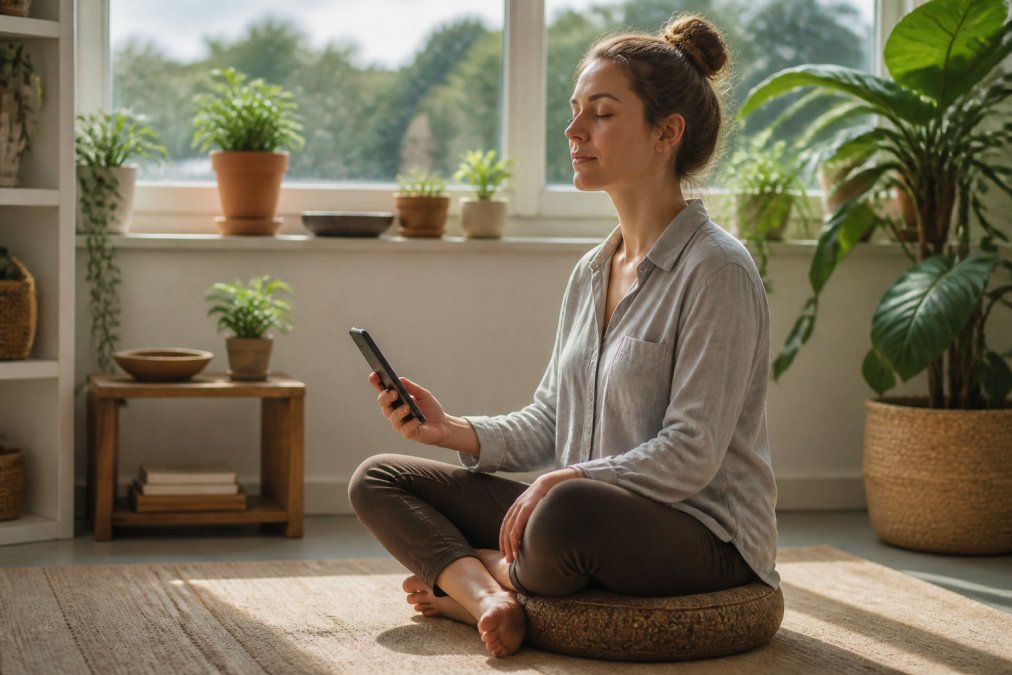
Your environment teaches your nervous system what to expect. A dedicated corner, even a small one, signals "this is where I downshift" far more effectively than scrolling in bed.
A Premium Buckwheat Meditation Cushion at $37.90 provides firm support that maintains spinal alignment, so you are not distracted by aching legs five minutes in. Place a Cork & Natural Rubber Meditation Mat underneath to define the space and keep the cushion stable on hard floors.
Light a candle with a grounding scent to anchor the ritual. The Forest State of Mind Candle at $29.99 uses cedarwood and sandalwood notes that many practitioners find calming, and the act of lighting it becomes a Pavlovian trigger for relaxation.
Starting Your First Session
Begin with the shortest session your app offers, typically 3 to 5 minutes. The goal is not a profound experience; it is proving you can show up.
- Put your phone in Do Not Disturb mode before opening the app
- Sit comfortably with your spine tall and shoulders relaxed
- Use headphones if your environment is noisy
- Close your eyes and follow the guide's voice without judging your performance
- When your mind wanders, which it will, simply return to the voice
How Long to Meditate for Stress Relief
The honest answer depends on whether you are putting out a fire or building a firebreak. Acute stress responds to as little as 60 to 90 seconds of paced breathing. Chronic stress requires a daily 10-to-15-minute practice sustained over weeks. Most beginners mistakenly treat both the same way.
The 90-Second Emergency Reset
When your sympathetic nervous system is fully engaged, your prefrontal cortex, the part that makes reasoned decisions, is partially offline. This is why trying to "think your way out" of an acute spike fails. Use your app's breathing timer for a physiological intervention instead.
Repeat for 90 seconds. Slow exhales stimulate the vagus nerve, activating the parasympathetic "rest and digest" response (peer-reviewed research). Most meditation apps include a breathing timer with visual or haptic cues; set it to 90 seconds and use it the moment you notice jaw clenching or chest tightening.
The 10-Minute Daily Baseline
For chronic stress, the research-backed sweet spot is 10 to 15 minutes daily (PubMed). But that duration is a destination, not a starting line. A realistic titration schedule looks like this:
| Week | Session Length | Focus | Why This Works |
|---|---|---|---|
| Week 1 | 3 minutes | Habit formation | Short enough that your brain doesn't negotiate with you |
| Week 2 | 5 minutes | Attention training | Long enough to notice your first mind-wandering cycle |
| Week 3-4 | 7 minutes | Body awareness | Builds tolerance for internal sensations |
| Week 5-6 | 10 minutes | Stress regulation | Matches the minimum dose for measurable physiological change |
| Month 2+ | 12-15 minutes | Maintenance | Sustainable without becoming a chore |
The 20-Minute Ceiling Myth
Many guides imply longer is better, but that is not supported by stress physiology. The goal is not a "deep state", it is training your nervous system to downshift on command. A 20-minute session once a week does less than 5 minutes daily, because daily repetition strengthens the neural pathway. If you have 20 minutes, split it: 10 in the morning and 10 before bed.
When Duration Is Not the Problem
If you consistently sit for 10 minutes and feel more agitated, duration is not your issue. You may be pushing against a stress load that needs movement, social connection, or sleep first. Reduce your session to 2 minutes and pair it with a physiological reset like a cold water face splash or a brief walk.
A Note on Wearable Integration
A growing trend is syncing meditation apps with wearables that track heart rate variability (HRV), a measurable indicator of nervous system flexibility, higher HRV generally correlates with better stress resilience. Some apps display HRV before and after a session, giving real-time feedback on whether your practice is shifting your physiology. If you own a smartwatch, check whether your meditation app can import that data.
Integrating Meditation into Daily Wellness Routines
The apps that succeed are attached to existing habits. Rather than scheduling meditation as a separate block requiring willpower, stack it onto something you already do automatically. This is habit stacking, your brain already has a neural pathway for the anchor behavior, so you are just adding a new loop.
The Three Anchor Points That Actually Stick
Morning anchor: coffee or tea. While your water heats or coffee brews, sit for 3 minutes with your app. The brewing time is a natural waiting period you already tolerate, you are repurposing dead time, not adding to your morning.
Midday anchor: the post-lunch transition. The period after eating is when blood sugar dips and stress feels amplified. A 5-minute session at your desk, with headphones on and eyes closed, functions as a hard reset. It is more effective than scrolling social media because it does not introduce new cognitive load.
Evening anchor: the commute or the doorway. For remote workers, the transition between work and home mode is often invisible, which is why work stress bleeds into personal time. A 5-minute session immediately after you close your laptop, or as soon as you walk through the door, creates a deliberate psychological boundary.
Micro-Meditations: The 1-to-3-Minute Gap Strategy
Most guides assume you have 10 to 20 uninterrupted minutes. In high-stress work environments, that assumption is fiction. The realistic approach is micro-meditations: 1-to-3-minute sessions inserted into the cracks of your day. These are not watered-down versions of longer practices; they are a distinct technique for interrupting a stress spiral before it escalates.
Here is where micro-meditations fit into a real workday:
- Before a difficult email or call: 90 seconds of paced breathing to lower your reactivity
- Between back-to-back meetings: 2 minutes of body scanning to release shoulder and jaw tension
- After a stressful interaction: 3 minutes of loving-kindness or gratitude practice to prevent rumination
- Before making a decision: 60 seconds of focused attention to clear mental fog
Most meditation apps have a "quick" or "mini" category. If yours does not, use the timer function with a single guided breath count.
Designing Your Environment for Automatic Practice
Your environment is a silent coach. If your cushion is buried in a closet, you will not meditate; if it is visible with a candle and phone stand, you are far more likely to sit. The same applies digitally: put your meditation app on your home screen, not in a folder.
Movement-Based Integration for Physical Restlessness
For people whose stress shows up as physical restlessness, pacing, fidgeting, leg bouncing, seated meditation can feel like punishment. A tactile alternative is a sensory maze or worry stone: guide a marble through wooden pathways or trace a textured surface while practicing the same moment-to-moment awareness. This is not a lesser practice; it is a different entry point into the same attentional muscle.
Pairing Practice with Physiological Support
Meditation trains your nervous system to downshift, but it works better when your body has the raw materials for relaxation. Many practitioners find that magnesium glycinate taken in the evening supports the same relaxation pathways they train during meditation. This is a complement, not a substitute.
Troubleshooting Common Meditation Hurdles
Every practitioner hits walls. The difference between those who sustain a practice and those who quit is knowing that the obstacles are features, not failures.
"I can't quiet my mind." You are not supposed to. The practice is noticing the noise and returning to your anchor. Each return is a rep, like a bicep curl for your attention.
"I fall asleep every time." This signals exhaustion, not failure. Try sitting upright rather than lying down, meditating earlier in the day, or using a more engaging guided session.
"I feel more anxious when I try." Some people experience a temporary increase in awareness of bodily sensations they normally suppress. Start with grounding exercises that emphasize external focus, like noticing sounds or physical contact points, before moving to internal awareness. Consider whether a Premium Vibroacoustic Therapy Meditation Cushion Bundle at $699.99, which translates audio into physical vibration, might provide enough sensory anchoring to bypass an overactive mind.
"I miss days and feel like I failed." Missing a day is data, not a verdict. The habit loop re-establishes the moment you open the app again. Perfectionism is the enemy of consistency.
Your Path to Consistent Stress Relief
The most sophisticated meditation app in the world cannot outrun a chaotic environment or an unsupported body. Sustainable stress relief requires the right digital tool, a physical space that signals safety, and a routine that respects your actual schedule.
A supportive cushion, a grounding scent, or a tactile focus object can be the difference between a practice that lasts and one that fades. Start with 5 minutes tomorrow morning. Build from there.
Frequently Asked Questions
Do meditation apps actually work for anxiety?
Yes. Clinical research shows app-based mindfulness interventions can meaningfully reduce symptoms of anxiety and stress. The key is regular use. A daily practice of 10 to 15 minutes, even a few times a week, activates the relaxation response and helps you build the skill of noticing anxious thoughts without getting caught up in them. For the best results, pair your app sessions with other proven strategies like physical activity and good sleep habits.
How long should you meditate daily to see stress reduction?
Most studies show noticeable stress reduction with 10 to 20 minutes of daily meditation. Consistency matters more than session length. Starting with just 5 minutes each morning can help you build the habit. Once you're comfortable, gradually increase to 15 or 20 minutes. Some apps offer time-optimized micro-meditations of 3 to 5 minutes, which are effective for acute stress spikes during a busy workday.
What is the most effective way to use a meditation app?
The most effective approach combines three elements: a consistent schedule, a distraction-free space, and the right session type. Pick a regular time each day, even if it's just a few minutes. Choose guided sessions that match your current stress level. Use the app's breathing techniques during acute stress, and reserve longer body scan or mindfulness sessions for daily practice. Track your progress in the app to stay motivated.
Can meditation apps replace therapy for stress management?
No. Meditation apps are valuable self-help tools for everyday stress management, but they are not a replacement for professional mental health care. If you experience chronic anxiety, panic attacks, or depression, consult a licensed therapist or healthcare provider. Cognitive behavioral therapy (CBT) and other professional treatments are evidence-based approaches for clinical conditions. Apps work best as a complement to professional care, not a substitute.
Stress relief is a skill, not a personality trait. The tools you choose determine whether that skill develops or stalls. Pair your meditation app with the physical support your body needs, and you give yourself the best chance at a practice that delivers lasting calm. Explore our meditation collection at thewellbeingshop.com and build a space your nervous system recognizes as safe.