


 Link label

Meal Prep for Weight Loss: A Busy Professional's Guide
Table of Contents
- Why Meal Prep Works for Weight Loss
- Building Your Weekly Meal Prep Plan for Weight Loss
- High-Protein Meal Prep Ideas for Every Meal
- Easy Healthy Meal Prep for Work
- Meal Prep Recipes for Weight Loss: Practical Examples
- Customizing Portions and Macronutrients
- Common Meal Prep Mistakes to Avoid
- Frequently Asked Questions
Last Updated: October 8, 2026
Why Meal Prep Works for Weight Loss
Meal prep works for weight loss because it removes the guesswork from eating: you control portions, ingredients, and nutrition, with no decisions required when you're hungry or tired.
The deeper advantage is accountability, you've already decided what you'll eat, so impulse choices disappear.
Busy professionals can transform their results by dedicating one afternoon to preparation.
Building Your Weekly Meal Prep Plan for Weight Loss
A solid meal prep weight loss plan starts with choosing the right day and time. Most professionals find Sunday afternoon works best. You're not rushed, and you have energy to focus.
Your plan should cover breakfast, lunch, dinner, and snacks. Without prepped snacks, you'll reach for whatever's convenient when energy dips mid-afternoon.
The 60-90 Minute Prep Day Workflow
You don't need hours to prep a full week. A realistic 60-90 minute workflow looks like this:
Minutes 0-15: Setup and planning
- Pull out all containers and ingredients
- Read through your recipes
- Set up your workspace with cutting boards and knives
Minutes 15-45: Chop and prep
- Chop all vegetables at once
- Marinate proteins if needed
- Cook grains in the background
Minutes 45-75: Cook proteins and roast vegetables
- Grill chicken or bake salmon
- Roast vegetables at high heat
- Cook any additional components
Minutes 75-90: Assemble and store
- Portion everything into containers
- Label with dates
- Store in the refrigerator
Choosing Your Prep Day and Timing
Sunday works for most people, but consistency matters more than the day, pick your highest-energy day and stick with it. Early afternoon (12-2 p.m.) is ideal: you're not tired from the workday and finish before evening plans. Adjust prep quantities for dinners out, and prep only 3 days of meals if you travel midweek.
High-Protein Meal Prep Ideas for Every Meal
Protein is the foundation of any meal prep weight loss strategy. It keeps you full longer, supports muscle recovery, and has a higher thermic effect than carbs or fats.
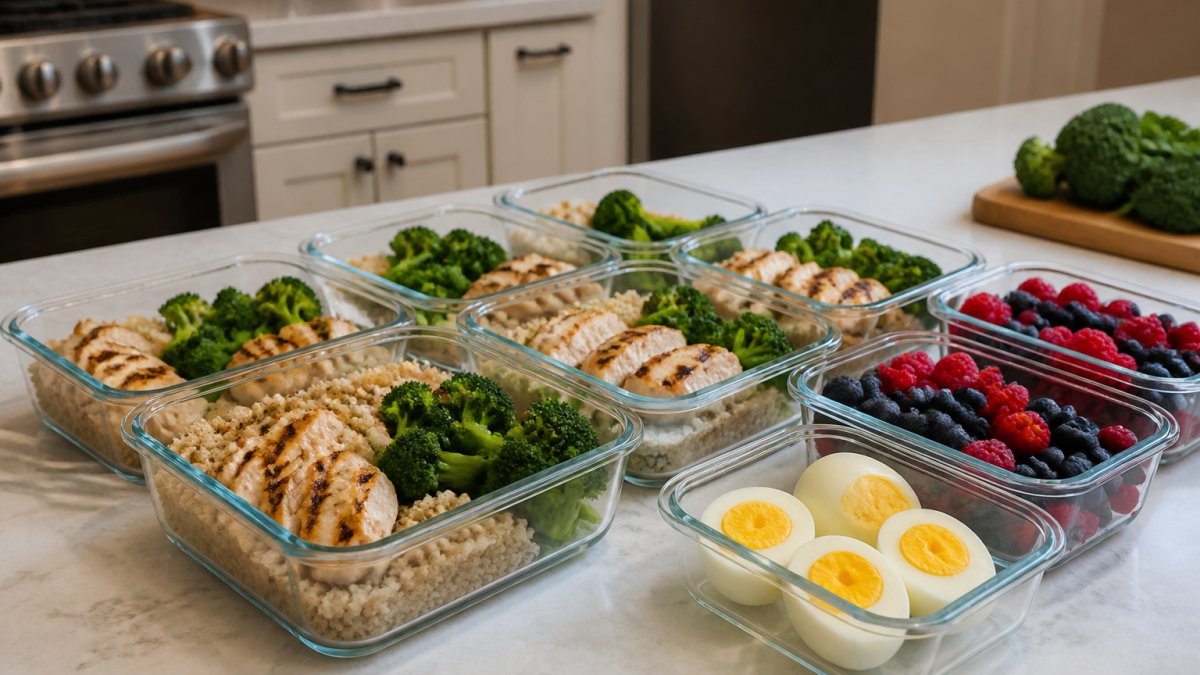
Your goal is 25-35 grams of protein per meal. This amount satisfies hunger without excess calories.
Breakfast: Egg Muffins and Overnight Oats
Egg muffins are the simplest prep breakfast: mix eggs with vegetables, pour into muffin tins, and bake 12 at once. They last five days refrigerated, with about 6 grams of protein each.
Overnight oats suit people who want something faster. Mix oats, Greek yogurt, milk, and berries in a jar the night before.
Lunch: Protein Bowls and Make-Ahead Salads
Lunch is where most professionals struggle, busy at work, the vending machine calls.
A basic bowl structure: lean protein + whole grain + roasted vegetables + healthy fat + sauce.
Example combination:
- 4 ounces grilled chicken
- 1/2 cup cooked quinoa
- 1 cup roasted broccoli and bell peppers
This delivers 35 grams of protein and keeps you full until dinner.
Make-ahead salads work if you store the dressing separately. Pack greens, vegetables, and protein in the container.
Dinner: Lean Proteins and Roasted Vegetables
Best lean protein choices:
- Chicken breast (31 grams protein per 3.5 ounces)
- Salmon (25 grams protein per 3.5 ounces)
- Ground turkey (29 grams protein per 3.5 ounces)
Pair any protein with roasted vegetables, roasting concentrates flavor with minimal active cooking. Toss in olive oil, salt, and pepper, then roast at 425°F for 25-30 minutes.
Add a whole grain like brown rice or sweet potato for sustained energy.
Easy Healthy Meal Prep for Work
The best meal prep plan is one you'll actually follow, for professionals, that means getting food from your kitchen to your desk and keeping it safe and appealing until you eat it.
Portable Containers and Storage Solutions
Container choice matters more than most people realize: you need something that doesn't leak, holds temperature, and fits in your work bag.
Best container types:
- Glass containers with snap lids (microwave safe, durable, see-through)
- Stainless steel containers (insulated, keeps food cooler longer)
- BPA-free plastic containers (lightweight, affordable, stackable)
Avoid containers that stain, absorb odors, or are too large for a standard lunch bag. Buy one matching set so lids and bases pair up, and label everything with the prep date so you eat older meals first.
The Office Cold Chain: Transport, Refrigeration, and Reheating
The gap between a great prepped meal and a sad one is usually temperature, not recipe. Treat your commute like a short cold chain.
Transport:
- Use an insulated lunch bag with at least one reusable ice pack for commutes over 30 minutes.
- Pack cold items together so they insulate each other.
- Keep the bag out of direct sun and off heated seats.
Refrigeration at work:
- Get your bag into the office refrigerator as soon as you arrive, not after your first meeting.
- With no refrigerator, a quality insulated bag with two ice packs holds food safely for roughly 4-5 hours; beyond that, choose shelf-stable options.
- At home, store prepped meals on the middle shelf, not the door, the door fluctuates in temperature.
Reheating without ruining texture:
- Reheat proteins and grains together, but add delicate vegetables (greens, zucchini) after heating or keep them raw.
- Splash a teaspoon of water over grains before microwaving to prevent drying.
- Reheat in 60-90 second bursts, stirring between, rather than one long blast.
Desk-Friendly Meals That Stay Appealing
If you eat at your desk or in a shared break room, favor these formats:
- Grain bowls, hold up well, reheat evenly, and can be eaten with one utensil.
- Wraps and lettuce cups, no reheating required; pack fillings separately and assemble at your desk.
- Cold protein plates, hard-boiled eggs, sliced chicken, cheese, and cut vegetables need no microwave at all.
Avoid meals that require a knife, a plate, or careful plating, setup friction pushes people to the cafeteria line.
Food Safety and Refrigerator Storage Timelines
Proper storage prevents foodborne illness and waste. The USDA and FDA advise keeping your refrigerator at 40°F or below and your freezer at 0°F or below; most prepped meals last 4-5 days at that temperature.
Storage timeline by food type:
- Cooked chicken or turkey: 3-4 days
- Cooked salmon or fish: 3 days
- Cooked ground meat: 3-4 days
Don't prep more than 5 days at once, quality and safety decline after day five. Prep twice weekly or freeze portions for later in the week.
Freezing for the back half of the week:
- Most cooked proteins, soups, stews, and grain dishes freeze well for 2-3 months.
- Cool food before freezing and leave headroom in the container since liquids expand.
- Thaw overnight in the refrigerator, not on the counter.
Meal Prep Recipes for Weight Loss: Practical Examples
These recipes deliver balanced nutrition with under 20 minutes of active prep each.
Grilled Chicken with Roasted Vegetables and Quinoa
Ingredients (makes 4 servings):
- 1.5 pounds chicken breast
- 2 cups mixed vegetables (broccoli, bell peppers, zucchini)
- 1 cup dry quinoa
Instructions:
- Cook quinoa according to package directions (about 15 minutes). Set aside.
- Toss vegetables with 1 tablespoon olive oil, salt, and pepper. Spread on baking sheet.
- Roast vegetables at 425°F for 25 minutes.
- While vegetables roast, season chicken with salt, pepper, and garlic powder.
- Grill chicken 6-7 minutes per side until internal temperature reaches 165°F.
- Slice chicken and divide into containers with quinoa and vegetables.
Nutrition per serving: 420 calories, 38g protein, 35g carbs, 12g fat
Salmon Bowls with Sweet Potato and Greens
Ingredients (makes 4 servings):
- 1.5 pounds salmon fillet
- 2 medium sweet potatoes
- 4 cups mixed greens
Instructions:
- Cube sweet potatoes and roast at 400°F for 20 minutes until tender.
- Season salmon with salt and pepper. Bake at 375°F for 12-15 minutes.
- Mix tahini and lemon juice with 2 tablespoons water to create dressing.
- Assemble bowls: greens on bottom, sweet potato and salmon on top.
- Pack dressing separately. Add before eating.
Nutrition per serving: 410 calories, 35g protein, 28g carbs, 18g fat
Plant-Based Protein Options
Best plant-based proteins:
- Lentils (9 grams protein per cooked cup)
- Chickpeas (15 grams protein per cooked cup)
- Tofu (10 grams protein per 3.5 ounces)
Combine plant proteins with whole grains for complete amino acid profiles, lentils with brown rice provide all nine essential amino acids.
Customizing Portions and Macronutrients
Weight loss happens in a calorie deficit, but the size of that deficit, and the portions that deliver it, is personal. Here's how to find your own numbers.
Start With an Estimate, Then Adjust
A reasonable starting point for many adults is 1,600-2,200 calories daily for weight loss, but body size, activity, and age shift that range. Use this three-step loop:
- Estimate. Pick a starting calorie target near the middle of your likely range.
- Track for two weeks. Weigh yourself at the same time each morning and note hunger and energy.
- Adjust by 100-200 calories. If weight is flat and hunger is manageable, trim slightly. If you're losing faster than about 1-2 pounds per week or feel depleted, add a little back.
Most people lose quickly the first week (often water weight), then settle into a slower, steadier rate. Judge the trend across two to three weeks, not day to day.
Build Portions With Your Hands and Plate
You don't need a food scale at every meal. A practical portion framework:
- Protein: a palm-sized portion (roughly 25-35 grams) at each meal
- Vegetables: two fists, or about half the plate
- Whole grains or starchy carbs: one cupped hand
This framework scales naturally: a larger, active person uses larger hands and a bigger plate; a smaller, desk-bound person uses smaller portions.
Set Protein First, Then Fill In
Protein anchors a weight-loss plate because it supports fullness and muscle retention. Aim for 25-35 grams per meal, or roughly 1.2-1.6 grams per kilogram of body weight daily. A sustainable macro split often looks like:
- Protein: 30-35% of calories
- Carbohydrates: 40-45% of calories
- Fat: 20-25% of calories
Treat these as a template, not a rule: if you train hard, more carbohydrate may work better; if you're less active, shifting toward protein and fat can keep hunger in check.
Adapt Portions to Your Week, Not Just Your Body
Your needs change day to day, so build flexibility into your prep:
- Higher-activity days: add a half-cup of grains or an extra protein portion to lunch.
- Desk-heavy or travel days: lean on the vegetable and protein portions and trim the starch.
- Dinner out planned: prep a lighter lunch so the day balances out.
A Simple Way to Personalize Without Counting Forever
Counting every calorie works for some and burns out others. A middle path: count for two to three weeks to learn your portions, then switch to the hand-and-plate method and check the scale weekly.
When to Get Individual Guidance
If you have a medical condition, are pregnant, or take medication affecting appetite or metabolism, work with a physician or registered dietitian rather than adjusting portions alone. For most healthy adults, the estimate-track-adjust loop above is a safe, sustainable way to find portions that fit your body and week.
Common Meal Prep Mistakes to Avoid
Mistake 1: Prepping too much variety. You get bored and quit.
Mistake 2: Not seasoning properly. Bland food gets abandoned.
Mistake 4: Cooking everything at once. Your food cools unevenly.
Mistake 5: Storing improperly. Meals spoil or taste like plastic.
Start with one week of prep.
We support this journey with tools designed for real life. Our curated selection of fitness equipment, mind-body training tools, and nutritional support helps professionals build sustainable habits.
Frequently Asked Questions
What is the best meal prep for losing weight?
The best meal prep for weight loss combines lean protein, nonstarchy vegetables, whole grains, and healthy fats in balanced portions. Focus on nutrient-dense foods like grilled chicken, salmon, eggs, quinoa, sweet potatoes, and plenty of leafy greens. Prepare meals in advance so you avoid impulsive, high-calorie choices during busy workdays. Consistency and portion control matter more than perfection.
How long does meal-prepped food last in the refrigerator?
Most cooked meal-prepped foods stay safe for 3-4 days when stored in airtight containers at 40°F or below. Cooked chicken, fish, and vegetable mixtures follow this timeline. Raw salad components (greens, dressing separate) last 2-3 days. Freezing extends shelf life to 2-3 months. Always label containers with the prep date and discard anything that smells off or shows visible mold.
What are easy high-protein meals to prep for work?
Easy high-protein meal prep options include grilled chicken with roasted vegetables, salmon bowls with sweet potato, egg muffins with cheese and spinach, and Mediterranean chickpea salads. Overnight oats with Greek yogurt and berries work for breakfast. Turkey meatballs with marinara and whole-grain pasta are simple to batch-cook. Pair each with a vegetable side and a whole grain to stay full through your workday.
How many meals should you prep at once for weight loss?
Most busy professionals benefit from prepping 5 lunches and dinners (10 meals total) plus 5 breakfasts in a single session. This covers a full workweek and prevents reliance on takeout or vending machines. If you prefer shorter prep sessions, divide the work across two days. Start with 3 days' worth (6 meals) if you're new to meal prep, then expand as the routine becomes automatic.