


 Link label

Can You Start Yoga If You're Not Flexible?
Last Updated: October 27, 2026
Quick Summary
You do not need to be flexible to start yoga, because flexibility is a result of practice, not a prerequisite. Start yoga with bent knees, blocks, straps, and shortened stances so each pose fits your body. Begin with gentle sessions of 10 to 15 minutes and progress slowly off props.
- Standard foam blocks are about 9 by 6 by 4 inches and give you three usable heights.
- A 6- to 8-foot cotton strap with a buckle is enough for seated forward folds and hamstring work.
- Each session follows a 2-3 minute warm-up, 10-12 minutes of main poses, and a 2-3 minute cool-down.
- In week 1, use blocks for every pose that needs them and hold each pose 30 seconds.
- Stop a pose when you feel sharp pain, joint pinching, numbness, or dizziness.
Table of Contents
- Do You Need to Be Flexible to Start Yoga?
- Yoga Modifications for Beginners With Tight Muscles
- Beginner Yoga Poses for Flexibility That Meet You Where You Are
- Yoga Props for Beginners: Blocks, Straps, and Bolsters
- A Beginner Yoga Routine at Home You Can Repeat All Week
- How to Choose a Beginner Yoga Class or Video
- When to Modify, Rest, or Stop: Safety for Stiff Bodies
- Build Your Home Practice With the Right Gear
- Frequently Asked Questions
Do You Need to Be Flexible to Start Yoga?
No. You do not need to be flexible to start yoga, and stiffness is not a barrier to practice. It is the reason to begin. Yoga builds flexibility through practice, not before it.
The fear is real: people picture a room full of bendy bodies and assume they will stick out. That picture is wrong. Beginner classes are full of stiff hips, tight hamstrings, and shoulders that ache from desk work.
Flexibility is a result of yoga, not a prerequisite. Poses are meant to be adapted to your body, not the other way around. The American Council on Exercise frames flexibility as a trainable quality, one that improves with consistent, gentle movement over time.
Here is what most guides get wrong: they show advanced poses and call them beginner-friendly. That sets you up to fail.
Below, we will walk through modifications, props, and a weekly routine for starting yoga. Keep reading for practical ideas to begin.
Yoga Modifications for Beginners With Tight Muscles
A yoga modification is a change to a pose that adjusts its range or position.
Gentle movement can be a way to approach stretching.
Try these adjustments:
- Bend your knees in any forward fold. Reaching your toes is not the goal.
- Shorten your stance in lunges and warrior poses to lower the demand on your hips.
- Place your hands on blocks instead of the floor.
- Keep a slight bend in straight-leg poses.
- Skip deep backbends until your spine feels ready.
If your hips feel stiff after sitting, you could try a short yoga session. For targeted relief, see these stretches to relieve tight hips from sitting.
Beginner Yoga Poses for Flexibility That Meet You Where You Are
Beginner yoga poses can be practiced with support.
Start with these:
- Cat-Cow. On hands and knees, alternate arching and rounding your spine. Move slowly with your breath.
- Supported Forward Fold. Sit on a folded blanket with knees bent, then hinge forward over a bolster or blocks.
- Low Lunge With Blocks. Step one foot back, lower the knee, and rest your hands on blocks on either side of your front foot.
- Figure-Four Stretch. Lie on your back, cross one ankle over the opposite knee, and gently draw the legs in.
- Legs Up the Wall. Lie on your back with legs resting up a wall. This one is pure rest.
You can try these poses at a comfortable pace.
Body awareness matters more than depth. A shallow version done with attention beats a deep version done with strain.
Yoga Props for Beginners: Blocks, Straps, and Bolsters
Yoga props for beginners can be used as supports. Blocks, straps, and bolsters can change how a pose is approached.
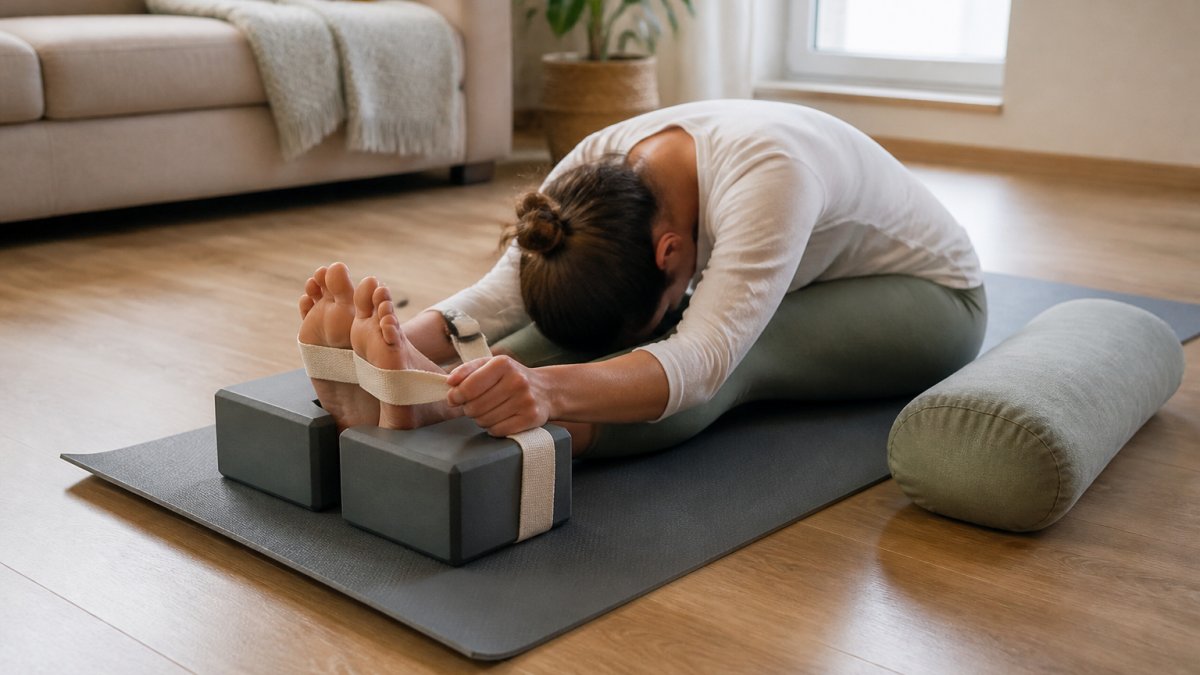
Here are some ways to use props:
-
Blocks raise the ground so your hands can reach. Standard foam blocks are about 9 by 6 by 4 inches, which gives you three usable heights: flat (lowest), on the 6-inch edge (middle), and on the 4-inch edge (tallest). Start on the tallest setting and lower it only when your hands reach the floor with a straight back. Use two blocks for lunges and forward folds, one under each hand.
-
Straps extend your arms in stretches like seated forward folds and hamstring work. A 6- to 8-foot cotton strap with a buckle is enough. Loop it around the ball of your foot and hold the ends with bent elbows, do not pull your arms straight to force reach.
-
Bolsters support restorative poses and make rest comfortable. A firm rectangular bolster works under the knees in savasana and under the hips in supported bridge. Two stacked bed pillows in a tight pillowcase are a fine substitute.
-
A blanket cushions knees and hips on hard floors. A firm, folded blanket under the knees in low lunge or cat-cow removes the pressure that makes people avoid floor poses.
-
A chair or wall is a legitimate prop. A sturdy dining chair supports chair-based balance poses and seated stretches; a wall supports legs up the wall and standing balance work.
-
Forward fold: hands on two blocks at the tallest height, knees bent, spine long.
-
Low lunge: one block under each hand, back knee on a folded blanket.
-
Seated forward fold: strap around the feet, sit on a folded blanket to tilt the pelvis forward.
-
Figure-four: no prop needed, but a block under the top knee stops the hip from over-rotating.
-
Legs up the wall: a folded blanket under the hips, legs resting up the wall.
If you have a stiff body, our picks for yoga equipment for non-flexible people match props to the poses that need them most. The National Academy of Sports Medicine notes that props help beginners maintain alignment while mobility develops.
Alignment comes first. Depth comes later.
A Beginner Yoga Routine at Home You Can Repeat All Week
A beginner yoga routine at home can be planned around a time that works for you. This section offers a sample weekly schedule and progression.
Every session follows the same shape:
- Warm-up (2-3 minutes): cat-cow, easy seated side bends, and slow shoulder rolls. Never stretch cold muscles.
- Main poses (10-12 minutes): the day's focus poses, held 30-60 seconds each, breathing steadily.
- Cool-down (2-3 minutes): legs up the wall or a supported forward fold, then slow breathing.
Here is a week you can run on repeat:
| Day | Focus | Time | Poses |
|---|---|---|---|
| Monday | Hips | 15 min | Figure-four, low lunge, cat-cow |
| Tuesday | Spine | 15 min | Cat-cow, gentle twist, legs up the wall |
| Wednesday | Hamstrings | 15 min | Supported forward fold, strap stretch |
| Thursday | Rest | 10 min | Legs up the wall, breathing |
| Friday | Full body | 20 min | All five poses, slow pace |
| Saturday | Strength | 15 min | Low lunge holds, gentle plank |
| Sunday | Rest | 10 min | Breathing and light stretching |
Now the part most routines leave out, how to progress across four weeks:
- Week 1: Use blocks for every pose that needs them. Hold each pose 30 seconds. The goal is showing up, not depth.
- Week 2: Keep the same poses but add one breath cycle to each hold (about 5 seconds). Notice which side feels tighter and give it the extra time.
- Week 3: Lower one block setting in your two easiest poses. If your back rounds or your breath shortens, go back up.
- Week 4: Add a second round of the main poses on Monday, Wednesday, and Friday. Keep rest days at 10 minutes.
How to Choose a Beginner Yoga Class or Video
Choose a beginner yoga class or video by matching the style to your body, not to the instructor's flexibility. Look for labels like "gentle," "beginner," or "chair-friendly," and check whether props are used.
What separates a good beginner class from a bad one? Cues about modifications. An instructor who says "bend your knees if you need to" is teaching to real bodies.
Use this checklist before you commit:
- The class is labeled beginner or gentle
- The instructor offers prop alternatives
- Poses are held long enough to settle in
- There is a warm-up and a cool-down
- You can pause or rewind if it is a video
Online video gives you the freedom to pause.
When to Modify, Rest, or Stop: Safety for Stiff Bodies
Stop a pose when you feel sharp pain, joint pinching, numbness, or dizziness. Modify when a stretch feels intense but manageable. Rest when your body signals fatigue.
The rule of thumb: sensation is fine, pain is not. Muscle stretch feels warm and broad. Joint pain feels sharp and local.
Watch out: pushing through sharp pain in the knees or lower back is the most common way stiff beginners get hurt. Back off and use a prop instead.
Also watch for these signs:
- Numbness or tingling in hands or feet
- Sharp pinching in hips or shoulders
- Dizziness during or after a pose
- Pain that lingers after class
The American College of Sports Medicine advises checking with a doctor before starting a new exercise routine if you have existing joint issues. That is not a scare tactic. It is common sense for anyone with a history of injury.
Rest days are part of the plan, not a break from it. Stiff joints need recovery time as much as muscles do.
Build Your Home Practice With the Right Gear
A home practice can include equipment such as a mat, blocks, a strap, or a bolster.
At thewellbeingshop.com, we curate fitness and recovery tools to support home wellness routines.
Frequently Asked Questions
Do you need to be flexible to start yoga?
No. Flexibility is a result of yoga practice, not a prerequisite for it. Start with gentle movements and adjust poses to suit your comfort.
What type of yoga is best for inflexible beginners?
Look for classes labeled beginner-friendly or gentle, and choose a pace that feels comfortable to you.
How often should a beginner practice yoga to improve flexibility?
Choose a practice schedule and session length that fit your routine and comfort.
How long should I hold each yoga pose?
Choose a hold that feels comfortable, and stop or adjust if you feel pain or discomfort.
Starting yoga when you are stiff takes courage, and it takes the right tools. thewellbeingshop.com offers a curated selection of fitness equipment, mind-body training tools, and recovery gear designed to support small daily habits that add up. Our blocks, straps, and bolsters meet you where your body is today, and our focus on mind-body harmony helps you build strength at your own pace. Get started with thewellbeingshop.com and build a home practice that lasts.
