


 Link label

Alternatives to Traditional Meditation for Busy Professionals
Last Updated: November 7, 2026
Quick Summary
Alternatives to traditional meditation for busy professionals work through movement, breath, and sensory focus instead of seated silence. Practices like box breathing, short walks, desk stretches, journaling, and mindful eating build the same present-moment awareness and fit into a desk, a commute, or a fifteen-minute gap between calls.
- A sensory check-in naming three things you see, two you hear, and one you feel takes ninety seconds.
- Box breathing means inhaling, holding, exhaling, and holding for four counts each, repeated for two minutes.
- A ten-minute walking loop with attention on your feet works as well as a formal session for many people.
- Keep your notebook on the desk, because the friction of retrieving it is what kills the habit.
- Track sleep quality, jaw or shoulder tension, and stress recovery over a few weeks to judge a practice.
Table of Contents
- Why Sitting Still Fails Some Professionals (and What Works Instead)
- Mindfulness Activities for Busy People That Fit a 15-Minute Gap
- Breathing Exercises for Stress You Can Run at Your Desk
- Quick Stress Relief Techniques at Work Between Meetings
- Short Relaxation Techniques That Use Movement Instead of Stillness
- Journaling, Creative Work and Mindful Eating as Alternatives
- How to Tell If a Meditation Alternative Is Actually Working
- Build Your Home Practice with the Right Mind-Body Tools
- Frequently Asked Questions
Why Sitting Still Fails Some Professionals (and What Works Instead)
If sitting cross-legged with your eyes closed leaves you more restless than relaxed, you are not doing it wrong, and alternatives to traditional meditation for busy professionals may suit you better. Many busy professionals find that traditional meditation clashes with a wired, deadline-driven nervous system.
The good news is that alternatives to traditional meditation for busy professionals work through movement, breath, and sensory focus instead of silence. For a deeper guide to mind-body training built around a busy schedule, see Mind Body Training for Busy Professionals.
What Counts as a Meditation Alternative
A meditation alternative is any practice that builds present-moment awareness without requiring seated stillness. It trains the same attention and self-awareness muscles, but through breathwork, mindful movement, journaling, or sensory engagement. The goal is the same calm and focus. The route is different.
Mindfulness Activities for Busy People That Fit a 15-Minute Gap
Short, structured practices beat long sessions you skip. A common approach is to anchor awareness to one sense or task for a set block of time. Try a sensory check-in: name three things you can see, two you can hear, and one you can feel.
If you prefer guided support, meditation apps offer a practical way to use short breaks without committing to a long session. The trick is a fixed timer, not an open-ended sit.
Breathing Exercises for Stress You Can Run at Your Desk
Breathing exercises can be a discreet way to ease stress at work. Box breathing is the simplest: inhale for four counts, hold for four, exhale for four, hold for four. Repeat for two minutes.
A longer exhale than inhale tends to calm the body (The relaxation effect of prolonged expiratory breathing). Try inhaling for four and exhaling for six. The American Institute of Stress notes that controlled breathing is a widely used tool for reducing acute stress.
Quick Stress Relief Techniques at Work Between Meetings
Quick stress relief techniques at work are often the ones you can start in under a minute. Stand up and roll your shoulders. Take a slow walk to refill your water. Step outside for two minutes of daylight. Each resets attention without needing a quiet room or an app.
Short Relaxation Techniques That Use Movement Instead of Stillness
For people who find stillness hard, movement is often the easier door. Short relaxation techniques built on intentional movement let restlessness become part of the practice rather than an obstacle.
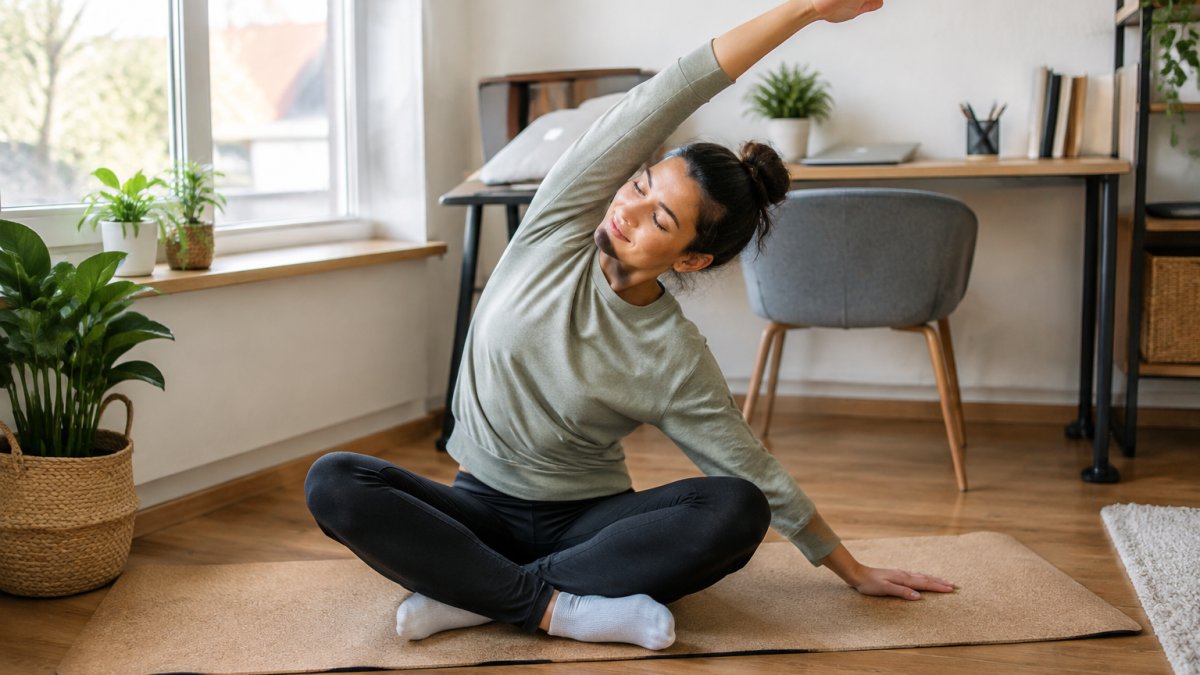
Match the Movement to Your Time Block
The practice you keep is often the one that fits the gap you have, not the one that sounds best. Use this as a starting frame:
- One minute: Stand, roll your shoulders back three times, and do a slow neck turn left and right. This interrupts the forward-head posture that builds during back-to-back calls.
- Five minutes: Walk a loop of your floor or hallway with attention on the heel-to-toe roll of each foot. If you have stairs, two slow flights work the hips and calves without changing clothes.
- Fifteen minutes: A short yoga sequence or a full-body stretch on a mat. Sun salutations, a few standing forward folds, and a seated twist cover the major desk-bound tight spots.
Walking as the Most Accessible Option
Walking is the most accessible movement alternative because it needs no equipment, no privacy, and no change of clothes. A ten-minute loop with attention on your feet and surroundings works as well as a formal session for many people.
A common pattern is to attach the walk to something you already do, such as a phone call you can take on audio or the walk to refill your water. That removes the need to find a separate slot in the day.
Yoga and Mindful Stretching at a Desk
For desk-bound professionals, stretches that relieve tight hips from sitting pair well with a short movement break.
If you are drawn to a steadier routine, building a daily home yoga practice gives structure to the same idea. Keep the first version short. A ten-minute practice you repeat beats a forty-minute practice you do once.
Watch out: pushing into a stretch until it hurts is counterproductive. Move to the edge of tension and breathe there, and stop if a stretch produces sharp pain, numbness, or tingling.
Adapting Movement When Mobility Is Limited
Movement alternatives do not require a mat on the floor. Seated versions work for many people with mobility limits, chronic pain, or a shared office: seated spinal twists, ankle circles, and shoulder rolls can all be done from a chair. If you have a health condition or an injury, check with a healthcare professional before starting a new movement routine, and choose the seated or low-impact version first.
Journaling, Creative Work and Mindful Eating as Alternatives
These three alternatives share a mechanism: they give a racing mind a concrete task to hold, which is often easier than asking it to empty. Each can be done in a short block, and each has a realistic outcome you can expect rather than a promise.
Journaling and Reflective Writing
Reflective writing turns a racing mind into something you can see. Three prompts work well: what drained me today, what gave me energy, and one thing I am grateful for. A few lines beat a blank page every time.
- One minute: Write one sentence about what is taking up the most mental space right now.
- Five minutes: Answer the three prompts above in a single line each.
- Fifteen minutes: A longer brain dump with no editing, followed by circling one item you can act on tomorrow.
A common pattern is to keep the notebook on the desk rather than in a drawer, because the friction of retrieving it is what kills the habit.
Creative Activities as Attention Anchors
Creative activities such as sketching, playing music, or cooking engage attention fully, which is the point. The mechanism is not the art itself but the shift into a task with clear feedback: a line on paper, a chord, a chopped vegetable.
You do not need a studio or a long block. A five-minute sketch of what is on your desk, a few minutes on an instrument, or chopping vegetables for dinner all count.
Mindful Eating
Mindful eating is the easiest of the three to start because it attaches to something you already do. Put the phone down, take three slow bites, and notice taste and texture. One tech-free meal a day may feel more doable for some people than a daily sit.
- One minute: Three slow bites with full attention.
- Five minutes: Eat a snack without a screen.
- Fifteen minutes: One full meal with the phone in another room.
Watch out: mindful eating is not a weight-loss method, and treating it as one tends to backfire. The goal is attention and a pause, not restriction.
What to Realistically Expect
These practices are well suited to reducing the sense of autopilot during a workday. They are not a substitute for treatment of anxiety, depression, or an eating disorder. If a practice brings up distressing thoughts or makes eating feel more fraught, stop and talk to a healthcare professional. A simple test is to track whether you notice more pauses in your day over a few weeks.
How to Tell If a Meditation Alternative Is Actually Working
Judge a practice by whether it changes your day. A simple test is to track changes over a few weeks. Track three things: sleep quality, how often you notice tension in your jaw or shoulders, and how quickly you recover after a stressful call.
| What to Track | Healthy Sign | Warning Sign |
|---|---|---|
| Sleep quality | Falling asleep faster | No change after 2 weeks |
| Body tension | Noticing and releasing it | Chronic pain worsening |
| Stress recovery | Bouncing back faster | Growing dread or anxiety |
If a practice makes you feel worse, stop. Persistent anxiety, low mood, or panic is a reason to talk to a healthcare professional, not to push harder on a breathing app.
Build Your Home Practice with the Right Mind-Body Tools
A small, well-chosen kit removes the friction that kills routines. You do not need a studio. You need a mat you will actually unroll, a way to move, and a way to recover.
Here is how to choose:
- A mat that stays put. A non-slip surface makes movement-based practice safer and more inviting.
- Resistance for stretching. A multi-loop band helps you reach positions gradually.
- Recovery support. A foam roller eases tight muscles after a desk-bound day.
- Something compact. A mini ball or Pilates set fits a small space.
Our picks from the shop:
- THE YOGI ($69.99): a handmade, washable organic cotton mat, 78" x 27".
- Ananday Cork Yoga Mat ($118.00): cork over tree rubber, plant-based and plastic-free.
- Yoga Stretch Resistance Band ($10.99): multi-loop design for controlled, gradual stretching.
- Yoga Foam Roller & Massage Stick, 46 cm ($25.00): textured foam for muscle relief.
- Pilates Bar Kit with Resistance Bands ($25.00): adjustable bands for low-impact full-body work.
For a complete starter setup, explore our curated mind-body training kits and match the tools to the practice you will actually keep.
If your current routine keeps falling off after a week, the fix is usually a practice that fits your schedule and a kit that removes the excuses. thewellbeingshop.com curates fitness and recovery tools built for exactly that: small habits that hold, home strength that builds, and mind-body harmony you can feel.
Frequently Asked Questions
What can I do instead of meditation if I cannot sit still?
Movement-based meditation alternatives work well for people who find stillness uncomfortable. Walking, yoga, breathwork and mindful stretching all give your attention an anchor without requiring you to sit. A 10-minute walk with no phone, or three rounds of slow breathing at your desk, counts as practice. The goal is the same as traditional meditation: a shift in attention and a calmer nervous system. Pick one method and repeat it at the same time daily so it becomes a habit rather than a one-off.
How do breathing exercises for stress help during a workday?
Slow breathing is a practice many people use to help them unwind. The practical version is simple: inhale through the nose for four counts, hold for four, exhale for six. Two minutes of this between meetings is enough to reset before your next task. Keep it short and repeatable rather than treating it as a long session you will skip. Pairing it with a fixed trigger, like closing your laptop after a call, makes it stick.
Can walking or exercise replace traditional meditation?
Walking and exercise can complement a meditation practice. A brisk 15-minute walk gives you both physical activity and a mental break from screens. What walking does not do is train the specific skill of observing your thoughts without reacting, so if that is your goal, combine a walk with a few minutes of breathwork. For most busy professionals, the combination is more realistic than a 30-minute seated session.
What are quick stress relief techniques at work that take five minutes or less?
Five-minute options include box breathing at your desk, a short walk outside, progressive muscle relaxation from your chair, and a two-minute stretch with a resistance band. Journaling three lines about what is stressing you also works. The key is choosing one technique and using it before stress builds, not after. Try setting a phone reminder mid-morning and mid-afternoon to run a single short relaxation technique.
Prices of mind-body practice tools
