


 Link label

Why Premium Home Wellness Equipment Matters
Last Updated: November 5, 2026
Quick Summary
Premium home wellness equipment matters because the gear you keep using is the gear that fits your body, your space, and your routine. Buying well means lower lifetime cost per year of use, available repair parts, and meaningful resale value compared with disposable budget gear.
- Steel gauge, weld quality, powder coating, and bearing smoothness separate serious equipment from entry-level gear.
- Compare total cost against years of use rather than a premium purchase price against a budget sale price.
- Measure working envelope, ceiling height under load, door swing, and flooring under point loads before buying.
- Re-torque all bolts after assembly and again after the first week.
- The Verse Agile Rack NEO sets up in under three minutes with no wall mounting required.
Table of Contents
- Why Premium Home Wellness Equipment Matters More Than Ever
- The Home Gym Equipment Buying Guide: What Separates Premium from Budget
- The True Cost of Home Gym Equipment: Initial Investment vs. Lifetime Ownership
- Home Workout Equipment for Small Spaces: Doing More with Less
- Home Gym Equipment Safety: What Cheap Gear Gets Wrong
- Matching Equipment to Your Fitness Goals and Adherence
- Connected Features, Privacy, and Ongoing Fees
- Choosing Your Premium Home Wellness Setup
- Frequently Asked Questions
Why Premium Home Wellness Equipment Matters More Than Ever
The case for premium home wellness equipment is simpler than most buyers expect: the gear you keep using is the gear that fits your body, your space, and your routine. The case for buying well is that the gear you keep using is the gear that fits your body and routine.
That distinction matters more now that so many people train at home by default rather than by necessity. A home gym is no longer a stopgap. It is the primary training space for a lot of households, which raises the bar on equipment quality, durability, and comfort.
Below, we break down what separates premium equipment from budget gear, how to think about lifetime cost, and how to match equipment to your actual goals. Read our breakdown of why curated wellness gear is worth it for the deeper argument behind these choices.
The Home Gym Equipment Buying Guide: What Separates Premium from Budget
A home gym equipment buying guide usually starts with price. We start with construction, because that is where the real difference lives.
Material Quality and Construction
Steel gauge, weld quality, powder coating, and bearing smoothness separate serious equipment from entry-level gear.
The same logic applies to small items. A silicone-wrapped dumbbell with a cast iron core feels balanced in the hand and will not roll across the floor mid-set.
Warranty, Repairability, and Long-Term Service
Budget equipment is usually treated as disposable. When a cable frays or a pad tears, replacement parts are hard to source and often cost as much as a new unit.
The True Cost of Home Gym Equipment: Initial Investment vs. Lifetime Ownership
Cost of ownership is more than the purchase price. It also includes maintenance and replacement parts.
Here is how the trade-offs compare:
| Factor | Budget Equipment | Premium Equipment |
|---|---|---|
| Initial investment | Lower | Higher |
| Expected lifespan | Shorter | Longer |
| Replacement costs | Frequent | Rare |
| Repair parts | Hard to source | Available |
| Cost per year of use | Often higher | Often lower |
| Resale value | Minimal | Meaningful |
Where the Money Actually Goes
A useful way to model lifetime cost is to separate the purchase price from the three costs that follow it: servicing, parts, and replacement.
How to Run the Comparison Yourself
You do not need a spreadsheet to make this decision, but it helps to compare total cost against years of use.
Watch out: comparing a premium unit's purchase price against a budget unit's sale price is the most common error in this analysis, the comparison only means something when both sides are expressed as cost per year of use over the same horizon.
Home Workout Equipment for Small Spaces: Doing More with Less
Space planning starts with a tape measure, not a shopping cart. Measure the room, note ceiling height, and map door swings before choosing anything. Equipment dimensions matter more than marketing photos suggest, and the dimensions that matter most are the ones the spec sheet leaves out.
The Measurements That Actually Decide the Layout
Most buyers check footprint length and width and stop there. The numbers that determine whether a setup works in a small room are:
- Working envelope, not footprint. A rack's footprint is the floor it occupies; its working envelope is the floor plus the bar path, the plate loading zone on each side, and the space to step in and out. A compact rack can still need several feet of clearance on the loading side.
- Ceiling height under load. Overhead pressing, pull-ups, and any bar path above shoulder height need clearance measured from the floor to the lowest obstruction, a ceiling fixture, a garage door track, a duct.
- Door swing and traffic path. A rack that blocks the only door to the room will get moved, and equipment that gets moved gets used less.
- Flooring under point loads. Racks and stacks concentrate weight on small contact points. Rubber tiles or a platform spread that load and protect the subfloor; bare carpet over a wood subfloor is the usual failure point.
Accessibility and Inclusive Design
This is where most small-space guides stop, and where the decision actually gets made for a lot of households. A home gym shared by two people of different heights, ages, or mobility levels needs equipment that adjusts quickly and safely, not equipment that fits one user perfectly.
All-in-One Home Gym: Power Rack with Smith Machine & Functional Trainer →
Ask these questions before buying:
- Adjustability range. Do the j-hooks, safeties, and seat positions cover the shortest and tallest users in the household? A rack that only fits one lifter is a single-user purchase.
- Entry and exit. Can a user step into a rack or onto a bench without ducking, twisting, or lifting a leg over a crossmember? Low step-over height and open walk-in designs matter more as mobility changes.
- Controls and setup force. Selector pins, pop-pins, and cable adjustments should be operable with one hand and without tools. High-force or two-handed adjustments get skipped, and skipped adjustments mean poor form.
- Noise. Cable stacks, dropped weights, and rowing machines carry through floors and walls. Rubber flooring, bumper plates, and equipment with enclosed weight stacks reduce the noise footprint in apartments and shared homes.
- Storage and reach. Bands, dumbbells, and accessories stored above shoulder height or behind equipment go unused. Keep the tools you use most within arm's reach of the working position.
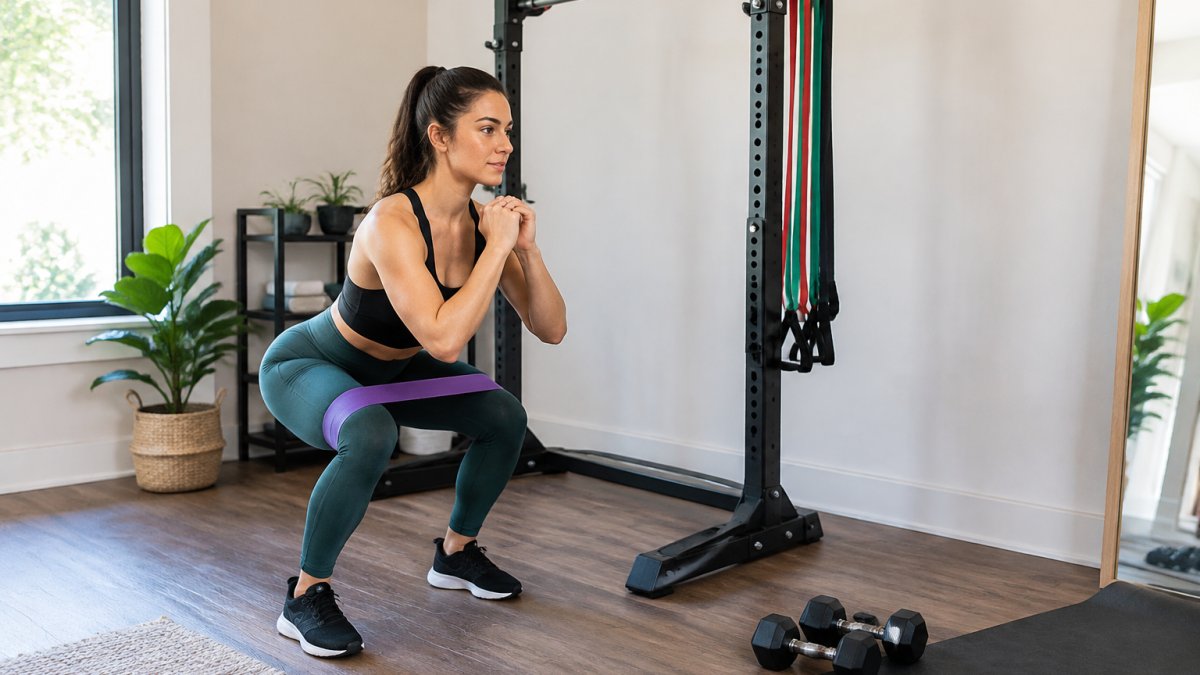
A lightweight portable squat rack can fit a small corner, and resistance bands are easy to take on the go. If you are building a compact setup, browse our home gym weight equipment for small spaces.
Home Gym Equipment Safety: What Cheap Gear Gets Wrong
Home gym equipment safety depends on stability, load ratings, and careful assembly.
A practical safety checklist before your first session:
- Confirm the rack or bench is rated above your working load
- Re-torque all bolts after assembly and again after the first week
- Check cables and bands for fraying before every session
- Verify flooring is level and non-slip under the equipment
- Keep a clear zone around any moving bar or cable path
Matching Equipment to Your Fitness Goals and Adherence
Exercise consistency depends less on motivation than on friction. Equipment that is comfortable, quick to set up, and suited to your training preferences gets used. Equipment that is awkward or painful to adjust gets ignored.
If you have 20 to 30 minutes a day, choose tools that support short, focused sessions: adjustable dumbbells, bands, and a rack you can load quickly.
Once your setup is in place, the next step is progression. Our step-by-step guide to progressing home strength training covers progressive overload, tracking methods, and equipment-free techniques for breaking through a plateau.
Connected Features, Privacy, and Ongoing Fees
Connected fitness equipment can add convenience, but ongoing fees and data practices are worth reviewing before you buy.
Ask three questions before choosing a connected product. What does the subscription cost per year? What happens to the equipment's core functions if you cancel? What data does the app collect, and can you export or delete it?
Choosing Your Premium Home Wellness Setup
Start with the larger pieces, such as the rack, that carry the most load. Add smaller tools as your routine settles.
For a complete strength setup, our All-in-One Home Gym pairs a Smith machine, functional trainer, and power rack with dual 220 lb weight stacks and heavy-duty construction. For renters and small spaces, the Verse Agile Rack NEO sets up in under three minutes with no wall mounting required. Smaller pieces like the MUNA Triangle Dumbbell and the XGear loop band set round out mobility and accessory work.
Browse the fitness equipment collection or reach out for help choosing equipment based on your space and goals.
Frequently Asked Questions
Is it worth buying premium home wellness equipment?
Premium home wellness equipment often costs more upfront, but the gap narrows over time. A $3,999 all-in-one power rack with dual weight stacks, for example, replaces multiple machines and monthly gym fees. The real question is how many years you will use it: the longer your horizon, the more the math favors premium.
What makes premium home fitness equipment worth the investment?
Three factors drive the value: durability, safety, and adherence.
How do I choose home gym equipment for a small space?
Start with measurements, not wish lists. Record your room's length, width, and ceiling height in inches, then check each product's footprint and clearance needs. Favor multi-function pieces: an all-in-one trainer consolidates a Smith machine, functional trainer, and power rack into roughly 72 by 82 inches. Portable options like a lightweight squat rack under 47 lbs or a set of loop resistance bands add training variety without permanent floor space.
How can I tell if home workout equipment is safe and durable?
Check the stated weight capacity and compare it to your actual lifts with a margin. Look for safety bars and J-hooks on racks, and check the warranty terms on the product listing. Read the specs for wobble-prone areas like cable systems and folding joints. If a listing omits capacity ratings or warranty details, treat that as a warning sign before you buy.
Building a home wellness routine that lasts is not about buying more. It is about buying the right pieces once, then showing up for them. The Well Being Shop curates fitness equipment, mind-body training tools, and nutritional support so your setup supports daily movement instead of collecting dust. Get started with thewellbeingshop.com and build a home gym you will actually use.
